Warning: This article contains rigorous academic analysis of a song about putting your left leg in and out. Side effects may include an uncontrollable urge to form a circle, mild vertigo, and the dawning realisation that you have spent your entire life performing a ritual you cannot actually explain.
Introduction: The Circle That Should Not Exist
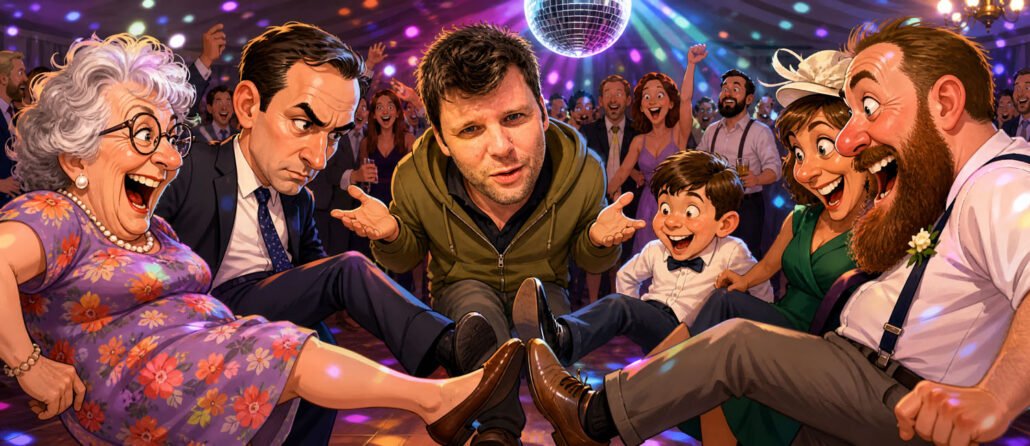
There is a moment at every wedding, every school disco, every ill-advised office Christmas party, when the DJ plays four opening notes and something ancient stirs in the room. Grown adults — accountants, solicitors, people who have chaired serious meetings that very afternoon — abandon their drinks, form a circle with total strangers, and begin, without discussion or consent, to insert individual limbs into the middle of that circle on command.
The Hokey Cokey.
Nobody organised this. Nobody explained the rules. And yet everyone, from the age of four to ninety-four, somehow already knows exactly what to do. This is not learned behaviour in any conventional sense. This is closer to instinct — a piece of cultural programming so deeply embedded that it bypasses conscious thought entirely.
So what, precisely, is going on? Why do we do this? Why does it work? And what, if anything, is it actually all about?
Let us investigate. Properly. With far more effort than a novelty circle dance has any right to receive.
Part One: A Brief and Confusing History
Older Than Anyone Wants It To Be
Here is the first uncomfortable truth: the Hokey Cokey is not a wartime novelty invention. It is a genuine British folk dance, with variants documented as early as 1826, and a clearly recognisable ancestor — “Hinkumbooby” — printed in Robert Chambers’ Popular Rhymes of Scotland in 1842:
Right hands in, and left hands out,
Hinkumbooby, round about.
By 1857, an “English/Scottish ditty” with the now-familiar in-out-shake structure was already being performed by two sisters from Canterbury on a trip to New Hampshire. By 1872 it had become “Ugly Mug.” By 1891, a version from Golspie in the Scottish Highlands had participants putting “all your right feet out” and turning themselves about. By 1892, Sheffield schoolchildren were dancing “Looby Loo” to essentially the same choreography. This is, in other words, a song that has been mutating steadily through British folk culture for the best part of two centuries, wearing a different name in nearly every decade, and it has never once stopped to explain itself.
The Legend Versus the Paper Trail
The story most people actually know — Blitz-era London, a Canadian officer, bandleader Al Tabor, and an ice cream seller’s cry of “Hokey Pokey, penny a lump” — is a genuinely charming piece of folklore. It is also, according to the documented publication history, almost certainly untrue, or at best a 1940s repackaging of something that already existed. Sheet music titled “The Cokey Cokey” was copyrighted in 1942 by songwriter Jimmy Kennedy, who had a well-established habit of writing internationally beloved children’s and novelty songs (he also wrote “Teddy Bears’ Picnic”). Kennedy and Tabor subsequently fell out over money, and Tabor settled out of court, surrendering his rights to the song.
So the honest version is this: a folk dance that had already been shaking itself about the British Isles for well over a century got a catchy new arrangement, a snappier name, and a canny publisher during the Second World War, and the wartime version is the one that stuck. The earlier hundred years quietly got left standing outside the circle.
Two Songs, One Argument
Separately, and almost entirely unconnected to the British story, “The Hokey Pokey” was independently copyrighted in the United States — first by two Pennsylvania club musicians in 1944, then by the Sun Valley ski-resort trio who released a recording in 1950 and are usually credited as its American originators. The two camps sued each other. The dispute was settled out of court, and to this day nobody has fully reconciled how one leg-based novelty dance managed to arise, or at least get commercially claimed, on both sides of the Atlantic at roughly the same time. Two nations, one circle, two lawsuits, no consensus.
A Song That Survived a World War, Then Charted Twice
What’s often overlooked is the timing of the version everyone actually remembers. The Hokey Cokey rose to popularity in Britain during the Second World War, performed in dance halls by people living through nightly air raids and genuine, sustained national crisis. There is something quietly remarkable about a population enduring the Blitz choosing, in its rare moments of respite, to voluntarily put its left leg in, its left leg out, and shake it all about.
It didn’t stop there. The song became a UK chart hit twice more, decades later: The Snowmen took it to number 18 in 1981, and Black Lace — no strangers to novelty dance records — charted with their own version in 1985. A dance older than the combustion engine has now been a hit record in three separate decades. Whether this reveals something profound about the British capacity for collective absurdity as a coping mechanism, or whether it just reveals that we will, given the choice, always reach for the same shrug of a song, remains, as with most things in this article, undetermined.
Part Two: Structural and Choreographic Analysis
The Grammar of the Limb
Strip away the melody and what remains is a rigid, almost liturgical structure. Each verse follows an identical four-part grammar:
1. Insertion — “You put your [limb] in.”
2. Removal — “You put your [limb] out.”
3. Repetition of Insertion — “In, out, in, out.”
4. Agitation — “You shake it all about.”
This is followed by the chorus, which performs the single strangest linguistic manoeuvre in the entire British popular canon: “You do the Hokey Cokey and you turn around.” This line asks the participant to perform an action — “the Hokey Cokey” — that is never defined anywhere else in the song. The song’s chorus instructs you to do the song. It is self-referential in a way that would make a postmodern novelist blush, except nobody in the circle has ever paused to notice, because by this point they are already turning around.
The final line of every verse — “That’s what it’s all about” — is, on inspection, a non-explanation of staggering confidence. At no point does the song clarify what “it” refers to. Is “it” the limb? The dance? Life itself? The song asserts meaning without ever supplying any, and asserts it so rhythmically and so repeatedly that nobody has ever successfully challenged it. This is not an accident. This is the most persuasive rhetorical device in the song, and it is aimed at your left knee.
The Escalation Sequence
Structurally, the Hokey Cokey behaves like a controlled experiment in incremental commitment. It begins with a single limb (left leg), a body part of relatively low personal risk. It then proceeds through the right leg, left arm, right arm, head, and — in the version performed at any gathering with a member of the clergy present and no small number without — “your whole self.”
This is, functionally, a compliance ladder. Behavioural psychologists have long understood that people who agree to a small request are significantly more likely to agree to a much larger one afterwards — a principle known as the foot-in-the-door technique, a phrase which, in this specific context, feels less like a metaphor and more like a stage direction. By the time the song demands your “whole self” in the middle of the circle, you have already publicly committed three limbs and your head to the cause. Social psychology would predict, correctly, that you will now put your whole self in without complaint.
The Circle as Ritual Geometry
The circle formation itself deserves attention. Unlike a line dance, which has a front and implies an audience, the circle has no hierarchy, no observer, and no exit. Everyone faces everyone. Everyone performs the same action simultaneously. Anthropologists studying ritual behaviour — genuine ones, studying genuine rituals — have long noted that circular formations with synchronised movement are among the oldest methods humans use to generate a feeling of group cohesion, from harvest dances to religious processions to, evidently, the closing thirty minutes of a christening.
The Hokey Cokey, in other words, is doing the actual anthropological work of a tribal unity ritual, using the actual anthropological structure of a tribal unity ritual, while everybody involved believes they are simply being a good sport at Auntie Denise’s sixtieth.
Part Three: The Psychology of Compliance
Why Does Everybody Just… Do It?
This is the central mystery. At a wedding, a room full of adults who would object to considerably smaller impositions on their dignity — a raffle, a speech going on too long, being asked to move their car — will, without hesitation, form a circle and shake a limb about in full view of their employer, their in-laws, and a hired photographer.
Three explanatory mechanisms present themselves:
Diffusion of embarrassment. Because everyone performs the action simultaneously, no individual bears the full weight of looking ridiculous. The embarrassment is distributed evenly across the circle, like a very undignified tax. This is the same mechanism that makes Mexican waves at football stadiums possible — no single person would ever choose to stand up and throw their arms in the air alone, but forty thousand people doing it in sequence somehow removes the risk entirely.
Musical entrainment. The tempo of the Hokey Cokey sits at a pace psychologists studying rhythm perception describe as maximally “groove-inducing” — fast enough to compel movement, slow enough that nobody is excluded on physical grounds. Even people who claim, loudly and often, that they “don’t dance” will comply, because the song is not really asking you to dance. It is asking you to follow four simple, sequential, low-skill instructions, which is a psychologically much easier sell.
Social proof under time pressure. The song moves quickly from instruction to instruction, leaving no meaningful window for private deliberation. By the time your brain has processed “should I be doing this,” your left leg is already back out again and the chorus has started. Hesitation is structurally not permitted. The Hokey Cokey does not wait for consensus. It assumes it.
Part Four: The International Variants — A Study in Naming Disputes
The Hokey Pokey Problem
In the United States, the dance is near-universally known as “The Hokey Pokey,” a naming discrepancy that has caused genuine, sustained transatlantic bafflement for eight decades. British audiences insist on “Cokey.” American audiences insist on “Pokey.” Nobody involved in either camp has ever satisfactorily explained why, and both sides treat the other’s version as an obvious and slightly suspicious corruption of the “correct” original — despite neither side actually being able to prove which came first.
Regional Limb Variants
Anecdotal reports — entirely unverified, but too good not to include — describe regional and school-specific variants in which additional or alternative body parts are substituted into the circle: hips, bottoms, “whole heads,” and, in at least one enthusiastically remembered primary school assembly, “your ears,” a request that produces visibly less coordinated results than any preceding limb and is, frankly, rarely attempted twice.
The Litigation Nobody Expected
In a genuinely remarkable footnote to twentieth-century legal history, ownership and royalty disputes over both “The Hokey Cokey” and “The Hokey Pokey” rumbled on for decades between rival claimants to authorship on both sides of the Atlantic, eventually reaching the courts. Somewhere in the archives of English and American case law sit formal legal judgments concerning who is entitled to profit from the words “you put your left leg in.” Several very serious lawyers, on two continents, argued this in earnest. That alone should tell you everything you need to know about the gap between how seriously a culture treats its own nonsense and how nonsensical that nonsense actually is.
The Time It Was Nearly Reported as a Hate Crime
No summary of the Hokey Cokey’s credibility problem would be complete without this: in 2008, an Anglican clergyman — the Provost of Wakefield Cathedral, no less — publicly claimed the dance was secretly a mocking parody of the pre-Vatican II Latin Mass, on the theory that the priest’s turning, hand movements, and the phrase “hoc est corpus meum” (“this is my body”) had been reworked by anti-Catholic wags into “hokey cokey” and a comedy dance. A Scottish politician then formally called for the police to treat performances of the song as a potential hate crime against Catholics.
The claim was, in the end, robustly dismissed by relatives of the song’s actual writers, by historians pointing out the song predates the theory by roughly a century, and — in one of the finest examples of British football supporters agreeing on absolutely anything — by fans of both Celtic and Rangers, who called for the two historically rival sets of supporters to jointly sing the Hokey Cokey together at Ibrox in protest at the very idea. Somewhere in Britain, in 2008, a bishop, a politician, and two warring football terraces were all simultaneously arguing, in complete seriousness, about a dance where you put your left leg in and shake it all about. This is, genuinely, the most accurate possible summary of this entire article.
A Cousin Worth Flagging
It would be remiss not to note The Birdie Song — released in the UK by The Tweets in 1981, the very same year The Snowmen took the Hokey Cokey back into the charts — which runs on near-identical mechanics: a simple, callable set of arm movements everyone already somehow knows, performed in unison, building to a slightly chaotic communal climax. Same compliance ladder, different limbs, feathers instead of legs.
The Time Warp, from The Rocky Horror Show, belongs on the same list. It has the identical structural DNA — “it’s just a jump to the left, and then a step to the right,” a spoken instruction set delivered in strict sequence, performed in unison by people who have never rehearsed it and don’t need to — dressed up in fishnets and theatrical mythology instead of a wedding-disco circle. Different costume, same compliance ladder, same left-then-right logic that’s carried the Hokey Cokey since at least 1826.
Both deserve their own full academic overreach at some point. Today is not that day.
Part Five: What the Circle Reveals About Us
The Dance as Democratic Ritual
Strip away the choreography and the copyright disputes, and something almost touching remains. The Hokey Cokey is one of the few social rituals left that requires no skill, no equipment, no partner, no rhythm, and no prior knowledge. A four-year-old and their great-grandmother can perform it, correctly, at the same tempo, with the same steps, in the same circle, at the same time. Very little else in human social life offers that level of universal, immediate, cost-free participation.
It is, in its own deeply silly way, one of the most genuinely egalitarian pieces of British culture we have. Nobody is better at the Hokey Cokey than anyone else. Nobody can be. The entire point collapses the moment anybody tries to do it well.
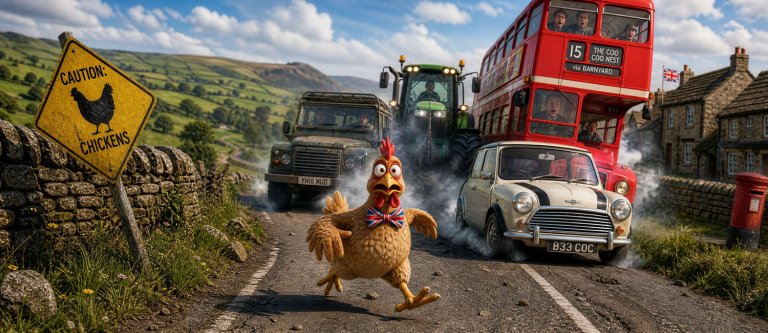
This is not the first time I’ve subjected something trivial to more academic rigour than it deserves — the chicken crossing the road got the same treatment, if you’re after a second dose.
Conclusion: What It’s All About
After subjecting this to more rigorous scrutiny than it has any right to receive, we can conclude the following: the Hokey Cokey is a wartime novelty song that accidentally reconstructs the anthropological architecture of tribal unity ritual, deploys a genuine behavioural-compliance ladder against your own limbs, and has been fought over in actual courts of law by actual barristers — all while insisting, with complete rhythmic confidence, that it cannot tell you what “it” is.
It doesn’t matter. You already know the steps. You have known them since before you could reasonably be expected to know anything. And the next time those opening notes play, you will form the circle, and you will put your whole self in, and you will not ask why.
That’s what it’s all about.
References
Chambers, R. (1842) Popular Rhymes of Scotland, 2nd edn. Edinburgh: William and Robert Chambers. [‘Hinkumbooby’, earliest documented lyrical ancestor.]
Nicholson, E.W.B. Golspie: Contributions to Its Folklore. [c. 1891 Highland variant.]
Northall, G.F. (1892) English Folk-Rhymes: A Collection of Traditional Verses Relating to Places and Persons, Customs, Superstitions, etc. London: Kegan Paul, Trench, Trübner & Co. p. 361. [‘Looby Loo’, Sheffield.]
Kennedy, J. (1942) The Cokey Cokey [sheet music, copyright registration]. London: Campbell Connelly & Co., agents for Kennedy Music Co. Ltd.
Lloyd, J. and Mitchinson, J. (2007) The Book of General Ignorance. New York: Harmony Books, p. 229.
Weber, B. (2009) ‘Robert Degen, Who Had a Hand in the Hokey Pokey, Dies at 104’, The New York Times, 3 December.
MacDonald, S. (2009) ‘Hokey Cokey no Catholic dig’, The Times, London, 11 January.
Cramb, A. (2008) ‘Doing the Hokey Cokey “could be hate crime”‘, The Daily Telegraph, 21 December.
Cialdini, R.B. (1984) Influence: The Psychology of Persuasion. New York: William Morrow. [Foot-in-the-door compliance technique, Ch. 3.]
Freedman, J.L. and Fraser, S.C. (1966) ‘Compliance without pressure: The foot-in-the-door technique’, Journal of Personality and Social Psychology, 4(2), pp. 195–202.
Turner, V. (1969) The Ritual Process: Structure and Anti-Structure. Chicago: Aldine Publishing. [Communal ritual and circular formation, pp. 94–130.]
McNeill, W.H. (1995) Keeping Together in Time: Dance and Drill in Human History. Cambridge, MA: Harvard University Press.
Janata, P., Tomic, S.T. and Haberman, J.M. (2012) ‘Sensorimotor coupling in music and the psychology of the groove’, Journal of Experimental Psychology: General, 141(1), pp. 54–75.
Enjoyed this entirely unnecessary investigation? Share it with someone who has definitely, at some point, put their whole self in.


Bluesky Discussion
View on BlueskyNo replies yet. Be the first to comment on Bluesky!