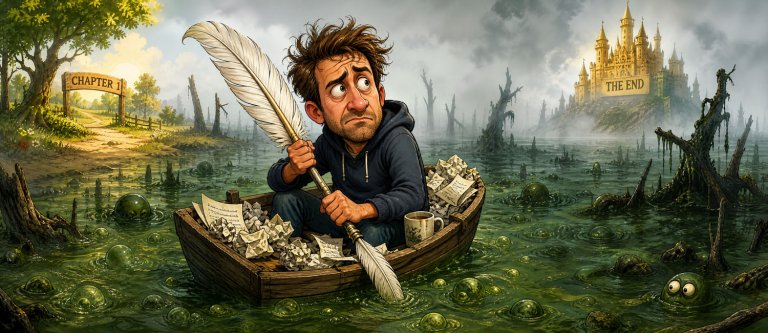
At some point, almost every novelist finds themselves stuck writing a novel they were absolutely convinced they had figured out. The initial excitement has evaporated. The opening chapters, which came so easily, are now a distant memory. The ending — which seemed so clear in your head three months ago — might as well be in another country. And between you and it sits a vast, featureless expanse of story that refuses to cooperate. This is called the murky middle, and it is completely, thoroughly, miserably normal.

The murky middle has derailed more novels than bad ideas, busy lives, and imposter syndrome combined. It is the place where most unfinished manuscripts live. The good news is that being stuck writing a novel is a solvable problem. The less good news is that the solution usually involves actually writing. That is precisely the thing you’ve stopped doing. However, here’s how to get back on track.


Step One: Diagnose Before You Medicate

There is no single reason for being stuck, which means there is no single fix. Before you try anything else, spend ten minutes working out which of the following most accurately describes your situation.

You have run out of plot. You know your beginning and you know your ending, but the middle — the long, complicated, consequential middle — has turned out to be much harder to fill than anticipated. This is a planning problem with a planning solution.

You have lost faith in the story. The idea that seemed so brilliant in October now seems embarrassing and derivative and probably not worth anyone’s time. This is not a plot problem. This is a confidence problem, and it lies to you constantly.

You have written yourself into a corner. A character has done something that made perfect sense at the time, and now you have no idea how to continue from where you’ve left them. Additionally, going back feels like admitting defeat. This is a fixable craft problem.

You have not actually been writing. Life happened. Work got busy. A box set appeared. You stopped writing for two weeks and then three and then somehow it’s been two months and the document feels like something from a previous life. This is a habit problem.

Each of these needs a different response. Therefore, picking the right one matters.

If You’ve Run Out of Plot: Outline the Next Five Chapters Only

When you’re stuck writing a novel because the middle has collapsed, the instinct is often to outline the entire remaining book from where you are to the end. Resist this. It’s exhausting, it usually produces an outline you don’t follow, and it delays actually writing by another fortnight.

Instead, outline the next five chapters only. Just five. What needs to happen to move things forward? What does your protagonist need, what’s stopping them getting it, and who or what is going to complicate that in the next five scenes? Write rough notes for each chapter — a paragraph is plenty — and then write the first of them.

Five chapters is achievable. It’s also enough to generate momentum, which will tell you what comes next better than any amount of staring at a planning document.

If You’ve Lost Faith: Put the Manuscript Away for a Week

This sounds like permission to procrastinate. It isn’t. The distinction matters enormously when you’re stuck writing a novel.

When you’re too close to a piece of writing, you lose the ability to read what’s actually on the page. Instead, you read what you remember writing, which is invariably worse than the reality. A week away from the manuscript — a genuine week, in which you do not open the document, think about the document, or tell anyone about the document — restores the necessary distance to read it as something approaching a reader would.

After the week, re-read from the beginning. Don’t edit. Don’t make notes. Just read it through as if someone else wrote it. For most writers, this produces one of two results: either it’s considerably better than they remembered, or they find exactly where the problem actually is, which is usually not where they thought it was.

Either outcome is progress. Furthermore, knowing where the real problem is beats endlessly reworking the wrong chapter.

Write the Next Scene Terribly on Purpose

This is one of the more counterintuitive solutions when you’re stuck writing a novel, but it works surprisingly often.

Set a timer for twenty minutes. Open the document. Write the next scene as badly as you possibly can. Don’t think about whether it’s good. Don’t edit as you go. Don’t stop when it feels wrong. Write placeholder dialogue like “THEY HAVE AN ARGUMENT ABOUT SOMETHING, FIGURE OUT LATER” if necessary. Write “[INSERT DESCRIPTION OF LOCATION HERE]” if the words won’t come. The goal is not a good scene. The goal is a scene that exists, because a scene that exists can be fixed, and a blank page cannot.

Moreover, what happens with this approach more often than not is that somewhere in the middle of writing badly on purpose, you accidentally start writing well. The permission to be terrible removes the pressure that was blocking you in the first place. Don’t tell anyone. It’s embarrassing. It works.

Jump Ahead and Write the Scene You’re Excited About

There is, very likely, a scene somewhere later in your novel that you have been looking forward to writing since you started. You can see it clearly. You know what happens in it. You might even have some of the dialogue already written in your notes.

Go write that scene now.

Non-linear drafting is not cheating. It is a legitimate way of maintaining creative momentum when the sequential approach has stalled. Write the scene you can write. The hole it leaves in the middle can be filled in later, and often the act of writing ahead clarifies what needs to happen to get there. Additionally, finishing something — even a scene that’s technically out of sequence — reminds your brain that forward motion is possible, which is useful information when you’ve been stuck for weeks.

Interview Your Characters

This sounds like the sort of advice you’d find in a creative writing workshop run by someone who uses the word “journey” too freely. Nevertheless, it is genuinely useful, so bear with it.

When you’re stuck writing a novel, particularly when you’ve written yourself into a corner, the problem is frequently that a character is being made to do something they wouldn’t actually do. The plot requires them to go left. However, the person they’ve become over the previous ten chapters would emphatically go right. You’ve been staring at this scene for two weeks because somewhere below the level of conscious thought, you know something is wrong with it.

Open a blank document. Ask your protagonist, in writing, what they want. Then ask what they’re afraid of. Ask what they would do next if you — the author with your plot requirements — weren’t in the way. Write their answers in their voice. You are not losing your mind. You are debugging a character, and the answer to why you’re stuck is often in there somewhere.

Stuck Writing a Novel? Try Changing Something Dramatic

Sometimes a story needs to be broken before it can be fixed.

If you’ve been stuck for a long time and none of the gentler approaches have worked, consider doing something drastic to the plot. Kill a secondary character who wasn’t supposed to die. Add a new character who shouldn’t be there yet. Move the story to a different location. Have your protagonist make a catastrophic decision and then work out the consequences. Change the timeline.

This is not vandalism. It is diagnosis by experimentation. Many of the changes you make won’t survive into the final draft. However, they might unlock a direction you hadn’t considered, and even the ones that don’t work tell you something useful about why the story is stuck. As a result, you end up knowing your own book better, which is never wasted.

Set Micro-Targets: The Two-Hundred-Word Rule

When you’ve been stuck writing a novel for a while, the target word count at the top of your document becomes the enemy. Fifty thousand words remaining feels like a geological timeframe. Therefore, stop looking at the total. Focus on today’s target only, and make that target absurdly small.

Two hundred words. That is approximately the length of two decent paragraphs. It takes most writers less than fifteen minutes. It is so achievable that refusing to do it starts to feel faintly ridiculous, which is precisely the psychological leverage you need.

Two hundred words a day is 73,000 words in a year. That is a complete first novel. The trick is not the number. The trick is re-establishing the habit of showing up, because writing is significantly easier to continue than it is to restart from cold.

Once the habit is re-established, the targets can grow. For now, small and consistent beats ambitious and occasional every time.

The Trusted Reader: Handle With Extreme Care

Showing your unfinished manuscript to someone else is a double-edged sword of the sharpest possible kind.

On one hand, a trusted reader — specifically, someone who reads widely in your genre and can give useful critical feedback — can often see exactly where the story has gone wrong. Fresh eyes are valuable. They haven’t been staring at the same document for four months.

On the other hand, the wrong reader at the wrong moment can destroy the confidence of a first-time novelist in a single conversation. Consequently, be exceptionally selective about who you show an unfinished draft to. Not your mum. Not your most enthusiastic friend. Ideally, someone who can separate what they personally like from what’s working or not working in the story.

Also, share only the chapters you feel represent the work fairly. Sharing the section you’re stuck on specifically — the rough, placeholder-heavy disaster zone — and asking someone to assess the plot from it is not a useful exercise for either of you.

The Proper Break vs the Procrastination in Disguise

There is a difference between taking a deliberate break from your novel and simply not writing it for an increasingly long time while feeling bad about not writing it. One of these is a creative tool. The other is a comfortable waiting room with no exit.

A deliberate break has a fixed end date. You decide in advance that you will not work on the novel for one week, and that on a specific day you will return to it. In the meantime, you do things that feed your creativity: read in your genre, watch films, go for walks, notice things. You are not avoiding the novel. You are letting it rest while you fill the tank.

Indefinite not-writing, by contrast, involves a lot of time thinking about writing while doing other things, and a low-level guilt that follows you around but doesn’t actually produce any pages. If this describes your current situation, set a date to return and put it in your calendar. Then keep it.

What Not to Do When You’re Stuck Writing a Novel

This section exists because some of the most popular advice for getting unstuck is, with the greatest respect to whoever came up with it, completely counterproductive. Knowing what to avoid saves time.

Don’t tell everyone you’re stuck. Talking about being stuck writing a novel is not the same as solving the problem. In fact, it often releases just enough creative pressure to delay actually doing anything about it. Pick one person who can help and talk to them. Don’t post about it online, where well-meaning but useless advice will arrive in large quantities.

Don’t delete anything. The temptation when you’re stuck is to conclude that everything you’ve written is the problem, and that starting fresh would fix it. It almost never fixes it. Cut the chapters you no longer want into a separate document called something like “Outtakes” or “Not Sure About This Bit.” Keep them. You may need them later, and you will certainly feel better knowing they still exist.

Don’t start researching. Research is the comfort food of the writer who is stuck writing a novel. It feels productive. It fills hours. It produces the satisfying sensation of doing something useful without actually moving the story forward by a single word. If you need specific research to write a specific scene, do the minimum required and write the scene. The deep-dive can happen in revision.

Don’t compare your draft to published books. When you’re stuck writing a novel and feeling low about the whole enterprise, the worst possible thing you can do is pick up a book you admire and compare it to your unfinished draft. You are comparing a rough, incomplete, unedited document to a finished, professionally edited, sometimes-decades-in-the-making piece of work. They are not comparable things, and measuring yourself against them will tell you nothing useful.

Don’t wait for inspiration. Inspiration is real. It also arrives reliably for people who are already sitting at the keyboard, and much less reliably for people who are waiting until they feel like writing. The feeling of wanting to write and the act of writing are two different things. One follows the other, but not necessarily in the order you’d expect.

Remember Why You Started

This is the last resort, not the first, because it requires a degree of honesty that’s easier to access when everything else has been tried.

Go back to whatever you had before the first word of the novel — your original notes, the email you sent yourself at midnight when the idea arrived, the scrap of paper with a half-formed premise on it. Read it. Find the emotional reason you wanted to write this particular story. Not the practical reason — “it seemed like a good idea” or “I’ve always wanted to write a novel” — but the specific, personal reason this story needed to exist.

That reason is still there. The murky middle has buried it under self-doubt and plot problems and the accumulated weight of every chapter that didn’t go as planned. However, it hasn’t gone anywhere. Getting back to it, and reminding yourself that the story is worth the difficulty, is sometimes the only thing that matters.

If you’re just getting started and haven’t hit the murky middle yet — lucky you — my guide on how to start writing a novel covers the first-chapter fundamentals that make the middle less likely to collapse in the first place. And if it’s creative projects of the non-novel variety giving you grief, the same stubborn principle applies: the only way out is through, and through is always worth it.

If you’ve ever wanted to know how to start writing a novel, you’ve probably already done what most aspiring writers do: opened a blank document, stared at it for twenty minutes, typed the word “Chapter” and then gone to make a cup of tea. This is, for the record, a completely normal part of the process. What’s less normal is everything that should happen before you open the document, and that’s what this guide is about.

I’ll be upfront: I have two novels currently in progress, which technically makes me a person who knows how to start writing a novel and considerably less certain about how to finish one. But starting — really starting, with a solid foundation rather than a vague sense of enthusiasm and a half-remembered dream — is something I’ve now done enough times to have opinions about. Here’s what actually works.


Find an Idea Worth Committing To

The most common advice you’ll hear is “write what you know,” which is simultaneously true and completely unhelpful. A more useful framing is: write what you can’t stop thinking about. The idea that keeps coming back to you on the commute, in the shower, in the middle of other people’s conversations. That persistent, slightly annoying creative itch is usually the one worth scratching for 80,000 words.

Ideas don’t have to arrive fully formed. They almost never do. What you’re looking for at the start is a collision: two or three things that don’t obviously go together but produce something interesting when they do. A familiar setting with an unfamiliar problem. A well-worn genre with an unexpected character at its centre. My own comedy-horror novel started as nothing more than a location and a mood — the story came later, one piece at a time.

Once you think you have an idea, test it with a single sentence. Not a marketing blurb or a pitch — just the core of the thing. “A disgraced [X] must [do Y] before [Z happens]” is a good enough template to start with. If you can fill it in, you probably have an idea. If you can’t, you might just have a vibe, and vibes alone won’t carry you to chapter twelve.

Know Your Genre (Even If You Plan to Bend It)

Genre isn’t a cage, it’s a set of reader expectations — and knowing what those expectations are is what gives you the power to meet them, subvert them, or do something interesting somewhere in between. A reader picking up a thriller expects momentum and a ticking clock. A reader picking up literary fiction expects interiority and precise language. Neither is right or wrong, but if you’re writing a thriller and you don’t know that yet, you might spend three chapters on backstory that your readers are silently screaming past.

Spend some time reading in your genre before you start writing in it. Not to copy what’s there, but to understand the shape of it. Stephen King, in his indispensable book On Writing, argues that reading widely is as important as writing regularly — and he’s produced enough novels to have earned the right to say so.

Plotter, Pantser, or Something in Between

This is the great ideological divide of the writing world, and it generates a disproportionate amount of heated debate for what is, ultimately, a question about your personal working style.

A plotter plans extensively before writing. Chapter breakdowns, character sheets, scene-by-scene outlines, the lot. There’s a story structure before a single page of prose exists. The advantage is that you’re much less likely to write yourself into a corner at chapter fifteen with no idea how to get out. The disadvantage is that some writers find the detailed outline kills the creative excitement before they’ve started.

A pantser (from the phrase “writing by the seat of your pants”) starts with an idea, possibly a character, maybe an opening scene, and simply writes to find out what happens. The advantage is that the story feels genuinely discovered rather than executed. The disadvantage is that the middle of the novel can become a swamp of scenes that don’t quite connect, and the dreaded first draft can require substantial structural surgery.

Most working novelists end up somewhere in the middle: a rough outline or some anchor points (beginning, a few key turns, a sense of the ending), but enough flexibility to let the story surprise you along the way. That’s the approach I’d recommend for a first novel. Enough structure to keep you from losing the thread, enough freedom to not feel like you’re colouring inside someone else’s lines.

Build Characters You Actually Understand

Plot is what happens. Character is why it matters. Readers will forgive a lot of structural wobble in a novel if they’re sufficiently invested in the people inside it — and they’ll put down a technically accomplished book in a heartbeat if the characters feel like furniture.

Before you start writing, know your protagonist well enough to predict how they’d react to things that aren’t in the novel. What do they want, and what do they need, and are those two things the same? (They rarely are, and the gap between them is often where the most interesting story lives.) What’s the thing they most want to avoid, and how quickly can you arrange for exactly that to happen? What are they wrong about at the start of the story, and will they know they were wrong by the end?

Secondary characters deserve the same treatment, even if they won’t get as much page time. A character who exists only to deliver information, create obstacles, or be impressed by the protagonist is a character the reader won’t believe in. Give everyone a reason for being in the room that has nothing to do with the protagonist, and the whole thing starts to feel populated rather than staged.

You don’t need a forty-page character bible. A page of notes per major character, honestly answered, is usually enough to get started. The rest you’ll discover as you write them.

One quick test that saves a lot of time later: read a page of your protagonist’s dialogue aloud and cover the dialogue tags. If you can’t tell who’s speaking, your character doesn’t have a distinct voice yet. Every significant character should sound like themselves rather than like the author — and finding that voice is one of the most enjoyable parts of a first draft, because it usually surprises you.

Structure: The Architecture Before the Bricks

Whatever genre you’re writing in, your novel has a shape — and understanding that shape before you start is the difference between knowing where you’re going and hoping you’ll figure it out when you get there.

The three-act structure is the standard starting point for a reason: it’s a description of how most satisfying stories actually work rather than a rigid formula imposed from outside. Act one establishes your world, your character, and the problem. Act two is the long middle — complications, reversals, rising stakes, your character being tested. Act three is the resolution. Roughly speaking, that’s about 25% setup, 50% middle, 25% ending, though these are guidelines rather than measurements.

For a first novel, I’d suggest knowing three things before you write chapter one: where your story begins (not just logistically, but emotionally — what is the status quo that’s about to be disrupted?), at least one major turning point in the middle, and roughly where it ends. You don’t need every beat mapped. You need enough that if you get lost, you have somewhere to navigate back to.

Choose Your Point of View Before You Start

Point of view is one of the most consequential decisions you’ll make about your novel, and it’s one that first-time writers often don’t consciously make at all — they just start writing from wherever feels natural and then wonder why the thing feels slightly off in places.

First person (“I walked into the room”) puts the reader directly inside one character’s head. It’s immediate, intimate, and great for voice-driven stories, but it limits you strictly to what that character knows, sees, and experiences. If something important happens when your narrator isn’t present, you have a logistical problem.

Third person limited (“She walked into the room”) gives you a little more flexibility — you’re narrating from close to one character at a time, following their perspective, but with slightly more narrative distance. This is the most common choice for contemporary commercial fiction, and for good reason: it gives you intimacy and flexibility without the strict constraints of first person.

Third person omniscient (“They walked into the room, unaware of what was waiting”) gives the narrator god-like knowledge of events, characters, and consequences. It can feel old-fashioned in contemporary literary fiction but works very well in certain genres. The danger is “head-hopping” — jumping between different characters’ inner thoughts so rapidly that the reader loses their footing.

Second person (“You walk into the room”) is a choice you should probably not make for your first novel unless you have a very specific and deliberate reason. It’s the kind of thing that works brilliantly in the right hands and reads as a gimmick in everyone else’s.

Pick your point of view intentionally, test it against the first few scenes in your head, and then commit to it. Changing POV halfway through a draft is one of the most time-consuming structural rewrites there is.

Set Up a Writing Routine That Works for Your Actual Life

This is the part where most writing guides suggest waking up at five in the morning to write three thousand words before breakfast. I’ll be honest: I find that advice intensely irritating, because it assumes a lifestyle that the majority of working people with jobs and families and commitments simply don’t have. The trick isn’t to write more than is humanly sustainable. It’s to write consistently with whatever time you actually have.

Five hundred words a day is 182,500 words in a year. That’s two novels, or one very chunky one. Even two hundred and fifty words — less than this section — written daily adds up to a completed first draft in a year if you don’t stop. The goal is not the session count. It’s not stopping.

Set a target you’ll actually hit on a tired Tuesday evening after work. Not the target you’d hit on an ideal Saturday with nothing else to do. Protect that time as much as you can, but don’t punish yourself for missing it — just write the next day instead. Guilt is not a useful creative tool.

How to Start Writing a Novel: Actually Writing Chapter One

Start as late in the story as you can. This is the single most useful tactical piece of advice I can give about the opening chapter of a novel, and it’s the one that new writers most consistently ignore (understandably, because instinct pulls in the opposite direction).

Most first chapters begin too early: the protagonist waking up, the weather, the backstory, the scene-setting that feels necessary but isn’t. Readers don’t need to know everything before something happens. They need something to happen, and they’ll accept the context as it becomes relevant. Start in the middle of something: a conversation, a decision, a moment of change. Give your reader a reason to read sentence two before you’ve finished sentence one.

Your first chapter needs to do several things at once: establish voice, introduce character, set the tone, raise a question the reader wants answered, and hint at the world without turning into a guided tour of it. That’s a lot to ask of a few thousand words. The good news is that you don’t have to get it right the first time. First drafts exist to be fixed, and the opening chapter of most published novels looks almost nothing like its first draft. Write it, move on, and come back to it when you know what the book actually is.

Common Mistakes to Avoid from the Start

A few patterns trip up most first-time novelists, and knowing them in advance is worth more than stumbling into them at chapter six:

  • Waiting until the idea is perfect. It won’t be. Start with the best version of the idea you have now, and let the writing improve it. The perfect idea that never gets written is worth precisely nothing.
  • Editing as you go. A chapter rewritten seventeen times while chapters two through ten don’t exist yet is not progress. Get the draft done first. Fix it second. They’re different jobs, and doing them simultaneously is a good way to finish neither.
  • Telling people about it instead of writing it. This is one I’ve learned the hard way. Talking about a novel releases some of the same creative satisfaction as writing it, with none of the word count. Be very selective about who you discuss it with until you have something on the page worth discussing.
  • Comparing your first draft to other people’s finished books. You are reading their final, edited, professionally polished work. You are writing your first attempt at a chapter you might not keep. They are not comparable things.
  • Stopping when it gets hard. It will get hard. Usually around a third of the way in, when the initial excitement has worn off and the end is still nowhere in sight. This is called the murky middle, and every novelist goes through it. Some days you’ll write scenes you know are wrong just to get through them. That’s fine. Wrong scenes that exist can be fixed. Blank pages can’t. The only way out is through.

One Last Thing

The gap between wanting to write a novel and having written one is, in its entirety, the act of sitting down and doing it on enough consecutive days. There’s no technique that substitutes for that, and no preparation that’s a replacement for the first draft. Read widely, plan enough to get started, and then write — imperfectly, inconsistently some weeks, occasionally brilliantly, more often adequately. The draft you finish is infinitely more useful than the one you’re still perfecting in your head.

If you’re at the funding and legal side of a creative project, I’ve also covered the indie film funding side of things separately — different medium, same fundamental principle: get started, and sort the rest out as you go.

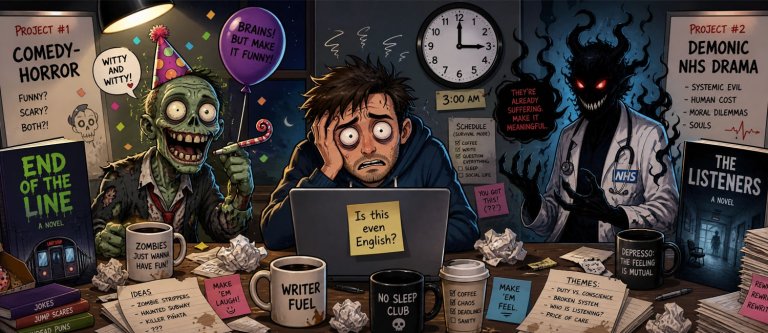
I have two novels on the go. This is either an admirable display of creative ambition or a spectacular failure of self-knowledge, and I’m honestly not sure which. One of them — End of the Line, a comedy-horror — currently sits at just over 25,000 words, which sounds impressive until you remember that a finished novel is typically around 80,000, and that the words I have are almost certainly not the words that will end up on the page. The other — The Listeners, a psychological, paranormal, demonic drama set in an NHS teaching hospital — is at a rather more modest 5,700, and is currently staring at me from my laptop screen with the quiet menace of something that knows it’s not done yet.

I say all of this not to brag — there is nothing to brag about here — but to establish that I have enough experience of the novel-writing process to tell you, with some confidence, that it is nothing like what people imagine it to be. Not even close.


What People Think It Is

There is a persistent and deeply romantic image of the novelist: sat in some atmospheric study, perhaps at a mahogany desk, perhaps near a window overlooking rolling hills, some excellent coffee steaming gently to one side, the words flowing out of them like water from a tap that someone has left running. The novelist in this image is channelling. They are visited by a muse. The story arrives, and they simply transcribe it.

I want to be very clear about this image: it is a lie. Not a gentle exaggeration or a slight simplification, but a thorough, comprehensive, structurally unsound lie, built on no evidence whatsoever and maintained entirely by the publishing industry’s reluctance to put “actually this nearly destroyed me” on the back cover. Stephen King — a man who has written more novels than most people have read — put it more bluntly than I can: “Amateurs sit and wait for inspiration, the rest of us just get up and go to work.” (On Writing, 2000). There is no muse. There is only the chair, and the screen, and the next sentence.

The reality — at least in my experience, and in the experience of most writers I’ve read about or listened to talk honestly about their work — is considerably less cinematic. The reality involves staring at a sentence you wrote last Tuesday and genuinely not knowing whether it’s the best thing you’ve ever produced or an embarrassment to the English language. Often, it is both. Sometimes it is neither. The real problem is that you can’t always tell the difference. Elmore Leonard’s advice — “I try to leave out the parts that people skip” (Elmore Leonard’s 10 Rules of Writing, 2007) — is, in principle, excellent. In practice, it requires you to know which parts those are, and that is precisely the judgment that deserts you at three in the morning when you’re re-reading chapter six for the fourth time and everything looks equally suspect.


Two Projects, Two Very Different Kinds of Torture

The thing about having two novels in progress simultaneously is that they illuminate each other in unexpected ways. Not in a useful, “this insight from one has improved the other” sense — though occasionally that happens — but in a “these two things are both making me question my own judgment and they are doing it in entirely different ways” sense.

End of the Line is, at its core, a comedy-horror. It is absurd, it is dark, it has a particular kind of energy that I find very easy to hear in my head and very difficult to sustain on the page for 80,000 words without it either becoming repetitive or losing the thread of what made it funny in the first place. The challenge with comedy-horror — and I say this with the authority of someone who has now written 25,000 words of it — is that the comedy and the horror are in constant negotiation. Too much comedy, and the threat evaporates. Too much horror, and the jokes stop landing. The whole thing is a tonal tightrope, and at 25,000 words in, I am acutely aware that I am both further than I’ve ever been and simultaneously not even halfway there.

The Listeners is a different problem entirely. Where End of the Line has voice — a very specific, recognisable voice that I can hear clearly — The Listeners has atmosphere. An NHS teaching hospital where something is very wrong, where the demonic and the bureaucratic rub uncomfortably against each other, where the paranormal intrudes on the mundanely institutional. I know what it feels like. I know what it sounds like, in the way you know what a piece of music sounds like even before you can play it. Getting that feeling into 5,700 words has been, so far, the work. Getting it into 80,000 words feels like a problem I’m not yet qualified to solve.


The Self-Doubt Is the Feature, Not the Bug

Here is something I wish someone had told me before I started writing long-form fiction: the self-doubt does not go away. You do not reach a point, somewhere around chapter three, where you think, “Yes — I’ve cracked this, I know what I’m doing,” and proceed with confidence from that point forward. Every writer I have ever heard speak honestly about the process describes some version of the same experience: the doubt remains. It shapeshifts. Early on, it asks whether the idea is good enough. In the middle, it asks whether you’ve made a catastrophic structural error that you’ll have to go back and unpick. Near the end, it asks whether the whole thing is actually the novel you set out to write, or some compromised version of it.

Hemingway is widely credited with the observation that “the first draft of anything is shit” — though the precise origin of that quote is genuinely disputed, appearing in various biographical accounts and letters without a definitive source. Dubious provenance aside, the sentiment is accurate enough to have stuck, and it’s stuck because writers recognise it immediately. Anne Lamott, whose Bird by Bird (1994) is probably the most honest book about writing that has ever been written, made essentially the same point with more generosity: “Almost all good writing begins with terrible first efforts. You need to start somewhere.” The words you have are not the words that will survive. That’s not failure. That’s the process.

What changes — or what I’m told changes, because I have not yet finished anything long enough to experience this personally — is your relationship to the doubt. You stop treating it as evidence that you should stop, and start treating it as evidence that you’re paying attention. The doubt, at its most useful, is your critical faculty staying engaged. It’s the part of you that cares whether the work is good. The problem is that this same part of you, at its least useful, will also spend forty-five minutes reading and re-reading a paragraph that is perfectly fine and interrogating it for flaws until it stops meaning anything at all. Both of these experiences feel identical from the inside. Joe Hill — who knows something about writing horror, having grown up watching his father do it — put it with characteristic economy: “Every first draft is perfect, because all a first draft has to do is exist.” (Various interviews, including Rolling Stone, 2013). It sounds like a reassurance. It might also be a survival strategy.


The Craft Question Nobody Likes to Answer

There is a conversation that writers — particularly writers who also work in other storytelling forms — eventually have to have with themselves, and it is this: what do you actually know about telling a story at novel length?

I come from a filmmaking background. I understand three-act structure. I understand scene-building, pacing, the mechanics of tension. These things are useful. They are not, it turns out, sufficient. The novel does things that film cannot, and the most important of those things is interiority — the capacity to live inside a character’s head for extended periods, to render thought and feeling and memory and perception in a way that no camera can quite capture. King again, this time from The Body (1982): “The most important things are the hardest things to say. They are the things you get ashamed of, because words diminish them.” This is, among other things, a description of why interiority is so difficult to write well — because the closer you get to what something actually feels like from inside a human consciousness, the more inadequate language starts to seem. This is also, not coincidentally, the thing that takes the longest to learn how to do without it becoming either self-indulgent or impenetrable.

End of the Line benefits from its genre in this respect: comedy-horror has a momentum to it, a plot-level drive that keeps things moving and gives the interiority somewhere to go. The Listeners demands it. A hospital drama with demonic undertones, built on psychological dread and institutional unease, lives or dies on whether the reader is inside the right heads at the right moments. Getting that wrong by thirty pages is, structurally speaking, catastrophic.

I am still working out how to get it right.


Why Do It, Then

This is the question that deserves an honest answer, and the honest answer is: because the alternative is not writing it, and not writing it is worse.

Jack London — who produced enough work in his lifetime to make the rest of us feel professionally inadequate — reportedly said: “You can’t wait for inspiration. You have to go after it with a club.” (Widely attributed; various collected letters and biographical accounts.) It’s the kind of advice that sounds aggressive until you’re actually in the middle of a novel, at which point it sounds like the most reasonable thing anyone has ever said.

There is a version of End of the Line that is funny and horrifying and exactly what I want it to be. There is a version of The Listeners that captures precisely the atmosphere I can feel but not yet fully articulate. I don’t know if I’ll write either of those versions. I might write something close to them, or something adjacent to them, or something that is a reasonable first attempt that I’ll look back on in five years and see exactly where it went wrong. That’s fine. That’s how it works.

Nobody who has ever written a novel — nobody who has got to the end, typed the last word, and closed the laptop — has done so without having the experience, somewhere in the middle of the thing, of not knowing whether they were capable of finishing it. Truman Capote, who was not known for sentimentality about the writing process, once said that finishing a book is “just like you took a child out in the back yard and shot it” (The Paris Review, 1957). I find this both deeply alarming and oddly comforting — alarming because it suggests the end is no easier than the middle, and comforting because at least it confirms there is an end. The uncertainty is not a sign that you’re doing it wrong. The uncertainty is just what it is.

Twenty-five thousand words in on one. Five thousand seven hundred on the other. Both of them waiting, with varying degrees of patience, for the next session.

I’ll get there.

Probably.


A little support goes a long way! If you’d like to help me keep creating, you can do so at https://ko-fi.com/garyjjspate

There is a very specific kind of confidence that only exists between the hours of midnight and roughly half past two in the morning, and I want to talk about it, because it has given me no end of grief over the years.

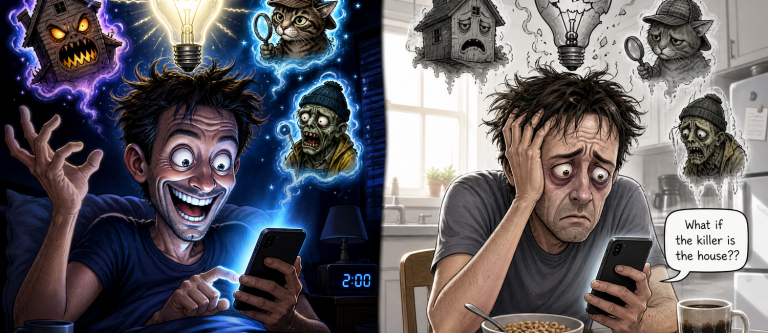
You know the one. You’re lying in bed, supposedly asleep, and your brain — having clocked off from anything useful hours ago — suddenly clears its throat and goes “right, here’s a thought.” And it’s not just a small thought. It’s a plot twist so perfectly constructed that you genuinely sit up in the dark and think: I am a genius, I’ll be fielding calls from Netflix before my toast goes cold.

I get my phone. I type it into my Notes app with the shaky urgency of a man defusing a bomb, because if I don’t capture this exact wording right now, in this exact moment, the universe will swallow it up and consign it to the annals of history. Then I go back to sleep, deeply satisfied, basically already drafting my awards speech.

Then it’s 7am, and I read it back.


The Morning Read-Back: A Crime Scene

Here is a small sample of things 2am-Gary has typed into my phone with absolute, unshakeable conviction:

“What if the killer is a poltergeist”

“Grimhaven but it’s in an alternative universe?”

“What if they push criminals through a time machine so they have to serve their punishment dodging dinosaurs?”

That last one, for the record, I stand by slightly more than the others. But the broader point remains: not one of these, read in daylight, with actual blood sugar in my system, survives contact with reality. They read less like notes from a working novelist and more like the rambling words of a madman who hasn’t slept for weeks and is living off copious amounts of caffeine.

It’s not that the ideas are always bad, exactly. It’s that 2am-Gary has access to none of the things that make an idea actually usable — things like plot logic, structural consequences, or any memory whatsoever of what happened in chapter six. 2am-Gary is a wildfire with ideas but no thought on whether any of them are actually any good.

Small Fish Has Survived Several Assassination Attempts

Small Fish — my football novel, currently twenty-four chapters planned, seven actually written, which is either a healthy work-in-progress or a crime scene depending on the day — has been “saved” by 2am ideas more times than I can count, and “saved” is doing an enormous amount of heavy lifting in that sentence.

At various points, 2am-Gary has decided that Grimhaven needed a secret underground tunnel system, that one of the central characters was secretly somebody’s long-lost brother for reasons that made perfect sense at 2am and absolutely no sense by Tuesday, and — my personal favourite — that the entire third act should be told backwards. Not flashback-backwards. Properly backwards, like Memento, except I am not Christopher Nolan, I am a man with a bad back trying to finish a novel about lower-league football, and the two things do not need to intersect.

None of these ideas made it into the actual manuscript. All of them felt, in the moment, like the missing piece I’d been searching for. This is the great cruelty of 2am: it doesn’t just generate bad ideas, it generates bad ideas that feel exactly identical to good ones, with none of the usual warning signs. There’s no flashing light. No klaxon. Just pure, false certainty, delivered straight to your nervous system at the worst possible hour for critical thinking.

End of the Line Got It Even Worse

My zombie novel, End of the Line, partly set in Grimsby because apparently even the undead have hometown pride, has weathered its own share of 2am interference. There was a stretch of about a fortnight where I was completely convinced the zombies needed an origin involving the docks, some kind of industrial chemical spill with a name I’d apparently already decided on, fully formed, like I’d seen the safety data sheet myself in a dream.

I wrote two pages of this at, predictably, gone midnight. I read it back the next morning with the specific horror of a man finding out what he did at a party he doesn’t remember attending. It wasn’t unsalvageable. It was, worse than that, almost good — good enough that I had to sit with it for an actual half hour before admitting it didn’t fit, which is far more time than a chemical-spill zombie subplot has any right to occupy in a grown man’s Tuesday.

So Why Does This Keep Happening

I’ve got a theory, which is that your brain, late at night, with all its usual inhibitions switched off, finally gets to do the thing it actually wants to do, which is be reckless. Daytime-Gary has deadlines, structural concerns, the nagging awareness that a 24-chapter outline doesn’t actually want a tunnel system shoved into chapter fifteen. 2am-Gary has none of that. 2am-Gary just wants to see what happens if the cat solves the murder.

And honestly, I don’t think the answer is to stop having the ideas. Every so often — rarely, but often enough to keep the habit alive — something genuinely good survives the morning read-back. The trick, as far as I can tell, isn’t suppressing 2am-Gary. It’s just refusing to let him anywhere near the actual manuscript without a chaperone. Write it down, by all means. Just don’t act on it until you’ve had breakfast, regained the use of your frontal lobe, and confirmed that no, the killer cannot, in fact, be the house.

Does anyone else’s brain turn into an unsupervised intern the second the lights go off? I’d love to know I’m not the only one waking up to notes I have no memory of writing and even less ability to explain. Tell me your worst 2am idea in the comments — bonus points if you also wrote it down and have since had to live with it.


Gary writes novels, mostly during the day, despite his best efforts to convince himself otherwise at 2am.