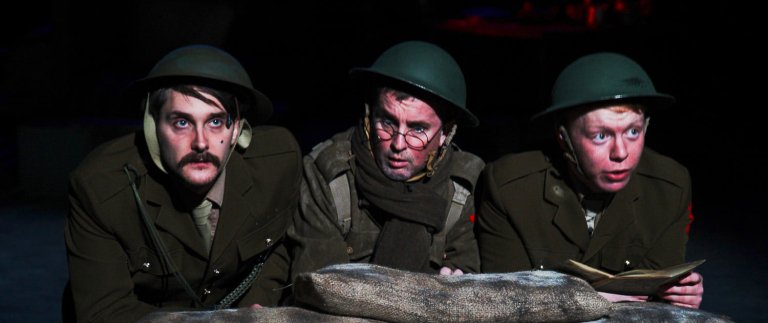

My first experience of amateur theatre was FHODS performing Blackadder Goes Forth in 2021 at The Tower Theatre. I went with no particular expectations — it was local, it was cheap, it was something to do. I had never given amateur theatre much thought before that night. I came out mesmerised.

Something happened in that room that I struggle to name precisely, but that I have chased in theatres ever since, with only partial success. It wasn’t just that Adam Button’s Blackadder was sharply, hilariously good — though he was — or that Nick Shread’s Baldrick had the audience in the palm of his hand. It was something underneath the performances. An energy I hadn’t encountered before and couldn’t quite account for.

I joined FHODS shortly afterwards. I am now the Front of House Manager at The Tower Theatre, and I have watched most of their productions since — from Beauty and the Beast to Sweeney Todd, from Steel Magnolias to Hobson’s Choice. I have watched them make audiences laugh and gasp and, in the case of Goodnight Mister Tom, quietly weep. I am not ashamed to admit that Mike Chisnall’s Mr Tom and Thomas Arnold’s young William got to me in a way I was not prepared for. I have sat through rather a lot of theatre in my time. Very little of it has done that.

Goodnight Mister Tom - amateur theatre by FHODS at The Tower Theatre in Folkestone


Eventually, I think I worked out what it was I felt that first night, and have felt in varying degrees ever since. The people on that stage were not there because it was their job. They were there because they could not imagine being anywhere else.

That distinction — between performing for love and performing for money — sounds sentimental. It is anything but. It is structural. And it changes everything about what an audience experiences.

Amateur theatre is not a lesser version of the real thing. In several important respects, it is the real thing, more purely than its professional counterpart.


The Tyranny of Polish

Professional theatre has a problem it rarely acknowledges: it is too good.

This sounds perverse, but bear with it. The best professional productions are feats of coordinated excellence — every element refined, rehearsed, and risk-managed to within an inch of its life. The set is flawless. The lighting is designed by someone who has won awards for designing lighting. The performances have been workshopped, previewed, and press-nighted into their final, optimal form.

The result is often extraordinary. It is also, paradoxically, distancing. When everything works perfectly, the audience becomes a consumer rather than a witness. We are presented with an experience that has been engineered for our approval, and we duly approve of it, and we go home, and that is largely that.

Amateur theatre cannot afford this kind of polish — financially or organisationally — and the absence of it creates something far more interesting: genuine risk. When a community cast takes to the stage, the possibility of failure is not a theatrical device. It is real. And that reality, that sense of human beings doing something difficult without a safety net, is precisely what the greatest defences of live performance have always rested on.

I think of Goodnight Mister Tom where a door kept swinging open of its own accord. The actor, Mike Chisnall, kept closing it, in character, without missing a line. The audience laughed, then settled back into something I can only describe as total absorption.

Blackadder Goes Forth gave me another perfect example. Graham Jeffery, playing the thunderously pompous General Melchett, forgot his lines. What followed was not a disaster. It was, somehow, absolutely hilarious — Melchett’s blustering self-importance made the fluff feel entirely in character, and the audience loved him for it. Nobody thought less of the show. If anything, they leaned in closer.

Graham forgetting his lines was not a failure of production, neither was the door with a mind of its own. It was theatre happening.


The Love Problem

There is a concept in psychology called the overjustification effect. When you pay someone to do something they already love, their intrinsic motivation — the pure, internal drive that made them love it in the first place — tends to diminish. The external reward crowds out the internal one. The activity stops being something they do for its own sake and becomes something they do for the money. The love, over time, gets complicated.

This is not a knock on professional actors, most of whom entered the profession precisely because of a deep and genuine passion for performance. But the structure of professional theatre — the contracts, the reviews, the career implications, the need to keep working — inevitably shapes how that passion is expressed. A professional actor is, among other things, a professional. They bring discipline and craft that amateurs rarely match. They also bring, whether they intend to or not, the subtle self-consciousness of someone whose livelihood depends on how well this goes.

An amateur brings none of that baggage, and all of that love.

When I watched FHODS perform Blackadder Goes Forth, what struck me was not the technical precision but the evident, unconcealed joy. These were people who had given up their evenings for months, learned their lines around full-time jobs and family commitments, and arrived on that stage not because their agent had negotiated a fee but because this was, for them, the point. The performance was the reward, not the means to one.

An audience can feel this. I am not sure it can be faked.


Who It’s Actually For

There is a question that professional theatre has never satisfactorily answered: who is it for?

The economics of ticketing have become eye-watering. A decent seat at a major London production now regularly costs more than a weekly shop. The audiences that result are, whatever the marketing says, not a cross-section of Britain. They skew older, whiter, and more affluent than the population they are supposed to serve. This is not the fault of the artists, most of whom care deeply about access, but of a funding and pricing structure that has become increasingly incompatible with the democratic claims theatre makes about itself.

Amateur theatre does not have this problem because it was never designed to solve it. It simply is it. The audience at a village pantomime or an amateur dramatic society’s Chekhov is the community itself — people who know someone in the cast, who live on the same streets, who share the same local anxieties and jokes and points of reference. The performance is not presented to the community. It emerges from it.

This is not a small thing. It is, arguably, the entire point of theatrical performance at its origin. The Greek chorus was not a professional ensemble. The medieval mystery plays were staged by the guilds — the bakers, the shipwrights, the goldsmiths — for the town. Theatre began as an act of communal self-expression, and amateur theatre is its most direct descendant.


The Participation Argument

Here is something professional theatre cannot offer: the chance to be in it.

More than 170,000 people in the UK participate in amateur theatre as performers, directors, or crew. That figure does not include the tens of thousands involved in school, college, and youth productions. These are people for whom theatre is not a spectator sport but a practice — something they do, with their bodies and voices, in collaboration with other people, for no financial reward and considerable personal expenditure of time and nerve.

The research on what this does to people is striking. Amateur performance has been consistently linked to improvements in confidence, mental health, social connection, and cognitive function. A rehearsal room is, among other things, a space where people learn to listen, to respond, to fail in front of others and try again. These are not trivial skills. They are, in an era of social atomisation and digital mediation, increasingly rare ones.

Professional theatre produces these effects in its audiences. Amateur theatre produces them in its participants and its audiences — and the line between the two, in a village hall where half the audience knows someone on stage, is far more porous than anything you will find at the National.


The Honest Caveat About Amateur Theatre

None of this is to pretend that amateur theatre is uniformly excellent, or that professional theatre lacks the qualities I have been attributing to its humbler cousin. There is amateur theatre that is excruciating and professional theatre that crackles with the precise aliveness I am describing. The categories are not watertight.

Nor is “amateur” a synonym for “small.” The National Operatic and Dramatic Association represents over 2,500 member societies. Some amateur productions are mounted in professional venues, with budgets and production values that would not embarrass a mid-scale regional house.

What the best amateur theatre has, which even the best professional theatre sometimes lacks, is a relationship between the people on the stage and the people watching that cannot be manufactured. It is the relationship of neighbours, of community members, of people who have a stake in each other’s success.

I have been Front of House at The Tower Theatre long enough now to know most of the faces that come through the door. I know which regulars book the same seats every run, which families have been coming for years, which first-timers arrive a little uncertain and leave wanting to know when the next show is. What I see, every time the lights go down, is a room of people who have shown up for each other — for the cast, yes, but also for the experience of being together in a place where something genuine is about to happen.

That is what FHODS gave me. That is what Goodnight Mister Tom gave me. That is what Blackadder Goes Forth gave me before I even knew I was looking for it. Not a performance delivered to an audience, but a community in the act of recognising itself.

You cannot put a price on that. That is why amateur theatre is better than professional.


FHODS’ next production is My Fair Lady which opens on Thursday 25th June at 7.30pm. Get your extremely reasonably-priced tickets here and support the very best of live amateur theatre at The Tower Theatre, Folkestone.

* FHODS is the Folkestone-Hythe Operatic and Dramatic Society, one of the UK’s longest-running amateur dramatics charities, formed in 1902. For more information see towertheatrefolkestone.co.uk/fhods.

There is a peculiar anxiety that follows theatre around like a bad review. Every decade or so, a new technology arrives — cinema, television, home video, streaming — and with it comes the same breathless announcement: live performance is finished. The audience will stay home. The curtain will fall for the last time.

It hasn’t. And understanding why tells us something important about what theatre actually is, and why, in an age of algorithmic content and infinite distraction, it may matter more than it ever has.

The Myth of the Dying Art Form

The numbers, to begin with, don’t support the eulogy. The West End attracted over 15 million visits in its most recent full season — figures that have largely recovered to pre-pandemic levels. Regional theatre, from the Royal Exchange in Manchester to the Lyceum in Edinburgh, continues to draw audiences and produce work that transfers to London and beyond. But raw attendance data misses the point. Theatre has never been a mass medium in the way television is, and measuring its health against Netflix subscriber counts is a category error. Theatre was never trying to reach everyone. It was always trying to reach *someone*, completely.


What distinguishes live performance from every other storytelling form is not spectacle, or music, or even great acting — all of which exist on screen. It is the condition of shared presence. An audience and performers occupying the same room, breathing the same air, with no possibility of pause, rewind, or second-guessing the algorithm’s recommendation. This is not a limitation. It is the entire point.

Why Theatre Matters

Before asking whether theatre is relevant, it is worth being precise about what it actually does — and why that is irreplaceable.

Theatre is the only art form that happens *because* you showed up. A novel exists whether you read it or not. A film plays on without you. But a performance is constituted, in part, by the audience’s presence. The energy in the room on a good night — that specific, unrepeatable charge between stage and stalls — is not a side effect of the art. It is the art.

This creates something no other medium can manufacture: genuine shared experience. Not the mediated, asynchronous quasi-togetherness of watching the same series on the same streaming platform — but actual co-presence, in real time, with strangers. You laugh together. You fall silent together. You feel, for the duration of the show, that you are part of something larger than your own private life. In an era when loneliness has become a public health concern and civic life has grown threadbare, that is not a trivial thing to offer.

Theatre also uniquely demands something of its audience. It cannot be consumed passively. It requires you to be in a specific place at a specific time, to surrender your phone, to give your full attention to human beings doing something difficult and risky in front of you. That difficulty — the actor without a safety net, the live performance that could falter — is precisely what makes it matter. We are not watching a recording of a thing. We are watching the thing itself, as it happens, knowing it will never happen in quite this way again.

Why Now

We live in an era of extraordinary mediation. Our relationships are filtered through screens. Our news arrives pre-sorted by engagement metrics. Our entertainment is curated to confirm existing preferences. The experience of sitting in a theatre — particularly an uncomfortable seat in a fringe venue, next to a stranger, watching something that does not care whether you enjoy it — is increasingly countercultural.

Theatre has historically thrived in periods of social fracture. Elizabethan drama flourished amid religious upheaval and political instability — Shakespeare’s Globe was not a heritage site but a live wire running through a city in ferment. The great post-war British theatre that gave us Osborne, Pinter, and Wesker emerged from a society reckoning with class, empire, and what it meant to be modern. Periods of disorder produce a hunger for the kind of direct, embodied, communal storytelling that only the stage provides.

We are in such a period now. And Britain, with its extraordinary infrastructure of subsidised and commercial theatre — the National, the RSC, hundreds of producing houses from Chichester to Dundee — is uniquely positioned to meet that hunger.

The Uncomfortable Geography of Recovery

It would be dishonest to write about theatre’s resurgence without naming who is being left behind.

The national numbers are, on one reading, cause for optimism. The West End drew a record 17.64 million people in 2025, generating over a billion pounds in revenue. Audiences across the country continue to choose live performance at scale. But aggregate figures flatter a picture that, at the regional level, is far more uneven — and in parts of the south east in particular, genuinely alarming.

The SOLT and UK Theatre’s 2026 annual report is candid about this. While organisations in England outside London report comparative resilience in audience attendance, their overall business confidence tells a different story: nearly one in five report negative business expectations, compared to just seven per cent in London. More than a third of all theatre organisations expect to run a deficit this year. Among subsidised venues — the producing houses, the mid-scale regionals, the civic theatres that serve communities with no other access to live performance — that figure rises to over half.

The south east sits in a particularly awkward position within this geography. It is neither London, with its deep philanthropic networks and commercial infrastructure, nor the regions that have benefited most visibly from the “levelling up” of arts funding in recent years. Arts Council England’s 2023–26 investment programme explicitly redirected money toward previously under-served areas — places like Wigan and Gloucester were cited as beneficiaries of funding that had been “too low for too long.” The south east, perceived as prosperous, received no such corrective. The assumption that affluence and access to arts funding travel together is one that communities across Kent, Sussex, Surrey and beyond are now paying for.

What this means in practice is that venues which serve towns and suburbs — not glamorous enough for West End economics, not deprived enough for targeted intervention — are being squeezed from both sides. Costs have doubled over the past decade. Staffing, energy, maintenance and insurance continue to rise. Real-terms ticket prices have actually fallen since 2019, as venues absorb inflation rather than pass it on, sustaining access at the cost of their own margins. And local authority funding, which underwrites many of these buildings as civic assets, has been in structural decline for fifteen years.

The pipeline of new work — already uneven nationally — is particularly thin where producing houses lack reserves to commission it. Too many venues retreat to safe revivals and touring productions not out of artistic timidity but simple financial necessity.

None of this diminishes the argument for theatre’s relevance. If anything, it sharpens it. The communities now at greatest risk of losing their local theatre are precisely those where the case for live, communal, embodied storytelling is strongest — places where a theatre is not one option among many cultural amenities, but often the only one.

The question worth asking is not whether theatre can compete with streaming on streaming’s own terms. It cannot, and shouldn’t try. The question is whether a society that understands what theatre does — and what it costs a community to lose it — is willing to fund it accordingly.

The audiences, when they find their way into a room and the lights go down, are still holding their breath.

Whether those rooms will still be there in five years is a question that deserves an answer before the curtain comes down for good.

Let me set the scene.

It’s a Friday or Saturday night — we don’t tend to put shows on midweek unless it’s panto season, when all bets and all weeknights are off. The house lights are about to go down, the cast are pacing backstage doing whatever it is actors do to summon the nerve to go on, and I’m standing in the foyer of the Tower Theatre doing the maths I try not to do too often. Tonight’s audience versus tonight’s costs. It’s not always a flattering equation.

If you work in theatre anywhere in the South East right now, you’ll know the feeling. Slower ticket sales. Shows pulled or rescheduled because the numbers simply don’t add up. Patrons who’d normally book without thinking twice now waiting until the last minute, watching their bank balance before they watch the curtain rise. It’s not dramatic in the way theatre is supposed to be dramatic. It’s just quietly, persistently harder than it used to be.

So is this it, then? Is the great British tradition of people putting on costumes in draughty halls and convincing other people to watch them finally winding down, defeated by energy bills and the price of a pint?

No. But we do need to have an honest conversation about why it feels that way, and what we can actually do about it.

The Bit Where I Show You Some Numbers (Don’t Worry, It’s Quick)

Here’s the genuinely strange thing about the current state of UK theatre nationally: more people are going than ever before. Over 37 million people attended theatres across the UK in 2025, with the West End alone welcoming a record-breaking 17.64 million theatregoers. Nationally, audiences aren’t the problem.

But here in the South East, that’s not quite the story on the ground — at least not this year. It’s worth being precise about that: the full-year national statistics are largely looking backwards, and don’t yet capture what’s actually happening right now. This year specifically, many of us have watched ticket sales slow noticeably, and more than a few shows across the region have had to be cancelled or rescheduled simply because the numbers didn’t stack up. The national picture and the local, current picture aren’t telling quite the same story, which makes it harder, not easier, to know what’s actually going on.

What both pictures agree on is the cost side. Production budgets have climbed steadily as labour, materials, energy, and building maintenance costs have increased, while theatres have largely held ticket prices steady to protect access. Translation: venues are eating the cost increases themselves rather than passing them on, which is admirable and also financially unsustainable in roughly equal measure. More than a third of theatres are forecasting an operating deficit this year, rising past half in the subsidised sector.

And that’s before you get to the funding picture, which is its own special kind of bleak. Public funding for arts and culture has dropped significantly per capita since 2010, with local authority contributions falling by as much as 48 per cent. Closer to home, the Astor Theatre in Deal — a proper community venue, not unlike ours — went public last year about a £20,000 shortfall, citing rising energy and supply costs squeezing them from every direction.

So nationally it’s “theatre has got harder and more expensive to make, just as people have less spare cash.” Here in the South East, we’re living that and watching the ticket sales dip on top of it. Two trends heading straight at each other like a particularly slow-motion car crash, with venues like ours caught in the middle, holding a clipboard and a slightly too-optimistic box office target.

What This Actually Looks Like From Where I’m Standing

The data is useful, but I work front of house, not in a spreadsheet, so let me tell you what it actually feels like.

This year so far we’ve put on Noises Off, Patio/Porch, and Dare to Dream Jr, with Two, Gypsy, Frankenstein and My Fair Lady still to come — My Fair Lady opens next Thursday. A real spread already, from farce to youth theatre to intimate drama, with a two-hander, a full-blown musical, and gothic horror still ahead of us — exactly the kind of varied programming a venue like ours should be proud of. And yet it’s been a noticeably harder year to fill seats than it has been in the past, with more of that variety still to sell. It’s the conversation with a regular who loves the show, genuinely does, but is now choosing between this and something else this month because they can’t do both. It’s watching a show that should sell out limp along at sixty per cent because people are booking later and later, holding out to see if anything more pressing comes up first. It’s the slightly sick feeling of having to have the “do we cancel or do we run it at a loss” conversation, which is a conversation nobody goes into theatre management hoping to have.

Panto is, as ever, the exception that proves the rule. Last year’s Jack and the Beanstalk did exactly what panto always does — packed the house, weeknights included, because pantomime occupies a strange and wonderful place in people’s budgets that other theatre doesn’t quite reach. This Christmas we’re bringing you Dick Whittington, and if history is anything to go by, it’ll once again be the one production of the year where the cost-of-living conversation politely steps aside for an hour and a half so everyone can boo the villain in peace. There’s probably a lesson in that, even if I haven’t fully worked out what it is yet.

None of this is anyone’s fault. Nobody’s villain here. People aren’t choosing not to come to the theatre because they’ve stopped caring about it — they’re choosing not to come because the heating bill won. That’s not a value judgement on theatre. That’s just maths, and maths doesn’t care how good your set design is.

So Can We Buck the Trend?

Yes. I genuinely believe that, and not in a forced “stay positive!” way that ignores the reality of the situation — more in a “we’ve actually got more tools than we think” way. Here’s where I think the fight gets won.

Make the price barrier softer, not lower. Slashing ticket prices isn’t sustainable when costs have gone the other way, but flexible pricing is genuinely effective. Pay-what-you-can performances, even just one per run, signal that you’re not trying to extract maximum value from people who don’t have it. Schemes like this have already shown that audiences from less affluent backgrounds, who are markedly less likely to attend otherwise, will come when the financial barrier is genuinely removed rather than just nudged.

Lean harder into community, because that’s the one thing the multiplex can’t compete with. A cinema chain cannot offer you the feeling of watching your neighbour’s kid nail their first ever solo line on stage. Community and amateur theatre has something the West End, for all its budget, doesn’t: people watching people they actually know. That’s not a consolation prize. That’s the entire point, and we undersell it constantly.

Marketing matters more than ever, and it’s relentless work. This isn’t a knock on anyone — marketing a theatre programme well is genuinely hard, thankless, never-finished work, and the people doing it across this industry deserve far more credit than they get. Audiences need to be told a show exists, repeatedly, in places they actually look, which means constant social media, local press, partnerships with other community groups — none of it flashy, all of it essential. I’ve huge respect for anyone holding that particular plate spinning, ours included.

And the best marketing isn’t ours to do at all. No poster, post, or press release beats a friend turning to you and saying “you have to see this.” Word of mouth is still the single most powerful tool in theatre’s box, and it doesn’t cost a venue a penny — it just needs patrons to actually use it. If you saw something you loved, tell someone. Tag the theatre, leave a review, mention it to a colleague over coffee, drag a reluctant partner along next time. Audiences have more power to keep their local theatre alive than most of them realise, and it costs nothing but a sentence.

Diversify what “coming to the theatre” means. Talks, workshops, youth productions, am-dram showcases, even just the bar being a nice place to sit on a Friday — every reason someone walks through the door that isn’t strictly “buy a ticket to a play” builds the habit of choosing you. Habit is worth more than any single sale.

Be honest with your audience about the squeeze. People are remarkably understanding when you tell them the truth. “We need your support to keep doing this” lands better than silence followed by sudden closure. The Astor Theatre’s crowdfunder worked, in part, because they said the quiet part out loud instead of pretending everything was fine until it very publicly wasn’t.

The Show Goes On (Probably With a Slightly Smaller Budget)

I don’t think we’re watching the end of theatre. I think we’re watching theatre get squeezed into proving, all over again, why it matters — and honestly, slightly annoyingly, I think it’ll manage it. It always has. Theatre has survived plagues, world wars, the invention of the television, and at least one period where everyone thought immersive Shakespeare in a car park was a good idea. It’ll survive this too.

But survival isn’t automatic, and it isn’t somebody else’s job. It’s box office numbers and bar takings and that one person who tells two friends about a show they loved. It’s every front of house manager doing slightly anxious maths in a foyer on a Friday, hoping the room fills up.

So if you’ve got a local theatre — and in Kent, you almost certainly have several rather good ones — go. Book the ticket. And don’t just think of it as plays, either. A venue like the Tower isn’t only Two and Gypsy and Frankenstein; it’s tribute acts that’ll have you up dancing, comedy nights that’ll have you in stitches, kids’ shows that’ll make a Saturday morning magic for someone small, and panto that’ll have the whole family booing a villain together. There is very likely something on at your local theatre this month that’s exactly what you fancy, whatever mood you’re in.

So go. Book the ticket, whatever it’s for. Bring someone who’s never been. Buy the interval ice cream even though it’s mysteriously the same price as a small car. Tell someone about it afterwards. It genuinely, actually helps more than you’d think — and it’s the difference between a theatre that survives this and one that quietly doesn’t.

What’s your local theatre, and what’s keeping you coming back — or keeping you away? I’d love to hear it in the comments.


*Gary is the Front of House Manager at the Tower Theatre in Folkestone, and has the spreadsheets to prove it.*