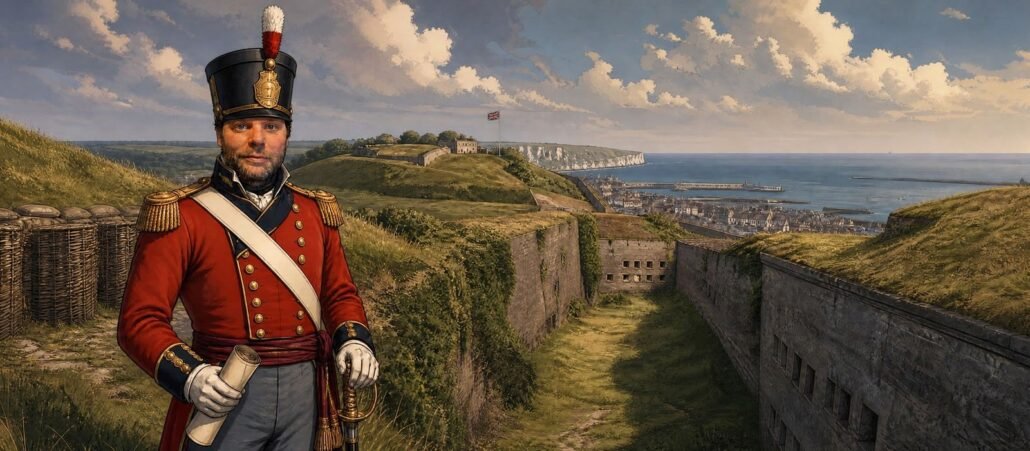
Prologue: A Very Large Panic Response
Western Heights is what happens when a nation spends nearly a century being absolutely convinced that Napoleon is about to personally row across the Channel. Perched on the chalk hilltop above Dover, it grew into the largest Napoleonic-era fortress in Britain — an entire fortified town of ditches, redoubts, barracks, and secret staircases, built almost entirely on the premise of “better safe than French.”
A Board of Ordnance official, reviewing the budget request, allegedly:
“You want to fortify an entire hill. Not the harbour. Not the town. The hill. Behind the town. Fine. Take the money. I don’t have the energy to argue with a man this frightened of France.”
Chapter One: The Fieldworks of Mild Concern
The first defences went up around 1779, during the American War of Independence, when Britain briefly remembered it also had European enemies and panicked accordingly. These were rough earthwork fieldworks — trenches and banks thrown up in a hurry, the fortification equivalent of shoving a chair against the door.
By 1781 the Board of Ordnance had bought up 33 acres of prime Kentish hilltop to build something more permanent, and a 1784 map shows the beginnings of a proper bastioned fort. Then, in 1783, the war ended, everyone relaxed, and construction quietly stopped, because nothing kills a fortification budget quite like peace breaking out.
A Dover resident, watching the half-finished earthworks sit untouched for a decade, probably:
“So we’re just leaving that there, then. A large hole in a hill, abandoned mid-panic, as a permanent local landmark. Lovely.”
Chapter Two: Napoleon Ruins Everyone’s Relaxing Decade
Work resumed in deadly earnest with the outbreak of the Napoleonic Wars in 1793, and properly accelerated from 1804 onward, as Britain became gripped by the very reasonable fear that a certain short, ambitious Frenchman was about to invade via the shortest possible sea crossing — which happened to run directly past Dover.
Someone in the War Office, drawing up plans, definitely:
“Right, if Napoleon lands at Dover, we need our men to be able to get from the harbour to the hilltop barracks as fast as possible, without getting shot, without getting lost, and ideally without having to walk through the town and be stopped by every innkeeper wanting to sell them a pint first.”
This is, genuinely, why they built the Grand Shaft — a bizarre and brilliant 200-step triple spiral staircase, bored 140 feet straight down through the cliff, three interlocking staircases wound around each other like the world’s most over-engineered fire escape. The official reasoning was efficient troop movement. The unofficial reasoning, one suspects, involved keeping soldiers, officers, and townsfolk from all colliding on the same stairs.
A sergeant explaining the Grand Shaft to a new recruit, imagined:
“There are three separate staircases, wound around one hole in a cliff, so that men can go up while other men go down while a third group of men do something else entirely, all without anybody making eye contact. This is the most British piece of engineering I have ever seen.”
A recruit, three flights in and badly out of breath:
“Could we not simply have built the barracks closer to the harbour.”
Meanwhile, up on the hill, two entire fortresses were rising: the Drop Redoubt, a pentagon of brick-faced ditches bristling with twelve 24-pounder guns and barracks for 200 men, and the Citadel, the grandest strongpoint of all, crowning the very top of the ridge. Between them ran the “lines” — a labyrinth of dry moats up to 15 metres deep, designed to make any attacking Frenchman feel extremely regretful about his life choices before he’d even reached the walls.
A French spy, reportedly, filing a report back to Paris:
“The English have dug a moat so deep that our men would need to invade the moat first, purely as a separate campaign, before being permitted to invade the actual fort. I recommend we invade somewhere flatter.”
By 1814, when the war finally ended and Napoleon was safely packed off to Elba, Britain had spent over £200,000 on the Western Heights — a genuinely eye-watering sum for the time — to defend against an invasion that, in the end, never came anywhere near Dover.
The Board of Ordnance, tallying the final bill, probably:
“We have built the single most heavily fortified hill in the country. Napoleon never set foot on it. In fact, he never set foot within forty miles of it. Excellent use of funds, truly. File it under ‘deterrence,’ and let’s never examine that word too closely.”
Chapter Three: A Brief, Restful Period of Nobody Attacking Anyone
For the next four decades or so, Western Heights settled into a long and largely uneventful retirement as a garrison town, its guns pointed at an enemy who had been safely dead since 1821 and showed no sign whatsoever of changing that.
A bored sentry on the Drop Redoubt, sometime around 1840, imagined:
“I have spent six years pointing a 24-pounder cannon at the English Channel. Nothing has ever happened. I have named several of the passing seagulls. I fear I am becoming closer to gull society than to human society.”
Chapter Four: Napoleon III, or “Here We Go Again”
Then, in 1859, Britain worked itself into a near-identical panic — this time over Napoleon III, nephew of the original, and just successful enough as an emperor to make everyone deeply suspicious of anyone named Napoleon on principle. A Royal Commission was convened, concluded that Britain’s coastal defences were a national embarrassment, and recommended a colossal new building programme. History remembers these as the “Palmerston Forts,” and the good people of Dover remember them as the reason their hill got dug up all over again.
Lord Palmerston, allegedly, presenting the plan to Parliament:
“Gentlemen, is there any concrete evidence that Napoleon III intends to invade? No. Does that matter? Also no. Pass me the budget.”
The northern side of the hill was entirely relandscaped, the ditches between the Drop Redoubt and the Citadel deepened and rebuilt in brick, and the whole complex expanded further still. The final touches weren’t finished until the 1890s, by which point the fortress had been under more-or-less continuous construction, on and off, for well over a century, defending against two separate Napoleons, neither of whom ever showed up.
A stonemason, laying brick on the 1860s extension, dryly, imagined:
“My grandfather built the first bit of this hole. My father built the second bit. I am now building the third bit. At this rate my son will be born specifically to finish the drainage.”
Chapter Five: The Twentieth Century Finds Other Uses For A Very Large Hill
By 1902 the heavy guns had gone quiet, and the Drop Redoubt was repurposed as billets for the regimental band — a startling career downgrade from “defend the nation” to “please the officers with a nice bit of brass on a Sunday.” During the First World War it housed searchlights for Dover’s Anti-Aircraft Corps, and in November 1917 briefly held a captured German U-boat crew, who presumably had extremely mixed feelings about being marched into a fortress originally built to repel their great-grandfathers’ emperor.
A captured U-boat officer, surveying his new accommodation, imagined:
“So this is where I’m being held. A hundred-year-old fort, built to stop Napoleon, is now stopping me. I feel that history has been remarkably efficient with its recycling.”
Between the wars the fort was largely abandoned again, until the Second World War gave it one more job: as a lookout post for plotting long-range German shelling from across the Channel, and — most dramatically — as a staging point in April 1942 for Commandos and Canadian infantry preparing a cross-Channel raid on the French coast under Lord Lovat. For one brief moment, more than a century after it was built to keep Frenchmen out, Western Heights was used to help send Britons in.
A Commando, waiting to embark in 1942, imagined:
“Funny old fort, this. Built to stop an invasion of Britain. We’re using it to launch an invasion of France. I think somewhere in a museum, an eighteenth-century engineer has just spun in his grave so hard he’s generated usable electricity.”
By 1945, the site was abandoned for good, its guns silent, its ditches slowly filling with brambles, ivy, and the occasional confused sheep.
Epilogue: Heritage, At Risk, and Occasionally Locked
Western Heights today survives in pieces — the Drop Redoubt cared for by English Heritage and the volunteer-run Western Heights Preservation Society, the Grand Shaft still descending its dizzying 200 steps, and much of the wider site left to nature, ivy, and the Heritage at Risk Register, a somewhat undignified fate for what was once the most expensive hole in the ground in Kent.
A modern-day tour guide, wrapping up, probably:
“And that concludes our tour: two Napoleons who never showed up, one staircase built so soldiers wouldn’t have to make eye contact, and one very large hill that has, at various points, held cannons, a brass band, a captured U-boat crew, and several hundred confused sheep. Mind the nettles on your way out.”
Note: the historical framework here — the 1779 fieldworks, the 1804–1815 Napoleonic construction of the Grand Shaft, Drop Redoubt and Citadel, the 1859 Royal Commission and Palmerston-era expansion, and the twentieth-century military uses through both World Wars — reflects the real historical and archaeological record. The quotations, however, are entirely invented for comic effect and were not said by anyone, ever, probably.
About Two For The Road
Two For The Road is a walking history series following Gary as he journeys through Britain’s most historically significant locations — guided, unseen, by The Oracle. Gary’s Ramblings are the long-form historical (and comical) write-ups he puts together between takes.

Bluesky Discussion
View on BlueskyNo replies yet. Be the first to comment on Bluesky!