Prologue: Britain’s Third Attempt at Not Panicking
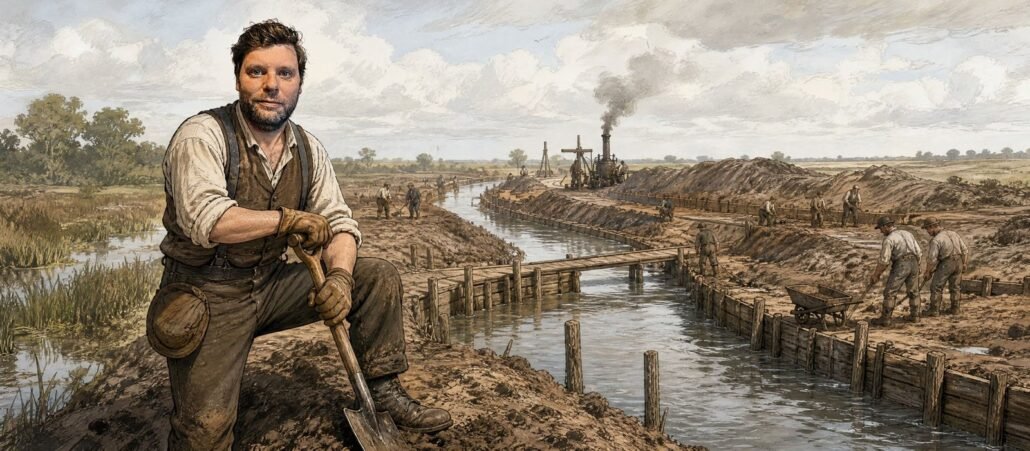
By 1804, Britain’s anti-Napoleon anxiety had already produced two lines of defence: the Royal Navy patrolling the Channel, and a chain of 74 stubby Martello towers dotted along the south coast like a row of concerned garden ornaments. This being Britain, two lines of defence were deemed insufficient, and so somebody suggested a third: dig a very long ditch and hope Napoleon’s entire army politely declines to cross it.
A government minister, hearing the plan for the first time, allegedly:
“So the Navy, the finest fighting force on Earth, isn’t enough. The Martello towers, each one a small stone fortress, aren’t enough. Your solution is… a ditch. A wet one. Go on then.”
Chapter One: The Ditch That Ate Romney Marsh
The idea came from Lieutenant-Colonel John Brown of the Royal Staff Corps, who pointed out a genuine flaw in the existing plan, which had been to simply flood Romney Marsh if the French turned up. The trouble, Brown noted, was that flooding the marsh would take ten full days — plenty of time for an invading army to stroll across it dry-shod — and would also cause chaos every single time somebody mistook a fishing boat for the entire Grande Armée.
Lieutenant-Colonel Brown, presenting his objection, imagined:
“Gentlemen, your plan is to flood an entire marsh over the course of ten days at the first sign of invasion. May I ask what we intend to do for those ten days? Stand on the beach, waving, saying ‘nearly ready, won’t be long’?”
His alternative — a permanent, pre-dug canal that would always be an obstacle, invasion or no invasion — was pitched to Prime Minister William Pitt the Younger and the Duke of York on 26 September 1804. Both men loved it instantly, which is generally what happens when you present anxious politicians with a plan that lets them be seen to Do Something.
William Pitt, agreeing to the scheme on the spot, probably:
“A ditch, dug in advance, that is simply always there. No ten-day delay, no false alarms, no standing on a beach looking sheepish. Yes. Build it. Build it enormous. I want Napoleon to see it from Boulogne and reconsider his whole week.”
Construction began at Seabrook, near Hythe, on 30 October 1804, with the ambitious goal of finishing by September 1805. What followed instead was a masterclass in 19th-century project delays: a brutal winter, relentless flooding, and serious trouble recruiting enough navvies willing to dig a canal through a marsh in the depths of a Kentish winter. By May 1805, a grand total of six miles out of the roughly twenty that needed digging by hand had been completed — and the September deadline was already a lost cause.
A navvy, up to his knees in freezing marsh water in January 1805, imagined:
“I was told I’d be digging a canal. Nobody mentioned the canal would be actively trying to become a lake around me at all times. I am not digging a trench. I am negotiating a truce with a swamp, and losing.”
Pitt, unimpressed with the pace, sacked the original contractors and consulting engineer, and handed the whole operation over to the military, with Brown himself now in direct command and up to 1,500 men — a mix of civilian navvies and soldiers — put to work. Powerful new steam-driven pumps were eventually brought in simply to keep the half-dug trench from filling itself back in overnight, which is a genuinely humbling way to discover your construction site has opinions of its own.
An engineer, watching the new steam pumps work through the night, imagined:
“We are now employing cutting-edge steam technology purely to stop a hole from un-digging itself. I did not train for six years to fight a marsh to a draw using a kettle.”
Chapter Two: A Genuinely Clever Design, Eventually
Once underway properly, the canal’s design turned out to be rather ingenious. It wasn’t built in a straight line — instead it zig-zagged deliberately along its length, with gun positions placed at the end of each straight section so that any French troops attempting to cross could be shot at along the full length of the water, rather than just from directly opposite. An earthen rampart and a military road ran along the landward bank, allowing troops and cannon to move rapidly up and down the entire 28-mile line.
A Royal Staff Corps officer, explaining the zig-zags to a visiting general, imagined:
“You see, General, we’ve bent the canal so that any Frenchman crossing it is being shot at from the side as well as the front. It’s not an obstacle so much as a very long, very wet shooting gallery, and he is cordially invited to be the target.”
Two sections were eventually joined by the rivers Rother and Brede, running from Hythe all the way to Cliff End near Hastings — a full 28 miles of ditch, rampart, road, and towpath, built specifically to stop one man from stepping onto English soil.
Chapter Three: Finished Just In Time For Nobody To Need It
The canal was formally completed in April 1809, at a cost of roughly £234,000 — a genuinely eye-watering sum, and, delightfully, almost bang on the original estimate, which may be the only 19th-century British infrastructure project in history to come in on budget. There was, however, one small problem: Napoleon’s navy had already been decisively smashed at the Battle of Trafalgar back in 1805, four years earlier, and his invasion barges at Boulogne had long since been reassigned, along with his attention, to central Europe. Britain had spent five years and a small fortune building the most elaborate ditch in Christendom against an invasion that had effectively been called off before the ditch was even half dug.
A junior clerk at the Treasury, reviewing the final accounts in 1809, imagined:
“So, to confirm: we have spent £234,000, employed 1,500 men, fought a literal marsh, and invented a new use for steam power — to build a defensive line against a French invasion fleet that was defeated at Trafalgar four years before we finished. I will file this under ‘thorough.’”
The canal quickly and cheerfully earned itself the nickname “Pitt’s Ditch,” used by absolutely everyone who wanted to remind the Prime Minister, gently but pointedly, that he had spent an enormous sum of public money on a very long puddle that Napoleon never came anywhere near.
A satirical pamphleteer of the day, having a wonderful time, imagined:
“Behold Mr Pitt’s magnificent ditch! Twenty-eight miles long, five years in the making, and successfully repelling zero Frenchmen to date. A triumph of engineering, if not of timing.”
Chapter Four: Finding Other Things To Do With A Very Long Wet Ditch
Deprived of its intended enemy, the canal set about finding gainful employment elsewhere. Guard houses were built at every bridge along its length, ostensibly for defence but very quickly repurposed as checkpoints against Romney Marsh’s other great local industry: smuggling. This met with what historians generously describe as “limited success,” Romney Marsh smugglers having had considerably more practice evading authority than the authority had experience catching them.
A customs officer stationed at a canal guard house, filing his tenth consecutive unsuccessful report, imagined:
“Nothing suspicious to report tonight. Also nothing suspicious to report last night. Also nothing suspicious to report the night before, despite three separate local farmers mysteriously acquiring an excellent brandy collection this month.”
From 1810 the canal was opened up for public use, with a barge service eventually running between Hythe and Rye and tolls charged for use of the accompanying Royal Military Road — Britain having decided that if the Napoleon-defeating ditch wasn’t going to defeat any Napoleons, it may as well start defeating some ferry fares instead. The novelty wore off, however, and by 1877 the canal was formally abandoned by the military and leased out to the Lords of the Level of Romney Marsh, its glory days as an instrument of national defence quietly over.
A barge operator on the Hythe-to-Rye run, sometime in the 1850s, imagined:
“This canal was built to stop the greatest army in Europe. I am currently using it to transport four sacks of turnips and a slightly seasick vicar to Rye. I choose to see this as a promotion for the turnips.”
Chapter Five: An Unexpected Second Career
Remarkably, more than 130 years after being dug to repel one European dictator, the canal found itself pressed back into anti-invasion service against a second one. During the Second World War, the canal line was reinforced with concrete pillboxes, and once again treated as a serious defensive barrier — this time against the very real threat of a German invasion following the fall of France in 1940.
A Home Guard volunteer, manning a brand-new WWII pillbox beside a 130-year-old Napoleonic canal, imagined:
“So this ditch was dug against Napoleon, didn’t see a moment of action, sat here quietly for over a century ferrying turnips and the odd vicar, and has now been reactivated against Hitler. I don’t know whether to call this canal remarkably prescient or simply extremely unlucky with its choice of neighbours.”
Once again, no invasion came, and the canal returned — for what one assumes it hoped would be the final time — to a quiet retirement.
Epilogue: A Very Long, Very Peaceful Walk
Today the Royal Military Canal survives as one of the loveliest and strangest walking routes in Kent and East Sussex — 28 miles of dead-straight-then-suddenly-zig-zagging waterway, lined with dragonflies, kingfishers, the occasional startled marsh frog, and interpretation panels cheerfully explaining that this tranquil, tree-lined footpath was once Britain’s most expensive anti-French sulk.
A modern-day dog walker, strolling the towpath, probably:
“Lovely walk. Very peaceful. Apparently this whole thing was dug to stop Napoleon, who never showed up, cost a fortune, got nicknamed ‘Pitt’s Ditch,’ and mostly ended up being used to catch smugglers, badly. Anyway — good spot for a kingfisher, this bit.”
Note: the historical framework here — John Brown’s 1804 proposal, Pitt and the Duke of York’s endorsement, the difficult 1804–1809 construction, the canal’s zig-zag defensive design, its completion four years after Trafalgar had already ended the invasion threat, its nickname “Pitt’s Ditch,” its later use against smuggling and eventual 1877 abandonment, and its reactivation with pillboxes in the Second World War — reflects the real historical record. The quotations, however, are entirely invented for comic effect and were not said by anyone, ever, probably.
About Two For The Road
Two For The Road is a walking history series following Gary as he journeys through Britain’s most historically significant locations — guided, unseen, by The Oracle. Gary’s Ramblings are the long-form historical (and comical) write-ups he puts together between takes.
Bluesky Discussion
View on BlueskyNo replies yet. Be the first to comment on Bluesky!