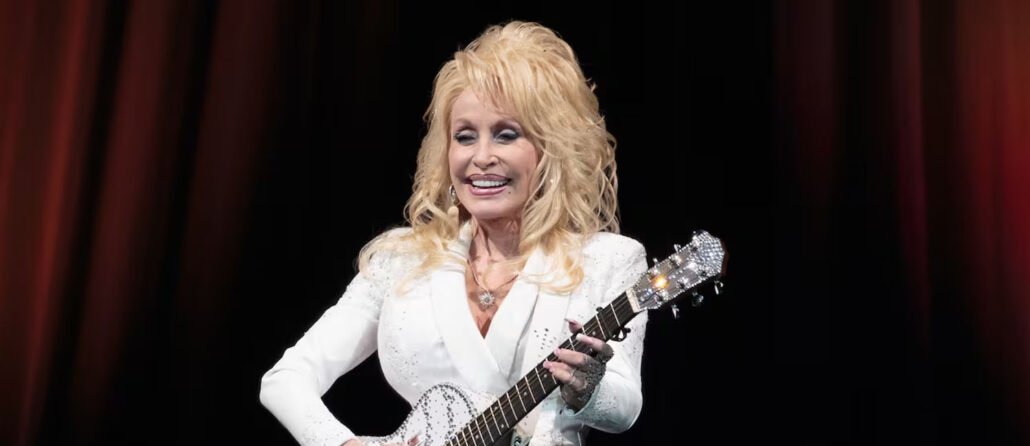
I found out today, like most people did — a headline, then a moment where you have to read it twice. It’s been two hours since the news broke and it still doesn’t feel real. Dolly Parton has died, at 80, at home in Nashville. Her family says it was peaceful. I don’t think “gutted” is too strong a word for how it landed.
I want to write something honest about what she meant to me, because it’s more than I expected, and even in these two hours I’ve felt it creep up in a way I didn’t see coming.
Grown Up Around Her, Without Ever Quite Choosing Her
I’ve known who Dolly Parton is for as long as I can remember, because my dad was a country singer through the 90s and into the early 2000s, and that meant country music was simply the sound of my childhood, whether I’d have picked it myself or not. Dolly was always somewhere in that — a constant, rather than a discovery.
I wasn’t a fan exactly, not in the way you’re a fan of a band you found yourself and feel proprietary about. But I understood, even as a kid, that she was different in scale to almost everyone else in that world. She wasn’t just a country artist that country fans liked. She reached past the genre entirely, in a way hardly anyone manages. You didn’t have to know a single other thing about country music to know Dolly Parton.
The Appreciation That Came Later
It’s only really as an adult that I properly understood what I’d been taking for granted. We’re deep into an era of one-hit wonders, of anyone with a laptop and a Spotify upload button being able to call themselves a star for a fortnight, of AI-generated music muddying the water even further about what a genuine career even looks like anymore. Longevity like Dolly’s has basically stopped being possible for most people. She had a six-decade career, still writing, still recording, still turning up and meaning it, right to the end.
And she wasn’t just long-lasting, she was everywhere, in the way almost nobody in music manages to be. I’d genuinely believe you if you told me there’s someone living deep in a rainforest with zero access to modern technology who’s still somehow heard of Dolly Parton. That’s not really a joke. Her reach felt like it had stopped being about genre or country of origin a long time ago.
The Bodyguard Confession
Here’s the one I’ll admit to slightly sheepishly. I grew up loving The Bodyguard — Whitney Houston, Kevin Costner, all of it — and I heard “I Will Always Love You” the way most people my age did, as a Whitney song. It took me embarrassingly long to find out Dolly wrote it, and sang it first.
Once I actually went back and listened to her original, it completely rearranged how I felt about the song. Whitney’s version is a power ballad, huge and technically extraordinary, but some of the tenderness gets a bit lost under the sheer force of it. Dolly’s is softer, plainer, more like someone actually saying goodbye to someone they loved rather than performing the feeling of it. I prefer hers. Both are brilliant, entirely distinct achievements, but Dolly’s is the one that actually sounds like the words mean what they say.
More Than the Music
The thing I keep coming back to today isn’t even the songs, as good as they are. It’s that she used everything she built — the fame, the fortune, the platform — to actually help people, consistently, for decades, without making a performance of the generosity. Literacy programmes for children. Support in moments of crisis. A genuine, practical kindness running underneath the rhinestones the whole time.
She wasn’t just a legend because of what she wrote and sang. She was a legend because of who she was while she was doing it. That’s a much rarer thing, and it’s the part of her the world is going to miss most.
Rest in peace, Dolly. We will always love you.
Photo: Suzanne Cordeiro/AFP/Getty Images
Bluesky Discussion
View on BlueskyNo replies yet. Be the first to comment on Bluesky!