
Posts

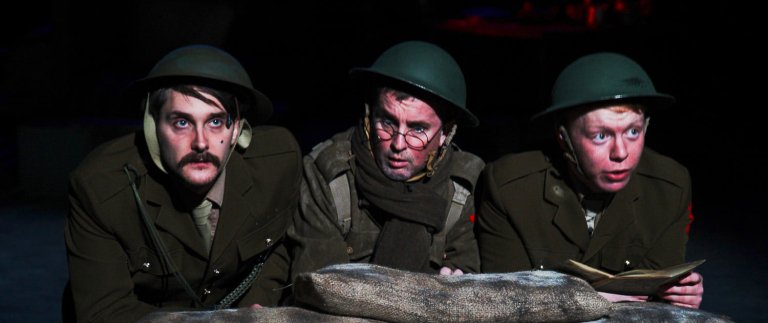
My first experience of amateur theatre was FHODS performing Blackadder Goes Forth in 2021 at The Tower Theatre. I went with no particular expectations — it was local, it was cheap, it was something to do. I had never given amateur theatre much thought before that night. I came out mesmerised.

Something happened in that room that I struggle to name precisely, but that I have chased in theatres ever since, with only partial success. It wasn’t just that Adam Button’s Blackadder was sharply, hilariously good — though he was — or that Nick Shread’s Baldrick had the audience in the palm of his hand. It was something underneath the performances. An energy I hadn’t encountered before and couldn’t quite account for.

I joined FHODS shortly afterwards. I am now the Front of House Manager at The Tower Theatre, and I have watched most of their productions since — from Beauty and the Beast to Sweeney Todd, from Steel Magnolias to Hobson’s Choice. I have watched them make audiences laugh and gasp and, in the case of Goodnight Mister Tom, quietly weep. I am not ashamed to admit that Mike Chisnall’s Mr Tom and Thomas Arnold’s young William got to me in a way I was not prepared for. I have sat through rather a lot of theatre in my time. Very little of it has done that.

Goodnight Mister Tom - amateur theatre by FHODS at The Tower Theatre in Folkestone


Eventually, I think I worked out what it was I felt that first night, and have felt in varying degrees ever since. The people on that stage were not there because it was their job. They were there because they could not imagine being anywhere else.

That distinction — between performing for love and performing for money — sounds sentimental. It is anything but. It is structural. And it changes everything about what an audience experiences.

Amateur theatre is not a lesser version of the real thing. In several important respects, it is the real thing, more purely than its professional counterpart.


The Tyranny of Polish

Professional theatre has a problem it rarely acknowledges: it is too good.

This sounds perverse, but bear with it. The best professional productions are feats of coordinated excellence — every element refined, rehearsed, and risk-managed to within an inch of its life. The set is flawless. The lighting is designed by someone who has won awards for designing lighting. The performances have been workshopped, previewed, and press-nighted into their final, optimal form.

The result is often extraordinary. It is also, paradoxically, distancing. When everything works perfectly, the audience becomes a consumer rather than a witness. We are presented with an experience that has been engineered for our approval, and we duly approve of it, and we go home, and that is largely that.

Amateur theatre cannot afford this kind of polish — financially or organisationally — and the absence of it creates something far more interesting: genuine risk. When a community cast takes to the stage, the possibility of failure is not a theatrical device. It is real. And that reality, that sense of human beings doing something difficult without a safety net, is precisely what the greatest defences of live performance have always rested on.

I think of Goodnight Mister Tom where a door kept swinging open of its own accord. The actor, Mike Chisnall, kept closing it, in character, without missing a line. The audience laughed, then settled back into something I can only describe as total absorption.

Blackadder Goes Forth gave me another perfect example. Graham Jeffery, playing the thunderously pompous General Melchett, forgot his lines. What followed was not a disaster. It was, somehow, absolutely hilarious — Melchett’s blustering self-importance made the fluff feel entirely in character, and the audience loved him for it. Nobody thought less of the show. If anything, they leaned in closer.

Graham forgetting his lines was not a failure of production, neither was the door with a mind of its own. It was theatre happening.


The Love Problem

There is a concept in psychology called the overjustification effect. When you pay someone to do something they already love, their intrinsic motivation — the pure, internal drive that made them love it in the first place — tends to diminish. The external reward crowds out the internal one. The activity stops being something they do for its own sake and becomes something they do for the money. The love, over time, gets complicated.

This is not a knock on professional actors, most of whom entered the profession precisely because of a deep and genuine passion for performance. But the structure of professional theatre — the contracts, the reviews, the career implications, the need to keep working — inevitably shapes how that passion is expressed. A professional actor is, among other things, a professional. They bring discipline and craft that amateurs rarely match. They also bring, whether they intend to or not, the subtle self-consciousness of someone whose livelihood depends on how well this goes.

An amateur brings none of that baggage, and all of that love.

When I watched FHODS perform Blackadder Goes Forth, what struck me was not the technical precision but the evident, unconcealed joy. These were people who had given up their evenings for months, learned their lines around full-time jobs and family commitments, and arrived on that stage not because their agent had negotiated a fee but because this was, for them, the point. The performance was the reward, not the means to one.

An audience can feel this. I am not sure it can be faked.


Who It’s Actually For

There is a question that professional theatre has never satisfactorily answered: who is it for?

The economics of ticketing have become eye-watering. A decent seat at a major London production now regularly costs more than a weekly shop. The audiences that result are, whatever the marketing says, not a cross-section of Britain. They skew older, whiter, and more affluent than the population they are supposed to serve. This is not the fault of the artists, most of whom care deeply about access, but of a funding and pricing structure that has become increasingly incompatible with the democratic claims theatre makes about itself.

Amateur theatre does not have this problem because it was never designed to solve it. It simply is it. The audience at a village pantomime or an amateur dramatic society’s Chekhov is the community itself — people who know someone in the cast, who live on the same streets, who share the same local anxieties and jokes and points of reference. The performance is not presented to the community. It emerges from it.

This is not a small thing. It is, arguably, the entire point of theatrical performance at its origin. The Greek chorus was not a professional ensemble. The medieval mystery plays were staged by the guilds — the bakers, the shipwrights, the goldsmiths — for the town. Theatre began as an act of communal self-expression, and amateur theatre is its most direct descendant.


The Participation Argument

Here is something professional theatre cannot offer: the chance to be in it.

More than 170,000 people in the UK participate in amateur theatre as performers, directors, or crew. That figure does not include the tens of thousands involved in school, college, and youth productions. These are people for whom theatre is not a spectator sport but a practice — something they do, with their bodies and voices, in collaboration with other people, for no financial reward and considerable personal expenditure of time and nerve.

The research on what this does to people is striking. Amateur performance has been consistently linked to improvements in confidence, mental health, social connection, and cognitive function. A rehearsal room is, among other things, a space where people learn to listen, to respond, to fail in front of others and try again. These are not trivial skills. They are, in an era of social atomisation and digital mediation, increasingly rare ones.

Professional theatre produces these effects in its audiences. Amateur theatre produces them in its participants and its audiences — and the line between the two, in a village hall where half the audience knows someone on stage, is far more porous than anything you will find at the National.


The Honest Caveat About Amateur Theatre

None of this is to pretend that amateur theatre is uniformly excellent, or that professional theatre lacks the qualities I have been attributing to its humbler cousin. There is amateur theatre that is excruciating and professional theatre that crackles with the precise aliveness I am describing. The categories are not watertight.

Nor is “amateur” a synonym for “small.” The National Operatic and Dramatic Association represents over 2,500 member societies. Some amateur productions are mounted in professional venues, with budgets and production values that would not embarrass a mid-scale regional house.

What the best amateur theatre has, which even the best professional theatre sometimes lacks, is a relationship between the people on the stage and the people watching that cannot be manufactured. It is the relationship of neighbours, of community members, of people who have a stake in each other’s success.

I have been Front of House at The Tower Theatre long enough now to know most of the faces that come through the door. I know which regulars book the same seats every run, which families have been coming for years, which first-timers arrive a little uncertain and leave wanting to know when the next show is. What I see, every time the lights go down, is a room of people who have shown up for each other — for the cast, yes, but also for the experience of being together in a place where something genuine is about to happen.

That is what FHODS gave me. That is what Goodnight Mister Tom gave me. That is what Blackadder Goes Forth gave me before I even knew I was looking for it. Not a performance delivered to an audience, but a community in the act of recognising itself.

You cannot put a price on that. That is why amateur theatre is better than professional.


FHODS’ next production is My Fair Lady which opens on Thursday 25th June at 7.30pm. Get your extremely reasonably-priced tickets here and support the very best of live amateur theatre at The Tower Theatre, Folkestone.

* FHODS is the Folkestone-Hythe Operatic and Dramatic Society, one of the UK’s longest-running amateur dramatics charities, formed in 1902. For more information see towertheatrefolkestone.co.uk/fhods.