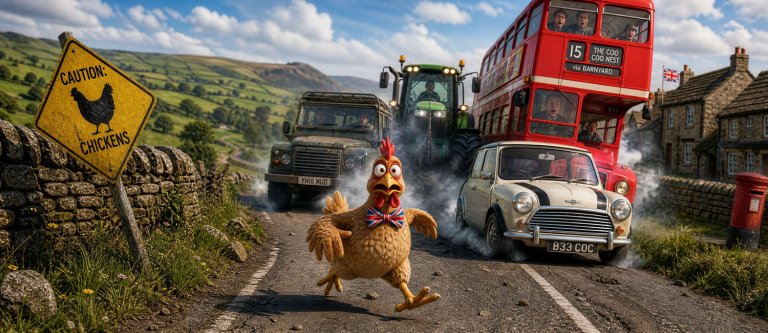

Warning: This article contains academic terminology applied to a joke about a chicken. Side effects may include mild existential confusion, an urge to re-examine your relationship with poultry, and the dawning realisation that you have been laughing at nothing for thirty years.
Introduction: The Question That Has Haunted Humanity
There are questions that define civilisation. Why are we here? What is consciousness? Is time linear? And then, sitting somewhere near the top of that pile with a look of complete indifference, is this:
“Why did the chicken cross the road?”
To get to the other side.
That’s it. That’s the whole thing. Six words of setup. Five words of punchline. And somehow, it has survived for over 170 years, been retold by every world leader, comedian, primary school teacher, and drunk uncle in recorded history, and spawned thousands of variations — none of which are as funny as the original, and the original isn’t even funny.
So what is going on? What cosmic joke is being played on us? And more importantly: why did the chicken cross the road?
Let us investigate. Properly. With far more effort than this deserves.
Part One: A Brief and Surprisingly Dignified History
The First Documented Crossing
The earliest known written appearance of the joke dates to 1847, published in The Knickerbocker, a New York monthly magazine. It appeared not as a headline act but buried in a section of miscellaneous wit under the heading “Gossip with Readers and Correspondents” — which tells you a great deal about how seriously the 19th century took it.
The original reads:
“There are ‘quips and quillets’ which seem actual conundrums, but yet are none. Of such is this: ‘Why does a chicken cross the street?’ Because it wants to get on the other side.”
Note the phrasing: “which seem actual conundrums, but yet are none.” Even in 1847, people understood immediately that this joke was breaking the rules of jokes. They just couldn’t quite explain why they were telling it anyway.
The Victorian Comedy Circuit
Nineteenth-century joke formats tended toward elaborate riddles with clever or punning punchlines — the kind of joke that rewards intelligence. “Why did the chicken cross the road?” does the opposite. It lures you in with the structure of an intelligent riddle and delivers the comedic equivalent of a shrug.
By the early 20th century it had become a fixture of vaudeville, American comedy almanacs, and schoolyard culture. By the mid-century, it was so ubiquitous that comedians were already using it as shorthand for the world’s oldest, most boring joke — which is itself a joke about the joke, meaning the meta-commentary predates the internet by about sixty years.
Part Two: The Psychological Architecture of the Joke
Why Is It Funny? (An Uncomfortable Question)
To understand this, we need to briefly dip into the three dominant theories of humour:
1. The Superiority Theory (Hobbes, 17th century): We laugh when we feel superior to something. The stumbling clown, the fool, the person who slips on a banana peel. Humour = watching someone else fail.
2. The Relief Theory (Freud, early 20th century): Laughter is a release of psychological tension. Jokes create pressure — a knot of expectation — and the punchline releases it. The relief is pleasurable. We laugh.
3. The Incongruity Theory (Kant, Schopenhauer, and basically everyone since): Humour arises when two incompatible mental frameworks collide unexpectedly. The setup pulls you in one direction; the punchline yanks you in another. The gap between expectation and reality is where comedy lives.
Now apply all three to our chicken:
Superiority? There’s nothing to feel superior to. The chicken crossed a road. Successfully. Good for it.
Relief? There’s no real tension built. The setup is a simple question. The “punchline” dissolves the question without creating any twist. There is no knot. There is no release. There is just… an answer.
Incongruity? Barely. You expect a clever twist. You get the literal answer. The incongruity is not between two clever ideas but between expecting cleverness and receiving nothing.
Which brings us to the real psychological mechanism at work here.
Anti-Humour: The Joke That Isn’t One
“Why did the chicken cross the road?” is one of the earliest and most effective examples of anti-humour in the English language.
Anti-humour is a comedic mode that deliberately subverts the expectations of joke structure. Instead of a surprising or clever punchline, it delivers something painfully obvious, deadpan, or meaningless. The joke is the absence of a joke. The comedy is in the betrayal of the contract.
When someone asks “Why did the chicken cross the road?”, your brain — having been trained by thousands of riddles to expect a pun or twist — immediately starts constructing possibilities. A pun on “other side”? A reference to something? A subversion? Your brain is doing work, and it expects to be rewarded.
“To get to the other side.”
Your brain receives nothing. Less than nothing. The answer is so obvious it almost insults the question. And your brain, faced with this bizarre cognitive anticlimax, does the only sensible thing: it laughs. Not because something is funny, but because something is wrong, and laughter is your nervous system’s way of saying “I don’t know how to process this, so I’m going to make a noise.”
Sigmund Freud would call this a failure of the pleasure economy of expectation. The setup invested cognitive energy; the punchline returned nothing. The laughter is not of joy — it is of confused disappointment, and we’ve somehow agreed as a species to call that entertainment.
The “Other Side” Double Meaning — Or Is There One?
Some analysts — yes, analysts; this is what academia sometimes does — have pointed to a second reading: “the other side” as a euphemism for death. The chicken crossed the road to get to the afterlife. It’s a death joke dressed as a children’s riddle.
This reading gained traction in the late 20th century and gives the joke an unexpectedly dark second layer. Under this interpretation, “Why did the chicken cross the road?” is an absurdist meditation on mortality — the chicken, like all of us, was simply moving toward its inevitable end.
Whether this is intentional or the result of academics having too much spare time is, as yet, undetermined. Both seem equally likely.
Part Three: The Structural and Linguistic Mechanics
The Perfect Joke Skeleton
For all its apparent emptiness, “Why did the chicken cross the road?” is technically a masterclass in joke construction. Let’s break it down:
The setup follows a classic riddle format — a question beginning with “why,” applying agency to a specific subject (the chicken), in a mundane real-world scenario (a road). It is entirely unremarkable, which is the point. It primes you to expect cleverness by wearing the clothes of a proper riddle.
The punchline does something sneaky: it is simultaneously the most literal answer possible and a complete non-answer. It resolves the question without satisfying it. “To get to the other side” explains the mechanical action while telling us absolutely nothing about why the chicken wanted to cross. The motivation remains entirely unknown. The chicken is, philosophically speaking, inexplicable.
The misdirection — and this is the engine of the joke — lies in the word “why.” In a standard riddle, “why” invites a clever or hidden reason. Here, “why” is answered with pure physical causality. It crossed the road because crossing roads results in being on the other side. It’s the logical equivalent of answering “Why did you eat the cake?” with “Because I put it in my mouth and chewed.”
Phonetics and Rhythm
The joke has nearly perfect comic rhythm. The setup (7 syllables) and punchline (6 syllables) create a near-symmetrical cadence:
Why did the CHICK-en CROSS the ROAD? — 7 syllables, three natural stresses
To GET to the OTH-er SIDE. — 6 syllables, three natural stresses
This rhythm is close to iambic, the metre of natural English speech and of Shakespeare’s verse. The joke, consciously or not, scans. It is phonetically pleasant. Your mouth enjoys saying it even when your brain is unimpressed by it.
This partly explains why it survives. It is easy to remember, satisfying to deliver, and rhythmically complete. The chicken joke is, structurally speaking, well made. It is just that what it is well made to do is produce absolutely nothing.
Part Four: The Variants — An Archaeology of Desperation
Over 170 years, the joke has accumulated variants the way a neglected coat accumulates lint. Let us examine the main categories and what they reveal about human psychology.
The Celebrity Variant
The most common mutation: replace “the chicken” with a famous person, and their answer becomes a window into their worldview.
Albert Einstein: Whether the chicken crossed the road or the road crossed the chicken depends upon your frame of reference.
Isaac Newton: Chickens at rest tend to stay at rest. Chickens in motion cross roads.
Julius Caesar: To come, to see, to conquer.
Hamlet: To cross or not to cross — that is the question.
These variants work on a straightforward comedic principle: they take the absurdity of applying intellectual frameworks to a chicken and produce a miniature parody of the person in question. They are mildly funny, endlessly repeatable, and say more about our desire to reduce famous people to catchphrases than anything else.
Note how each variant is essentially a different theory of motivation being applied to a creature that has no theory of motivation. The chicken doesn’t know it crossed the road to fulfil Newton’s First Law. The chicken crossed the road because it was a chicken, and chickens do things.
The Self-Referential Variant
At some point, comedians discovered they could put the original joke inside the answer to the original joke:
Why did the chicken cross the road? To get to the other side.
Why did the other side cross the road? To get back to the chicken.
This is recursion as comedy — an infinite loop dressed as a punchline. It resolves nothing and creates a closed system of chickens and roads from which there is no escape. Philosophers call this kind of structure an aporia. The rest of us call it “the moment the pub quiz goes off the rails.”
The Dark Variant
Why did the chicken cross the road? Because the farmer was on the other side.
Why did the chicken cross the road? It didn’t. KFC is on this side.
These variants restore the dark undertone — death is involved, as it often is with chickens in human civilisation — and reframe the whole joke as a tragedy. The chicken crossed the road toward its own demise. We were laughing at a condemned animal the whole time.
Well done, everyone.
The Postmodern Variant
Why did the chicken cross the road? Because the concept of a chicken is a social construct, and roads are merely the hegemonic infrastructure of—
This variant began in academic circles and has since colonised Twitter, where it is deployed whenever someone wishes to appear clever while expending the absolute minimum intellectual effort. It takes the anti-humour of the original and adds an additional layer of performative inaccessibility. The joke has now transcended comedy entirely and become a vehicle for mild insufferability.
This is, somehow, progress.
Part Five: What the Chicken Reveals About Us
The Joke as Cultural Mirror
A joke that survives 175 years is not surviving on comedy alone. It is doing something structural, cultural, even social. The chicken joke endures because:
It requires no context. Unlike topical humour, it is not tethered to an era. The chicken is eternal. The road is eternal. The other side is eternal.
It is universal. Roads exist in every culture. Chickens are farmed on every continent. The situation requires no translation of cultural experience. The only English-specific element is the slight ambiguity of “the other side,” and even that translates adequately in most languages.
It is a test. When you tell this joke to a child, you are teaching them the mechanics of riddles — setup, expectation, subversion. The joke is, in a very real sense, an introduction to the grammar of humour. It is comedy school for five-year-olds, which explains why adults still tell it to children and children still find it confusing in the exact same way they find most adult behaviour confusing.
It is a trap. The joke persists because people still fall for it. There will always be someone constructing an elaborate punchline in their head while the setup is being delivered. The joke is a self-replenishing prank. Every new generation encounters it fresh.
The Chicken as Existential Hero
Strip away the anti-humour mechanics, the variant analysis, and the phonetic theory, and what remains is actually rather poignant. The chicken crossed the road. It had a goal. It moved toward it. It got there.
The chicken did not overthink the road. It did not spiral into existential paralysis about what “the other side” would bring, whether the crossing was meaningful, or whether, once it arrived, it would simply want to cross back. The chicken identified an objective and pursued it with single-minded, beak-forward commitment.
In this reading, the chicken is not the butt of the joke. The chicken is the only character in the joke who knows exactly what it wants and goes and gets it.
The rest of us are still standing here asking why.
Conclusion: To Get to the Other Side
After subjecting this joke to more rigorous analysis than it has any right to receive, we can conclude the following:
The chicken crossed the road because it is a masterwork of anti-humour — a trap built from the grammar of riddles, powered by subverted expectations, and preserved by its own rhythmic simplicity. It is a small philosophical puzzle about motivation and causality. It is possibly a death joke. It is definitely a joke about jokes. And it is, at its structural core, a remarkably well-constructed nothing that has outlasted virtually every piece of comedy from its era.
It is the cockroach of jokes. Everything around it has died. The chicken endures.
Why?
To get to the other side, obviously.
References
Attardo, S. and Raskin, V. (1991) ‘Script theory revis(it)ed: Joke similarity and joke representation model’, Humor: International Journal of Humor Research, 4(3–4), pp. 293–347.
Freud, S. (1905) Der Witz und seine Beziehung zum Unbewußten. Leipzig and Vienna: Franz Deuticke. [Trans. Strachey, J. (1960) Jokes and Their Relation to the Unconscious. London: Routledge & Kegan Paul. The Standard Edition of the Complete Psychological Works of Sigmund Freud, Vol. VIII.]
Giddins, G. (2001) Commentary in Burns, K. (dir.) Jazz. PBS Documentary Series. Washington, D.C.: Public Broadcasting Service.
Hobbes, T. (1640) The Elements of Law, Natural and Politic. [Published 1650.] Ch. 9, §13.
Hobbes, T. (1651) Leviathan, or The Matter, Forme, and Power of a Common-wealth Ecclesiasticall and Civill. London: Andrew Crooke. Pt. I, Ch. 6.
Kant, I. (1790) Kritik der Urteilskraft. Berlin: Lagarde. [Trans. Meredith, J.C. (1952) The Critique of Judgement. Oxford: Clarendon Press.] §54, p. 199.
The Knickerbocker, or New-York Monthly Magazine (1847) ‘Gossip with Readers and Correspondents’, Vol. 29, March, p. 283. New York.
Morreall, J. (2009) Comic Relief: A Comprehensive Philosophy of Humor. Oxford: Wiley-Blackwell.
Morreall, J. (ed.) (1987) The Philosophy of Laughter and Humor. Albany: State University of New York Press.
Raskin, V. (1985) Semantic Mechanisms of Humor. Synthese Language Library, Vol. 24. Dordrecht: D. Reidel / Springer.
Schopenhauer, A. (1818) Die Welt als Wille und Vorstellung. Leipzig: F.A. Brockhaus. [Trans. Haldane, R.B. and Kemp, J. (1883) The World as Will and Idea, 6th edn. London: Routledge & Kegan Paul.] Vol. 1, pp. 76–77; Vol. 2, p. 271.
San Francisco Bulletin (1872) Supplement, 8 June, p. 2.
Enjoyed this entirely unnecessary investigation? Share it with someone who definitely needed 2,500 words about a chicken today.
