Posts

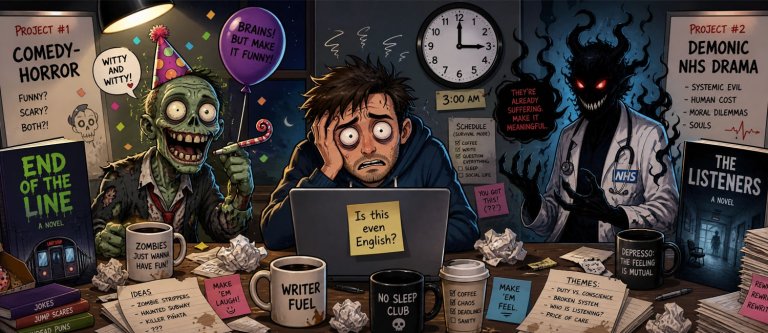
I have two novels on the go. This is either an admirable display of creative ambition or a spectacular failure of self-knowledge, and I’m honestly not sure which. One of them — End of the Line, a comedy-horror — currently sits at just over 25,000 words, which sounds impressive until you remember that a finished novel is typically around 80,000, and that the words I have are almost certainly not the words that will end up on the page. The other — The Listeners, a psychological, paranormal, demonic drama set in an NHS teaching hospital — is at a rather more modest 5,700, and is currently staring at me from my laptop screen with the quiet menace of something that knows it’s not done yet.

I say all of this not to brag — there is nothing to brag about here — but to establish that I have enough experience of the novel-writing process to tell you, with some confidence, that it is nothing like what people imagine it to be. Not even close.


What People Think It Is

There is a persistent and deeply romantic image of the novelist: sat in some atmospheric study, perhaps at a mahogany desk, perhaps near a window overlooking rolling hills, some excellent coffee steaming gently to one side, the words flowing out of them like water from a tap that someone has left running. The novelist in this image is channelling. They are visited by a muse. The story arrives, and they simply transcribe it.

I want to be very clear about this image: it is a lie. Not a gentle exaggeration or a slight simplification, but a thorough, comprehensive, structurally unsound lie, built on no evidence whatsoever and maintained entirely by the publishing industry’s reluctance to put “actually this nearly destroyed me” on the back cover. Stephen King — a man who has written more novels than most people have read — put it more bluntly than I can: “Amateurs sit and wait for inspiration, the rest of us just get up and go to work.” (On Writing, 2000). There is no muse. There is only the chair, and the screen, and the next sentence.

The reality — at least in my experience, and in the experience of most writers I’ve read about or listened to talk honestly about their work — is considerably less cinematic. The reality involves staring at a sentence you wrote last Tuesday and genuinely not knowing whether it’s the best thing you’ve ever produced or an embarrassment to the English language. Often, it is both. Sometimes it is neither. The real problem is that you can’t always tell the difference. Elmore Leonard’s advice — “I try to leave out the parts that people skip” (Elmore Leonard’s 10 Rules of Writing, 2007) — is, in principle, excellent. In practice, it requires you to know which parts those are, and that is precisely the judgment that deserts you at three in the morning when you’re re-reading chapter six for the fourth time and everything looks equally suspect.


Two Projects, Two Very Different Kinds of Torture

The thing about having two novels in progress simultaneously is that they illuminate each other in unexpected ways. Not in a useful, “this insight from one has improved the other” sense — though occasionally that happens — but in a “these two things are both making me question my own judgment and they are doing it in entirely different ways” sense.

End of the Line is, at its core, a comedy-horror. It is absurd, it is dark, it has a particular kind of energy that I find very easy to hear in my head and very difficult to sustain on the page for 80,000 words without it either becoming repetitive or losing the thread of what made it funny in the first place. The challenge with comedy-horror — and I say this with the authority of someone who has now written 25,000 words of it — is that the comedy and the horror are in constant negotiation. Too much comedy, and the threat evaporates. Too much horror, and the jokes stop landing. The whole thing is a tonal tightrope, and at 25,000 words in, I am acutely aware that I am both further than I’ve ever been and simultaneously not even halfway there.

The Listeners is a different problem entirely. Where End of the Line has voice — a very specific, recognisable voice that I can hear clearly — The Listeners has atmosphere. An NHS teaching hospital where something is very wrong, where the demonic and the bureaucratic rub uncomfortably against each other, where the paranormal intrudes on the mundanely institutional. I know what it feels like. I know what it sounds like, in the way you know what a piece of music sounds like even before you can play it. Getting that feeling into 5,700 words has been, so far, the work. Getting it into 80,000 words feels like a problem I’m not yet qualified to solve.


The Self-Doubt Is the Feature, Not the Bug

Here is something I wish someone had told me before I started writing long-form fiction: the self-doubt does not go away. You do not reach a point, somewhere around chapter three, where you think, “Yes — I’ve cracked this, I know what I’m doing,” and proceed with confidence from that point forward. Every writer I have ever heard speak honestly about the process describes some version of the same experience: the doubt remains. It shapeshifts. Early on, it asks whether the idea is good enough. In the middle, it asks whether you’ve made a catastrophic structural error that you’ll have to go back and unpick. Near the end, it asks whether the whole thing is actually the novel you set out to write, or some compromised version of it.

Hemingway is widely credited with the observation that “the first draft of anything is shit” — though the precise origin of that quote is genuinely disputed, appearing in various biographical accounts and letters without a definitive source. Dubious provenance aside, the sentiment is accurate enough to have stuck, and it’s stuck because writers recognise it immediately. Anne Lamott, whose Bird by Bird (1994) is probably the most honest book about writing that has ever been written, made essentially the same point with more generosity: “Almost all good writing begins with terrible first efforts. You need to start somewhere.” The words you have are not the words that will survive. That’s not failure. That’s the process.

What changes — or what I’m told changes, because I have not yet finished anything long enough to experience this personally — is your relationship to the doubt. You stop treating it as evidence that you should stop, and start treating it as evidence that you’re paying attention. The doubt, at its most useful, is your critical faculty staying engaged. It’s the part of you that cares whether the work is good. The problem is that this same part of you, at its least useful, will also spend forty-five minutes reading and re-reading a paragraph that is perfectly fine and interrogating it for flaws until it stops meaning anything at all. Both of these experiences feel identical from the inside. Joe Hill — who knows something about writing horror, having grown up watching his father do it — put it with characteristic economy: “Every first draft is perfect, because all a first draft has to do is exist.” (Various interviews, including Rolling Stone, 2013). It sounds like a reassurance. It might also be a survival strategy.


The Craft Question Nobody Likes to Answer

There is a conversation that writers — particularly writers who also work in other storytelling forms — eventually have to have with themselves, and it is this: what do you actually know about telling a story at novel length?

I come from a filmmaking background. I understand three-act structure. I understand scene-building, pacing, the mechanics of tension. These things are useful. They are not, it turns out, sufficient. The novel does things that film cannot, and the most important of those things is interiority — the capacity to live inside a character’s head for extended periods, to render thought and feeling and memory and perception in a way that no camera can quite capture. King again, this time from The Body (1982): “The most important things are the hardest things to say. They are the things you get ashamed of, because words diminish them.” This is, among other things, a description of why interiority is so difficult to write well — because the closer you get to what something actually feels like from inside a human consciousness, the more inadequate language starts to seem. This is also, not coincidentally, the thing that takes the longest to learn how to do without it becoming either self-indulgent or impenetrable.

End of the Line benefits from its genre in this respect: comedy-horror has a momentum to it, a plot-level drive that keeps things moving and gives the interiority somewhere to go. The Listeners demands it. A hospital drama with demonic undertones, built on psychological dread and institutional unease, lives or dies on whether the reader is inside the right heads at the right moments. Getting that wrong by thirty pages is, structurally speaking, catastrophic.

I am still working out how to get it right.


Why Do It, Then

This is the question that deserves an honest answer, and the honest answer is: because the alternative is not writing it, and not writing it is worse.

Jack London — who produced enough work in his lifetime to make the rest of us feel professionally inadequate — reportedly said: “You can’t wait for inspiration. You have to go after it with a club.” (Widely attributed; various collected letters and biographical accounts.) It’s the kind of advice that sounds aggressive until you’re actually in the middle of a novel, at which point it sounds like the most reasonable thing anyone has ever said.

There is a version of End of the Line that is funny and horrifying and exactly what I want it to be. There is a version of The Listeners that captures precisely the atmosphere I can feel but not yet fully articulate. I don’t know if I’ll write either of those versions. I might write something close to them, or something adjacent to them, or something that is a reasonable first attempt that I’ll look back on in five years and see exactly where it went wrong. That’s fine. That’s how it works.

Nobody who has ever written a novel — nobody who has got to the end, typed the last word, and closed the laptop — has done so without having the experience, somewhere in the middle of the thing, of not knowing whether they were capable of finishing it. Truman Capote, who was not known for sentimentality about the writing process, once said that finishing a book is “just like you took a child out in the back yard and shot it” (The Paris Review, 1957). I find this both deeply alarming and oddly comforting — alarming because it suggests the end is no easier than the middle, and comforting because at least it confirms there is an end. The uncertainty is not a sign that you’re doing it wrong. The uncertainty is just what it is.

Twenty-five thousand words in on one. Five thousand seven hundred on the other. Both of them waiting, with varying degrees of patience, for the next session.

I’ll get there.

Probably.


A little support goes a long way! If you’d like to help me keep creating, you can do so at https://ko-fi.com/garyjjspate

Every filmmaker gets asked the same question eventually. Sometimes it comes from a curious friend, sometimes from a nervous newcomer at a workshop, and sometimes — if you’re honest — you ask it of yourself at two in the morning when the cursor is blinking and the page is empty.

Where do the ideas come from?

The truthful answer is: everywhere. And nowhere in particular. But that’s not especially helpful, so let’s dig a little deeper.

Start With What Moves You

The most reliable source of a good idea isn’t a clever concept or a marketable premise. It’s an emotional response to something that already exists. A film you saw. A song you can’t get out of your head. A TV show you watched twenty years ago that still sits with you.


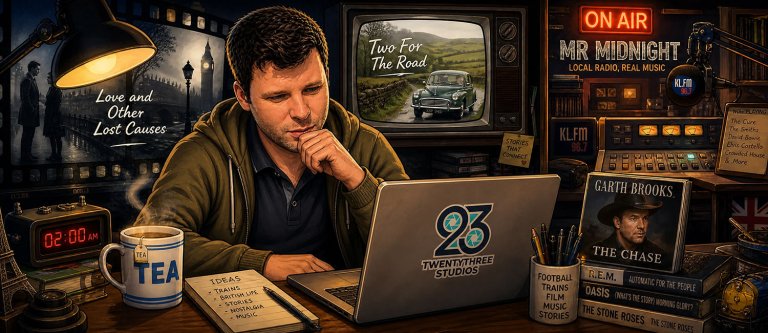
One of my own projects in development, Two For The Road, started exactly there. Growing up, I was captivated by Tim Grundy and his cameraman — known simply as The Eye — in their Discovery Home & Leisure series Two’s Country. There was something magical about their dynamic: warm, funny, genuinely informative without ever feeling like it was trying to teach you anything. Tim was one of the greatest TV and radio presenters this country ever produced, and I wanted to do something that honoured that legacy. The idea for Two For The Road was born not from a gap in the market, but from love — for a show, for a style, for a man whose work deserved a tip of the hat.

That’s as good a reason to make something as any.

Chase a Feeling, Not Just a Story

Here’s something film schools don’t always tell you: you don’t have to start with a story. Sometimes you start with a feeling — a mood, an aesthetic, an atmosphere — and build the story around it afterwards.

Love and Other Lost Causes came from exactly that. I used to run a film festival in Folkestone, and one short film I screened stopped me in my tracks. Not necessarily because of the story, but because of how it felt — the grade, the texture, the emotional temperature of it. I knew immediately that I wanted to capture something of that feeling in my own work, even if the story I told was entirely different.

The actual plot of Love and Other Lost Causes came later — a two in the morning brainstorming session, as it happens (there’s something about that particular hour that loosens the creative mind). But the seed of it was purely sensory. If a piece of work makes you feel something, ask yourself why. Then ask whether you can make something that makes someone else feel the same way.

Let Other Art Forms In

Film doesn’t exist in isolation. The best filmmakers are readers, music lovers, theatre-goers, gallery wanderers. Ideas cross borders all the time, and some of the most interesting projects begin somewhere other than a screenplay.

My project Mr Midnight began with a Garth Brooks song. If you know the track, you’ll understand immediately why it sparked something. If you don’t, I’d suggest looking it up. What I took from it wasn’t the literal narrative but the emotional world it suggested — and from there, with my own creative licence, I’ve been building a story largely set inside a small local radio station. The first draft is in progress. The song remains on the playlist.

Music, in particular, is a gift to filmmakers. A great song can hand you a tone, a character, a world, or a theme in three and a half minutes. Don’t ignore it.

Practical Tips for Finding Your Idea

If you’re stuck, here are a few starting points worth trying:

Write down five things that have genuinely moved you in the last year — films, songs, books, overheard conversations, places, memories. Don’t filter. Just list them. Then look for the thread that connects them. That thread is probably something you care about deeply, and something you care about deeply is worth making something about.

Ask yourself what you haven’t seen. Not in a commercial sense — not “what’s missing from the marketplace” — but personally. What story do you wish existed? What character do you never see represented? What place, what moment, what feeling has never quite been captured on screen in a way that felt true to you?

Don’t wait for the perfect idea. Start with the good-enough idea and let it become something better in the writing and the development. Love and Other Lost Causes was a 2am brainstorm. Mr Midnight started as a feeling about a song. Two For The Road started as gratitude. None of them arrived fully formed.

The Idea Is Just the Beginning

Finding the idea is only the first step, of course. There’s the writing, the rewriting, the pre-production, the endless logistics of actually getting something made. Two For The Road is ready to shoot — we’re just locking in the dates. Love and Other Lost Causes is written and moving into pre-production. Mr Midnight is still taking shape on the page.

Each one started somewhere different. Each one started with a feeling that refused to go away.

That’s the real test of an idea worth pursuing: not whether it sounds good in a pitch, but whether it’s still there in the morning.

UPDATE: I’ve finally seen sense and reverted back to the normal design. It was fun while it lasted.

So. The website’s gone full pirate.

Not “a small nautical flourish in the footer” pirate. Not “tasteful rope-border in the header” pirate. Full pirate. Skull and crossbones somewhere in the navigation, a colour palette that’s basically just every shade of “weathered wood” and “treasure chest,” and I’m fairly sure there’s a font in there now that I can only describe as Ransom Note’s slightly more seafaring cousin.

I’ve spent two decades building websites professionally. I know what good, restrained, on-brand design looks like. I have opinions about whitespace. And despite all of that, I sat down a few weeks ago and apparently decided that what my personal site — the one with my actual name on it, the one prospective clients might visit — really needed was to look like it was being run out of a beach hut by a man who recently lost an argument with a parrot.


The Honest Answer Is: I Don’t Fully Know

I’d love to give you a clean, sensible origin story here. Something like “it ties into a creative project” or “it’s a clever metaphor for charting your own course,” delivered with a knowing wink, the kind of thing that sounds great in a portfolio case study.

It isn’t that. I genuinely don’t have a tidy explanation. One day I was looking at the site thinking it needed a refresh, and somewhere between “needs a refresh” and “actually opening the design files,” my brain quietly filed a motion for pirates, the motion passed unopposed because nobody else was in the room to object, and that was that. There was no committee meeting. There was no mood board. There was just me, a laptop, and an alarming amount of confidence in galleon iconography.

If this is starting to sound familiar, it’s because it is — I’ve written before about how my best ideas arrive at 2am and don’t survive breakfast. This was very much one of those. Whether it was the heat — British people, as a species, are simply not built for warm weather, our internal thermostats are calibrated for “drizzle” and nothing else — or the four custard doughnuts and a Toblerone I’d apparently decided constituted a balanced evening meal, something sent me doollally enough to greenlight an entire pirate rebrand without consulting anyone, including, crucially, myself at a more sensible hour. Normally these ideas don’t make it past the morning read-back. This one, against all precedent, just… stuck.

This is, if I’m honest, a known pattern by now. 2am-Gary has form. He’s the same one who once tried to give Small Fish a secret underground tunnel system and convinced End of the Line’s zombies needed an entire chemical-spill backstory, complete with a name he’d apparently already settled on. Normally Daytime-Gary catches these at the door — reads them back over breakfast, winces, quietly deletes them, no harm done. This time Daytime-Gary just… didn’t. He looked at the pirate idea, shrugged, and let it through. I’d love to tell you why this one got past the bouncer when the tunnel system and the chemical spill didn’t. I don’t have an answer. Maybe a website doesn’t have the same structural consequences as a 24-chapter outline, so there was simply less for sensible-hours-me to object to. Maybe the doughnuts were just that good. Either way, this is, as far as I can tell, the first 2am idea to survive all the way to a full site overhaul, which feels like it should mean something, even if I can’t say what.

If you’re after deep psychological insight into why a man in his forties with a bad back and a strong professional design background has chosen this particular hill to die on, I can’t help you. I’ve asked myself the same question. The honest answer, every time, is something close to a shrug.

In My Defence (Such As It Is)

I do live on the Kent coast. There’s a sea nearby. There’s a long and genuinely storied history of smuggling, shipping and general seafaring nonsense around these parts, so it’s not a complete non-sequitur. I could, if pressed by a sufficiently patient interviewer, construct a reasonably convincing argument that this is “coastal heritage-inspired branding” rather than “bloke gets the urge to add a skull to his website and simply does not stop himself.”

But if I’m honest with you, and I try to be honest with you on this blog even when it’s mildly humiliating, the coastal heritage thing is a justification I built afterwards. It’s the kind of explanation you give a client when really the truth is “I just wanted to.”

What This Says About Me As a Designer

Probably nothing good, professionally speaking. If a client came to me and said “I’d like my entire web presence themed around 18th century maritime criminals, no particular reason,” I would, as a responsible designer, ask several follow-up questions before reaching for the cutlass clip art. I would want to understand the audience. The brand strategy. Whether this serves the user journey or simply serves my own desire to use the word “plunder” in a call-to-action button.

For myself, apparently, none of that scrutiny applies. I am both the client and the designer in this scenario, and it turns out I am an extremely easy client to please. I pitched myself one idea. I said yes immediately. There was no negotiation. I didn’t even ask myself for a deposit.

Full Site Overhaul, No Half Measures

And this isn’t a “just the homepage” situation either, for anyone hoping I’ll come to my senses on the inner pages. This is a full overhaul. Every corner of the site is getting the treatment. If you land on a contact form on my website in the near future and it doesn’t at least gesture vaguely toward “message in a bottle,” I will personally consider that a missed opportunity, and so, increasingly, will the site itself.

I’ve made my peace with the fact that some people who land on it will think “ah, coastal branding, lovely, very on-brand for a man in Kent.” And others will think “has he been at sea for several months without proper supervision.” Both reactions are valid. I am prepared to stand behind this decision with the same unwavering confidence with which I apparently made it, which is to say: very little actual reasoning, but enormous commitment.

So that’s the story, such as it is. No deep meaning. No grand rebrand strategy document. Just a man, a laptop, and an unsupervised impulse that nobody was around to talk him out of.

Oh, and yes I am aware my hand in the picture has five fingers and a thumb. You can’t expect AI to get everything right!

There is a very specific kind of confidence that only exists between the hours of midnight and roughly half past two in the morning, and I want to talk about it, because it has given me no end of grief over the years.

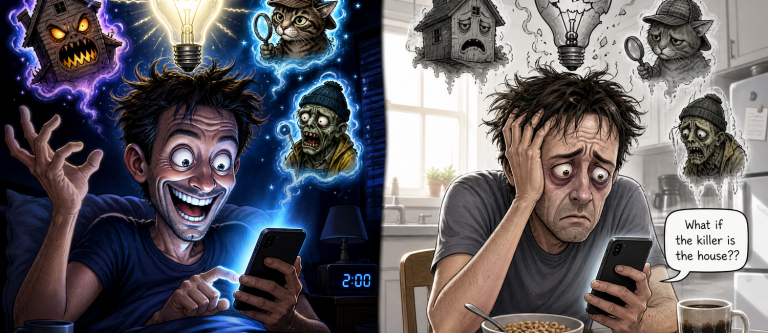
You know the one. You’re lying in bed, supposedly asleep, and your brain — having clocked off from anything useful hours ago — suddenly clears its throat and goes “right, here’s a thought.” And it’s not just a small thought. It’s a plot twist so perfectly constructed that you genuinely sit up in the dark and think: I am a genius, I’ll be fielding calls from Netflix before my toast goes cold.

I get my phone. I type it into my Notes app with the shaky urgency of a man defusing a bomb, because if I don’t capture this exact wording right now, in this exact moment, the universe will swallow it up and consign it to the annals of history. Then I go back to sleep, deeply satisfied, basically already drafting my awards speech.

Then it’s 7am, and I read it back.


The Morning Read-Back: A Crime Scene

Here is a small sample of things 2am-Gary has typed into my phone with absolute, unshakeable conviction:

“What if the killer is a poltergeist”

“Grimhaven but it’s in an alternative universe?”

“What if they push criminals through a time machine so they have to serve their punishment dodging dinosaurs?”

That last one, for the record, I stand by slightly more than the others. But the broader point remains: not one of these, read in daylight, with actual blood sugar in my system, survives contact with reality. They read less like notes from a working novelist and more like the rambling words of a madman who hasn’t slept for weeks and is living off copious amounts of caffeine.

It’s not that the ideas are always bad, exactly. It’s that 2am-Gary has access to none of the things that make an idea actually usable — things like plot logic, structural consequences, or any memory whatsoever of what happened in chapter six. 2am-Gary is a wildfire with ideas but no thought on whether any of them are actually any good.

Small Fish Has Survived Several Assassination Attempts

Small Fish — my football novel, currently twenty-four chapters planned, seven actually written, which is either a healthy work-in-progress or a crime scene depending on the day — has been “saved” by 2am ideas more times than I can count, and “saved” is doing an enormous amount of heavy lifting in that sentence.

At various points, 2am-Gary has decided that Grimhaven needed a secret underground tunnel system, that one of the central characters was secretly somebody’s long-lost brother for reasons that made perfect sense at 2am and absolutely no sense by Tuesday, and — my personal favourite — that the entire third act should be told backwards. Not flashback-backwards. Properly backwards, like Memento, except I am not Christopher Nolan, I am a man with a bad back trying to finish a novel about lower-league football, and the two things do not need to intersect.

None of these ideas made it into the actual manuscript. All of them felt, in the moment, like the missing piece I’d been searching for. This is the great cruelty of 2am: it doesn’t just generate bad ideas, it generates bad ideas that feel exactly identical to good ones, with none of the usual warning signs. There’s no flashing light. No klaxon. Just pure, false certainty, delivered straight to your nervous system at the worst possible hour for critical thinking.

End of the Line Got It Even Worse

My zombie novel, End of the Line, partly set in Grimsby because apparently even the undead have hometown pride, has weathered its own share of 2am interference. There was a stretch of about a fortnight where I was completely convinced the zombies needed an origin involving the docks, some kind of industrial chemical spill with a name I’d apparently already decided on, fully formed, like I’d seen the safety data sheet myself in a dream.

I wrote two pages of this at, predictably, gone midnight. I read it back the next morning with the specific horror of a man finding out what he did at a party he doesn’t remember attending. It wasn’t unsalvageable. It was, worse than that, almost good — good enough that I had to sit with it for an actual half hour before admitting it didn’t fit, which is far more time than a chemical-spill zombie subplot has any right to occupy in a grown man’s Tuesday.

So Why Does This Keep Happening

I’ve got a theory, which is that your brain, late at night, with all its usual inhibitions switched off, finally gets to do the thing it actually wants to do, which is be reckless. Daytime-Gary has deadlines, structural concerns, the nagging awareness that a 24-chapter outline doesn’t actually want a tunnel system shoved into chapter fifteen. 2am-Gary has none of that. 2am-Gary just wants to see what happens if the cat solves the murder.

And honestly, I don’t think the answer is to stop having the ideas. Every so often — rarely, but often enough to keep the habit alive — something genuinely good survives the morning read-back. The trick, as far as I can tell, isn’t suppressing 2am-Gary. It’s just refusing to let him anywhere near the actual manuscript without a chaperone. Write it down, by all means. Just don’t act on it until you’ve had breakfast, regained the use of your frontal lobe, and confirmed that no, the killer cannot, in fact, be the house.

Does anyone else’s brain turn into an unsupervised intern the second the lights go off? I’d love to know I’m not the only one waking up to notes I have no memory of writing and even less ability to explain. Tell me your worst 2am idea in the comments — bonus points if you also wrote it down and have since had to live with it.


Gary writes novels, mostly during the day, despite his best efforts to convince himself otherwise at 2am.