

Posts

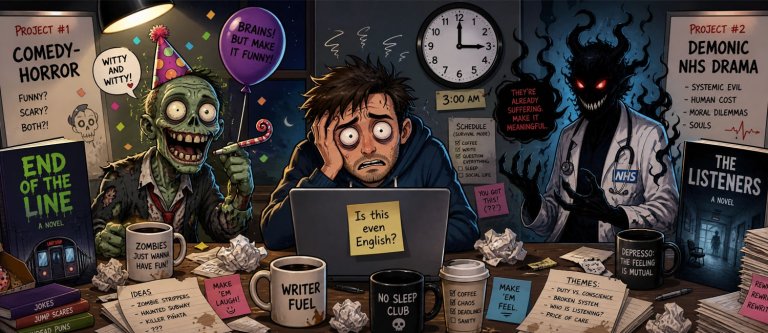
I have two novels on the go. This is either an admirable display of creative ambition or a spectacular failure of self-knowledge, and I’m honestly not sure which. One of them — End of the Line, a comedy-horror — currently sits at just over 25,000 words, which sounds impressive until you remember that a finished novel is typically around 80,000, and that the words I have are almost certainly not the words that will end up on the page. The other — The Listeners, a psychological, paranormal, demonic drama set in an NHS teaching hospital — is at a rather more modest 5,700, and is currently staring at me from my laptop screen with the quiet menace of something that knows it’s not done yet.

I say all of this not to brag — there is nothing to brag about here — but to establish that I have enough experience of the novel-writing process to tell you, with some confidence, that it is nothing like what people imagine it to be. Not even close.


What People Think It Is

There is a persistent and deeply romantic image of the novelist: sat in some atmospheric study, perhaps at a mahogany desk, perhaps near a window overlooking rolling hills, some excellent coffee steaming gently to one side, the words flowing out of them like water from a tap that someone has left running. The novelist in this image is channelling. They are visited by a muse. The story arrives, and they simply transcribe it.

I want to be very clear about this image: it is a lie. Not a gentle exaggeration or a slight simplification, but a thorough, comprehensive, structurally unsound lie, built on no evidence whatsoever and maintained entirely by the publishing industry’s reluctance to put “actually this nearly destroyed me” on the back cover. Stephen King — a man who has written more novels than most people have read — put it more bluntly than I can: “Amateurs sit and wait for inspiration, the rest of us just get up and go to work.” (On Writing, 2000). There is no muse. There is only the chair, and the screen, and the next sentence.

The reality — at least in my experience, and in the experience of most writers I’ve read about or listened to talk honestly about their work — is considerably less cinematic. The reality involves staring at a sentence you wrote last Tuesday and genuinely not knowing whether it’s the best thing you’ve ever produced or an embarrassment to the English language. Often, it is both. Sometimes it is neither. The real problem is that you can’t always tell the difference. Elmore Leonard’s advice — “I try to leave out the parts that people skip” (Elmore Leonard’s 10 Rules of Writing, 2007) — is, in principle, excellent. In practice, it requires you to know which parts those are, and that is precisely the judgment that deserts you at three in the morning when you’re re-reading chapter six for the fourth time and everything looks equally suspect.


Two Projects, Two Very Different Kinds of Torture

The thing about having two novels in progress simultaneously is that they illuminate each other in unexpected ways. Not in a useful, “this insight from one has improved the other” sense — though occasionally that happens — but in a “these two things are both making me question my own judgment and they are doing it in entirely different ways” sense.

End of the Line is, at its core, a comedy-horror. It is absurd, it is dark, it has a particular kind of energy that I find very easy to hear in my head and very difficult to sustain on the page for 80,000 words without it either becoming repetitive or losing the thread of what made it funny in the first place. The challenge with comedy-horror — and I say this with the authority of someone who has now written 25,000 words of it — is that the comedy and the horror are in constant negotiation. Too much comedy, and the threat evaporates. Too much horror, and the jokes stop landing. The whole thing is a tonal tightrope, and at 25,000 words in, I am acutely aware that I am both further than I’ve ever been and simultaneously not even halfway there.

The Listeners is a different problem entirely. Where End of the Line has voice — a very specific, recognisable voice that I can hear clearly — The Listeners has atmosphere. An NHS teaching hospital where something is very wrong, where the demonic and the bureaucratic rub uncomfortably against each other, where the paranormal intrudes on the mundanely institutional. I know what it feels like. I know what it sounds like, in the way you know what a piece of music sounds like even before you can play it. Getting that feeling into 5,700 words has been, so far, the work. Getting it into 80,000 words feels like a problem I’m not yet qualified to solve.


The Self-Doubt Is the Feature, Not the Bug

Here is something I wish someone had told me before I started writing long-form fiction: the self-doubt does not go away. You do not reach a point, somewhere around chapter three, where you think, “Yes — I’ve cracked this, I know what I’m doing,” and proceed with confidence from that point forward. Every writer I have ever heard speak honestly about the process describes some version of the same experience: the doubt remains. It shapeshifts. Early on, it asks whether the idea is good enough. In the middle, it asks whether you’ve made a catastrophic structural error that you’ll have to go back and unpick. Near the end, it asks whether the whole thing is actually the novel you set out to write, or some compromised version of it.

Hemingway is widely credited with the observation that “the first draft of anything is shit” — though the precise origin of that quote is genuinely disputed, appearing in various biographical accounts and letters without a definitive source. Dubious provenance aside, the sentiment is accurate enough to have stuck, and it’s stuck because writers recognise it immediately. Anne Lamott, whose Bird by Bird (1994) is probably the most honest book about writing that has ever been written, made essentially the same point with more generosity: “Almost all good writing begins with terrible first efforts. You need to start somewhere.” The words you have are not the words that will survive. That’s not failure. That’s the process.

What changes — or what I’m told changes, because I have not yet finished anything long enough to experience this personally — is your relationship to the doubt. You stop treating it as evidence that you should stop, and start treating it as evidence that you’re paying attention. The doubt, at its most useful, is your critical faculty staying engaged. It’s the part of you that cares whether the work is good. The problem is that this same part of you, at its least useful, will also spend forty-five minutes reading and re-reading a paragraph that is perfectly fine and interrogating it for flaws until it stops meaning anything at all. Both of these experiences feel identical from the inside. Joe Hill — who knows something about writing horror, having grown up watching his father do it — put it with characteristic economy: “Every first draft is perfect, because all a first draft has to do is exist.” (Various interviews, including Rolling Stone, 2013). It sounds like a reassurance. It might also be a survival strategy.


The Craft Question Nobody Likes to Answer

There is a conversation that writers — particularly writers who also work in other storytelling forms — eventually have to have with themselves, and it is this: what do you actually know about telling a story at novel length?

I come from a filmmaking background. I understand three-act structure. I understand scene-building, pacing, the mechanics of tension. These things are useful. They are not, it turns out, sufficient. The novel does things that film cannot, and the most important of those things is interiority — the capacity to live inside a character’s head for extended periods, to render thought and feeling and memory and perception in a way that no camera can quite capture. King again, this time from The Body (1982): “The most important things are the hardest things to say. They are the things you get ashamed of, because words diminish them.” This is, among other things, a description of why interiority is so difficult to write well — because the closer you get to what something actually feels like from inside a human consciousness, the more inadequate language starts to seem. This is also, not coincidentally, the thing that takes the longest to learn how to do without it becoming either self-indulgent or impenetrable.

End of the Line benefits from its genre in this respect: comedy-horror has a momentum to it, a plot-level drive that keeps things moving and gives the interiority somewhere to go. The Listeners demands it. A hospital drama with demonic undertones, built on psychological dread and institutional unease, lives or dies on whether the reader is inside the right heads at the right moments. Getting that wrong by thirty pages is, structurally speaking, catastrophic.

I am still working out how to get it right.


Why Do It, Then

This is the question that deserves an honest answer, and the honest answer is: because the alternative is not writing it, and not writing it is worse.

Jack London — who produced enough work in his lifetime to make the rest of us feel professionally inadequate — reportedly said: “You can’t wait for inspiration. You have to go after it with a club.” (Widely attributed; various collected letters and biographical accounts.) It’s the kind of advice that sounds aggressive until you’re actually in the middle of a novel, at which point it sounds like the most reasonable thing anyone has ever said.

There is a version of End of the Line that is funny and horrifying and exactly what I want it to be. There is a version of The Listeners that captures precisely the atmosphere I can feel but not yet fully articulate. I don’t know if I’ll write either of those versions. I might write something close to them, or something adjacent to them, or something that is a reasonable first attempt that I’ll look back on in five years and see exactly where it went wrong. That’s fine. That’s how it works.

Nobody who has ever written a novel — nobody who has got to the end, typed the last word, and closed the laptop — has done so without having the experience, somewhere in the middle of the thing, of not knowing whether they were capable of finishing it. Truman Capote, who was not known for sentimentality about the writing process, once said that finishing a book is “just like you took a child out in the back yard and shot it” (The Paris Review, 1957). I find this both deeply alarming and oddly comforting — alarming because it suggests the end is no easier than the middle, and comforting because at least it confirms there is an end. The uncertainty is not a sign that you’re doing it wrong. The uncertainty is just what it is.

Twenty-five thousand words in on one. Five thousand seven hundred on the other. Both of them waiting, with varying degrees of patience, for the next session.

I’ll get there.

Probably.


A little support goes a long way! If you’d like to help me keep creating, you can do so at https://ko-fi.com/garyjjspate

I live in Dover. Have done for a few years now, after nine years in Folkestone before that. Sadie’s here, Reggie the three-legged cat is here, work’s here, half of my adult life is built on this particular stretch of coastline. And yet if you read enough of what I write — the screenplays, the novels — you’d be forgiven for thinking I’d never actually left Grimsby. Or possibly that I’d quietly relocated to Pontypridd without telling anyone, including myself.

Neither is true. I’ve lived in Kent for thirteen years. I’ve spent a grand total of two weeks in Wales, ever. And yet my imagination appears to have filed a permanent change-of-address form with both places without consulting me first.

I find this mildly ridiculous, so naturally I’m writing a blog post about it.


Grimsby: Explainable, At Least

Let’s deal with the sensible one first. A novel called Small Fish, set in a fictionalised version of the town I called Grimhaven, twenty-four chapters deep, seven of them actually written, which for a writer is basically a personal best. A chunk of my zombie novel, End of the Line, is set in Grimsby too, because apparently even the apocalypse has to start somewhere familiar. Ideas that keep wandering back up the A180 whether I’ve invited them to or not.

This one I can explain. I grew up there. The better part of thirty years, give or take, versus just over a decade in Kent — so when my hands go back to Grimsby on the page, that’s not nostalgia, that’s just basic arithmetic. Kent is where I live. Grimsby is apparently where my subconscious still has a season ticket.

Small Fish became Grimhaven rather than literal Grimsby, mostly because I wasn’t trying to write a documentary about a real place that’s continued existing without my permission since I left it. I wanted the feeling of the place — the grit, the football, the very specific grey of a sky over the docks — without having to be accurate about, say, whether a particular chip shop is still open. (It’s probably not. They never are.) End of the Line, on the other hand, just goes ahead and uses the real place, possibly on the basis that if the dead are going to rise anywhere, it might as well be somewhere I know the geography of well enough to write a decent chase scene.

So: Grimsby makes sense. Moving on.

Wales: Does Not Make Sense, At All

Here’s the bit where I lose the plot slightly, so bear with me.

I’ve been to Wales twice in my entire life. A week each time — once in 1992, when I was a child and had approximately zero say in the itinerary, and again in 2025, as a fully grown adult who really should know better by now. Of that second trip, exactly one hour was spent in Pontypridd, the town where my grandmother was born. One hour. I’ve spent longer than that queuing for a gig.

And somehow, that one hour appears to have rewired something. Not the two weeks of general, perfectly pleasant Welsh holidaying. Not the scenery, not the castles, or the Blaenau Festiniog Light Railway, not whatever I had for lunch on either trip, which I genuinely cannot recall. Just the hour. In Pontypridd. Specifically.

I have no rational explanation for this, and I want to be clear that I’ve tried. My grandmother was from there, which is the only actual evidence I’ve got, and on paper it’s not much to build an entire emotional attachment on. People meet their actual living relatives for longer than an hour and feel less moved by it. I’m half convinced my own ancestors are mildly embarrassed on my behalf — “he was here for sixty minutes and now he wants to retire here, bless him.”

Because that’s the other thing. Sadie has mentioned, more than once, that when we eventually retire, Wales might be the answer. And the genuinely baffling part is that I don’t immediately laugh this off. Some small, currently unsupervised part of my brain goes “yeah, alright then,” based entirely on an hour I spent there once, in a town I couldn’t confidently find again without a satnav.

I have, if I’m honest, more feeling toward Wales as a concept than I have toward England, despite having lived in England my entire life and visited Wales for a combined total of roughly two weeks. This is not a sensible ratio. I am aware it is not a sensible ratio. I have made my peace with the fact that my sense of belonging apparently does not consult a spreadsheet before making decisions.

So What’s Actually Going On Here

I think — and this is very much a working theory, subject to change without notice — that creative work, and maybe identity generally, doesn’t care all that much about how long you’ve spent somewhere. It cares about whatever’s load-bearing. Kent is where my actual life happens: the bills, the cat, the theatre, the back pain, the whole functioning-adult operation. Grimsby is the thirty-year foundation underneath it, fully explicable, no mystery required. And Wales is just… in there. Uninvited. Unexplained. Possibly ancestral, possibly just a really good hour, possibly both.

I’ve stopped trying to force a tidy answer out of the Wales thing, mostly because I don’t think there is one, and partly because demanding logic from your own feelings is a famously losing battle. Some places just get under your skin regardless of how much actual time you’ve clocked there, like a song you’ve heard once and now can’t stop humming, except the song is a Welsh valley town and the humming is a vague but persistent desire to live there one day.

So if you ever read something of mine set in a windswept fictional fishing town, you’ll know where that’s from. And if, decades from now, you hear I’ve retired to a small house somewhere near Pontypridd having visited the place for a cumulative total of sixty minutes, please don’t act surprised. Some of us were always going to end up exactly where we couldn’t logically explain.

Does anyone else feel inexplicably tied to somewhere they’ve barely been? Or is it just me, romanticising a single hour like it owes me a mortgage? Let me know in the comments — I could use the company.


If you enjoy what I do, consider supporting me! Every little bit means the world!

Gary grew up in Grimsby, lives in Dover, Kent, and has a worrying amount of feelings about a Welsh town he’s visited once, for sixty minutes.

There is a very specific kind of confidence that only exists between the hours of midnight and roughly half past two in the morning, and I want to talk about it, because it has given me no end of grief over the years.

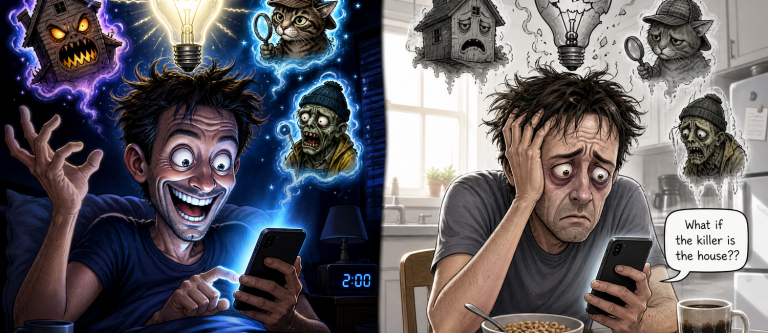
You know the one. You’re lying in bed, supposedly asleep, and your brain — having clocked off from anything useful hours ago — suddenly clears its throat and goes “right, here’s a thought.” And it’s not just a small thought. It’s a plot twist so perfectly constructed that you genuinely sit up in the dark and think: I am a genius, I’ll be fielding calls from Netflix before my toast goes cold.

I get my phone. I type it into my Notes app with the shaky urgency of a man defusing a bomb, because if I don’t capture this exact wording right now, in this exact moment, the universe will swallow it up and consign it to the annals of history. Then I go back to sleep, deeply satisfied, basically already drafting my awards speech.

Then it’s 7am, and I read it back.


The Morning Read-Back: A Crime Scene

Here is a small sample of things 2am-Gary has typed into my phone with absolute, unshakeable conviction:

“What if the killer is a poltergeist”

“Grimhaven but it’s in an alternative universe?”

“What if they push criminals through a time machine so they have to serve their punishment dodging dinosaurs?”

That last one, for the record, I stand by slightly more than the others. But the broader point remains: not one of these, read in daylight, with actual blood sugar in my system, survives contact with reality. They read less like notes from a working novelist and more like the rambling words of a madman who hasn’t slept for weeks and is living off copious amounts of caffeine.

It’s not that the ideas are always bad, exactly. It’s that 2am-Gary has access to none of the things that make an idea actually usable — things like plot logic, structural consequences, or any memory whatsoever of what happened in chapter six. 2am-Gary is a wildfire with ideas but no thought on whether any of them are actually any good.

Small Fish Has Survived Several Assassination Attempts

Small Fish — my football novel, currently twenty-four chapters planned, seven actually written, which is either a healthy work-in-progress or a crime scene depending on the day — has been “saved” by 2am ideas more times than I can count, and “saved” is doing an enormous amount of heavy lifting in that sentence.

At various points, 2am-Gary has decided that Grimhaven needed a secret underground tunnel system, that one of the central characters was secretly somebody’s long-lost brother for reasons that made perfect sense at 2am and absolutely no sense by Tuesday, and — my personal favourite — that the entire third act should be told backwards. Not flashback-backwards. Properly backwards, like Memento, except I am not Christopher Nolan, I am a man with a bad back trying to finish a novel about lower-league football, and the two things do not need to intersect.

None of these ideas made it into the actual manuscript. All of them felt, in the moment, like the missing piece I’d been searching for. This is the great cruelty of 2am: it doesn’t just generate bad ideas, it generates bad ideas that feel exactly identical to good ones, with none of the usual warning signs. There’s no flashing light. No klaxon. Just pure, false certainty, delivered straight to your nervous system at the worst possible hour for critical thinking.

End of the Line Got It Even Worse

My zombie novel, End of the Line, partly set in Grimsby because apparently even the undead have hometown pride, has weathered its own share of 2am interference. There was a stretch of about a fortnight where I was completely convinced the zombies needed an origin involving the docks, some kind of industrial chemical spill with a name I’d apparently already decided on, fully formed, like I’d seen the safety data sheet myself in a dream.

I wrote two pages of this at, predictably, gone midnight. I read it back the next morning with the specific horror of a man finding out what he did at a party he doesn’t remember attending. It wasn’t unsalvageable. It was, worse than that, almost good — good enough that I had to sit with it for an actual half hour before admitting it didn’t fit, which is far more time than a chemical-spill zombie subplot has any right to occupy in a grown man’s Tuesday.

So Why Does This Keep Happening

I’ve got a theory, which is that your brain, late at night, with all its usual inhibitions switched off, finally gets to do the thing it actually wants to do, which is be reckless. Daytime-Gary has deadlines, structural concerns, the nagging awareness that a 24-chapter outline doesn’t actually want a tunnel system shoved into chapter fifteen. 2am-Gary has none of that. 2am-Gary just wants to see what happens if the cat solves the murder.

And honestly, I don’t think the answer is to stop having the ideas. Every so often — rarely, but often enough to keep the habit alive — something genuinely good survives the morning read-back. The trick, as far as I can tell, isn’t suppressing 2am-Gary. It’s just refusing to let him anywhere near the actual manuscript without a chaperone. Write it down, by all means. Just don’t act on it until you’ve had breakfast, regained the use of your frontal lobe, and confirmed that no, the killer cannot, in fact, be the house.

Does anyone else’s brain turn into an unsupervised intern the second the lights go off? I’d love to know I’m not the only one waking up to notes I have no memory of writing and even less ability to explain. Tell me your worst 2am idea in the comments — bonus points if you also wrote it down and have since had to live with it.


Gary writes novels, mostly during the day, despite his best efforts to convince himself otherwise at 2am.