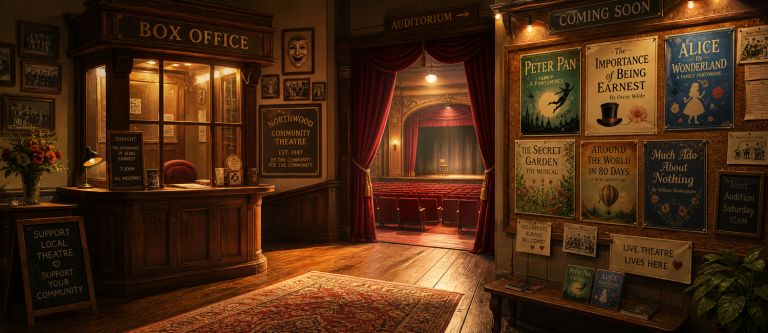



Let me set the scene.
It’s a Friday or Saturday night — we don’t tend to put shows on midweek unless it’s panto season, when all bets and all weeknights are off. The house lights are about to go down, the cast are pacing backstage doing whatever it is actors do to summon the nerve to go on, and I’m standing in the foyer of the Tower Theatre doing the maths I try not to do too often. Tonight’s audience versus tonight’s costs. It’s not always a flattering equation.
If you work in theatre anywhere in the South East right now, you’ll know the feeling. Slower ticket sales. Shows pulled or rescheduled because the numbers simply don’t add up. Patrons who’d normally book without thinking twice now waiting until the last minute, watching their bank balance before they watch the curtain rise. It’s not dramatic in the way theatre is supposed to be dramatic. It’s just quietly, persistently harder than it used to be.
So is this it, then? Is the great British tradition of people putting on costumes in draughty halls and convincing other people to watch them finally winding down, defeated by energy bills and the price of a pint?
No. But we do need to have an honest conversation about why it feels that way, and what we can actually do about it.
The Bit Where I Show You Some Numbers (Don’t Worry, It’s Quick)
Here’s the genuinely strange thing about the current state of UK theatre nationally: more people are going than ever before. Over 37 million people attended theatres across the UK in 2025, with the West End alone welcoming a record-breaking 17.64 million theatregoers. Nationally, audiences aren’t the problem.
But here in the South East, that’s not quite the story on the ground — at least not this year. It’s worth being precise about that: the full-year national statistics are largely looking backwards, and don’t yet capture what’s actually happening right now. This year specifically, many of us have watched ticket sales slow noticeably, and more than a few shows across the region have had to be cancelled or rescheduled simply because the numbers didn’t stack up. The national picture and the local, current picture aren’t telling quite the same story, which makes it harder, not easier, to know what’s actually going on.
What both pictures agree on is the cost side. Production budgets have climbed steadily as labour, materials, energy, and building maintenance costs have increased, while theatres have largely held ticket prices steady to protect access. Translation: venues are eating the cost increases themselves rather than passing them on, which is admirable and also financially unsustainable in roughly equal measure. More than a third of theatres are forecasting an operating deficit this year, rising past half in the subsidised sector.
And that’s before you get to the funding picture, which is its own special kind of bleak. Public funding for arts and culture has dropped significantly per capita since 2010, with local authority contributions falling by as much as 48 per cent. Closer to home, the Astor Theatre in Deal — a proper community venue, not unlike ours — went public last year about a £20,000 shortfall, citing rising energy and supply costs squeezing them from every direction.
So nationally it’s “theatre has got harder and more expensive to make, just as people have less spare cash.” Here in the South East, we’re living that and watching the ticket sales dip on top of it. Two trends heading straight at each other like a particularly slow-motion car crash, with venues like ours caught in the middle, holding a clipboard and a slightly too-optimistic box office target.
What This Actually Looks Like From Where I’m Standing
The data is useful, but I work front of house, not in a spreadsheet, so let me tell you what it actually feels like.
This year so far we’ve put on Noises Off, Patio/Porch, and Dare to Dream Jr, with Two, Gypsy, Frankenstein and My Fair Lady still to come — My Fair Lady opens next Thursday. A real spread already, from farce to youth theatre to intimate drama, with a two-hander, a full-blown musical, and gothic horror still ahead of us — exactly the kind of varied programming a venue like ours should be proud of. And yet it’s been a noticeably harder year to fill seats than it has been in the past, with more of that variety still to sell. It’s the conversation with a regular who loves the show, genuinely does, but is now choosing between this and something else this month because they can’t do both. It’s watching a show that should sell out limp along at sixty per cent because people are booking later and later, holding out to see if anything more pressing comes up first. It’s the slightly sick feeling of having to have the “do we cancel or do we run it at a loss” conversation, which is a conversation nobody goes into theatre management hoping to have.
Panto is, as ever, the exception that proves the rule. Last year’s Jack and the Beanstalk did exactly what panto always does — packed the house, weeknights included, because pantomime occupies a strange and wonderful place in people’s budgets that other theatre doesn’t quite reach. This Christmas we’re bringing you Dick Whittington, and if history is anything to go by, it’ll once again be the one production of the year where the cost-of-living conversation politely steps aside for an hour and a half so everyone can boo the villain in peace. There’s probably a lesson in that, even if I haven’t fully worked out what it is yet.
None of this is anyone’s fault. Nobody’s villain here. People aren’t choosing not to come to the theatre because they’ve stopped caring about it — they’re choosing not to come because the heating bill won. That’s not a value judgement on theatre. That’s just maths, and maths doesn’t care how good your set design is.
So Can We Buck the Trend?
Yes. I genuinely believe that, and not in a forced “stay positive!” way that ignores the reality of the situation — more in a “we’ve actually got more tools than we think” way. Here’s where I think the fight gets won.
Make the price barrier softer, not lower. Slashing ticket prices isn’t sustainable when costs have gone the other way, but flexible pricing is genuinely effective. Pay-what-you-can performances, even just one per run, signal that you’re not trying to extract maximum value from people who don’t have it. Schemes like this have already shown that audiences from less affluent backgrounds, who are markedly less likely to attend otherwise, will come when the financial barrier is genuinely removed rather than just nudged.
Lean harder into community, because that’s the one thing the multiplex can’t compete with. A cinema chain cannot offer you the feeling of watching your neighbour’s kid nail their first ever solo line on stage. Community and amateur theatre has something the West End, for all its budget, doesn’t: people watching people they actually know. That’s not a consolation prize. That’s the entire point, and we undersell it constantly.
Marketing matters more than ever, and it’s relentless work. This isn’t a knock on anyone — marketing a theatre programme well is genuinely hard, thankless, never-finished work, and the people doing it across this industry deserve far more credit than they get. Audiences need to be told a show exists, repeatedly, in places they actually look, which means constant social media, local press, partnerships with other community groups — none of it flashy, all of it essential. I’ve huge respect for anyone holding that particular plate spinning, ours included.
And the best marketing isn’t ours to do at all. No poster, post, or press release beats a friend turning to you and saying “you have to see this.” Word of mouth is still the single most powerful tool in theatre’s box, and it doesn’t cost a venue a penny — it just needs patrons to actually use it. If you saw something you loved, tell someone. Tag the theatre, leave a review, mention it to a colleague over coffee, drag a reluctant partner along next time. Audiences have more power to keep their local theatre alive than most of them realise, and it costs nothing but a sentence.
Diversify what “coming to the theatre” means. Talks, workshops, youth productions, am-dram showcases, even just the bar being a nice place to sit on a Friday — every reason someone walks through the door that isn’t strictly “buy a ticket to a play” builds the habit of choosing you. Habit is worth more than any single sale.
Be honest with your audience about the squeeze. People are remarkably understanding when you tell them the truth. “We need your support to keep doing this” lands better than silence followed by sudden closure. The Astor Theatre’s crowdfunder worked, in part, because they said the quiet part out loud instead of pretending everything was fine until it very publicly wasn’t.
The Show Goes On (Probably With a Slightly Smaller Budget)
I don’t think we’re watching the end of theatre. I think we’re watching theatre get squeezed into proving, all over again, why it matters — and honestly, slightly annoyingly, I think it’ll manage it. It always has. Theatre has survived plagues, world wars, the invention of the television, and at least one period where everyone thought immersive Shakespeare in a car park was a good idea. It’ll survive this too.
But survival isn’t automatic, and it isn’t somebody else’s job. It’s box office numbers and bar takings and that one person who tells two friends about a show they loved. It’s every front of house manager doing slightly anxious maths in a foyer on a Friday, hoping the room fills up.
So if you’ve got a local theatre — and in Kent, you almost certainly have several rather good ones — go. Book the ticket. And don’t just think of it as plays, either. A venue like the Tower isn’t only Two and Gypsy and Frankenstein; it’s tribute acts that’ll have you up dancing, comedy nights that’ll have you in stitches, kids’ shows that’ll make a Saturday morning magic for someone small, and panto that’ll have the whole family booing a villain together. There is very likely something on at your local theatre this month that’s exactly what you fancy, whatever mood you’re in.
So go. Book the ticket, whatever it’s for. Bring someone who’s never been. Buy the interval ice cream even though it’s mysteriously the same price as a small car. Tell someone about it afterwards. It genuinely, actually helps more than you’d think — and it’s the difference between a theatre that survives this and one that quietly doesn’t.
What’s your local theatre, and what’s keeping you coming back — or keeping you away? I’d love to hear it in the comments.
*Gary is the Front of House Manager at the Tower Theatre in Folkestone, and has the spreadsheets to prove it.*