
Posts

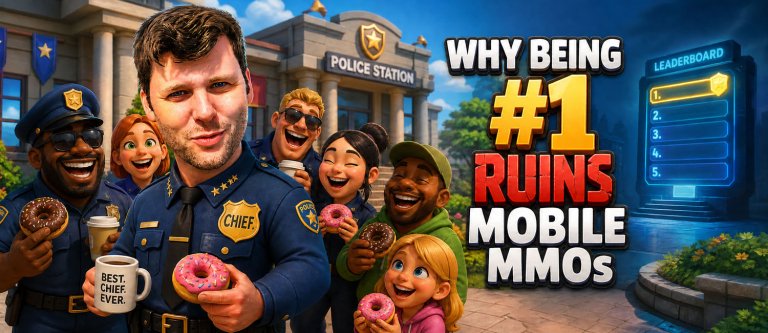
I don’t need to be number one at anything, least of all a mobile MMO. I’m quite happy pottering along at my own pace, chatting away in the alliance chat, helping people out, being helped out in return. That’s the actual game, as far as I’m concerned. The leaderboard is just wallpaper.

Not everyone sees it that way. And that’s the problem.


There’s Always Someone Chasing The Top Spot

Every mobile MMO has one. Doesn’t matter if it’s a city builder, a survival game, a kingdom sim — the State of Survivals, Evonys and Rise of Kingdoms of this world all run on the same instinct. There’s always that person, sometimes several, who’s decided the entire point of the exercise is to be ranked first. Not to enjoy the building, the strategy, the daft little community that forms around an app you downloaded on a whim. Just to be top.

On its own, fair enough. Chase what you like. The trouble is that in an MMO, nothing you do happens in isolation. Someone else’s obsession with rank one becomes everyone else’s problem, whether they signed up for it or not.

The Camaraderie Is The Actual Point

The bit that keeps me coming back to these games isn’t the grind, it’s the people. There’s something genuinely nice about a group of strangers coordinating, covering for each other, having a laugh in the group chat about something utterly trivial that happened in a game about pretend policing or farming or whatever the premise happens to be that week.

That camaraderie is fragile, though. It only survives if everyone’s playing roughly the same game — the relaxed, sociable one. The moment someone decides they’re playing the competitive, must-be-first version instead, the tone shifts. Suddenly there’s pressure. Suddenly casual players who were having a nice time feel like they’re dragging the alliance down. Suddenly it’s not a hobby, it’s an obligation.

You see the same pattern whether it’s a farming sim, a tycoon game, or one of the endless “build your empire” titles that seem to be advertised on every video on the internet. The genre doesn’t matter. The leaderboard does the same job every time. I’m currently playing one myself — Police Chief, a mobile MMO about building up a station and cracking down on cartoon crime — and even in the early hours you can already spot who’s playing for the community and who’s playing for the rank.

What The Leaderboard Chase Actually Costs

Here’s what I’ve watched happen, more than once, across more than one of these games:

  • The person chasing rank one starts spending real money to keep pace, and quietly expects everyone else to match the energy.
  • Alliance chat stops being banter and starts being logistics — assignments, quotas, “why hasn’t everyone donated today.”
  • Newer or slower players get made to feel like deadweight for daring to play at a normal pace.
  • The relaxed players — the ones who made the game fun in the first place — start drifting off, because who wants a second job.
  • The chaser eventually gets near the top, or close to it, and the alliance they’ve hollowed out to get there isn’t much fun for anyone anymore, including them.

That last one’s the real sting. The chase doesn’t just spoil it for the people happy to play casually. It tends to spoil it for the chaser too, eventually. Number one is a lonely, high-maintenance spot to defend, and it turns out a leaderboard position doesn’t do banter back.

You’re Allowed To Just Play The Game

If you’re the sort who enjoys an MMO the way I do — logging on, doing your bit, having a laugh with the alliance, not losing any sleep over rank — you’re not doing it wrong. You’re doing it exactly right. These games were designed to be enjoyed at a normal human pace by normal human people with normal human amounts of money and free time.

The number one spot is designed to be unattainable for most players, precisely so a small number of them will spend a large amount of money trying anyway. That’s not a design flaw. That’s the business model. You’re not missing out by declining to take part in it.

So if you’re in an alliance with someone quietly turning the whole thing into an unpaid full-time job, it’s worth saying so. Not everyone’s playing for the crown. Some of us are just here for the company.

I’ll keep pottering along with Police Chief, keep chatting away in the alliance, and keep letting the leaderboard do whatever it wants without me. No crown, no stress, no quotas — just a decent bit of pretend policing and a group chat worth logging in for. That’s a win in my book, even if the game doesn’t have a badge for it.

Spare time is a funny thing. The older I get, the more it resembles a cryptid — something people claim exists, but that I rarely see for myself. Between work, life, and the thousand small obligations that seem to multiply when you’re not looking, genuinely free time has become the rarest of luxuries.

Which makes it all the more important that when I do get some, I spend it badly.

By “badly,” I mean glued to a screen with a cup of tea going cold beside me, utterly absorbed in something that serves no practical purpose whatsoever. And I wouldn’t have it any other way.

The PC/Mac Rabbit Holes

My go-to games on the computer tend to fall into a particular category: the kind where you sit down at nine in the evening fully intending to have a quick go, and then look up to find it’s two in the morning and you’ve achieved something either magnificent or completely inexplicable.

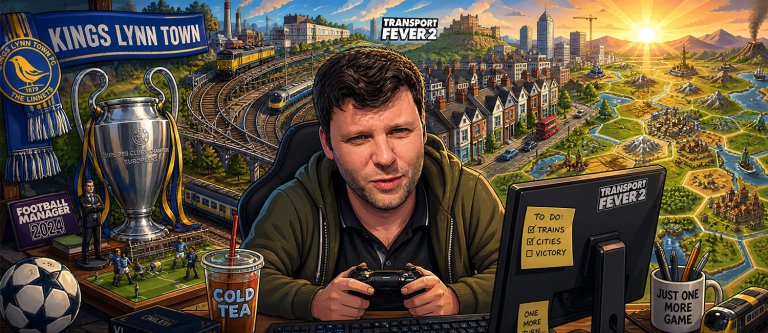
The Football Manager franchise has been my longest-running obsession, and my proudest achievement in it belongs to a save in FM24: I took Kings Lynn Town — yes, that Kings Lynn Town — and after fifteen years of grinding through the non-leagues, clawing up through the divisions, and surviving the kind of managerial pressure that would break lesser virtual men, I led them to Champions League glory. Fifteen years. European champions. I’d love to say it felt surreal, but honestly it felt earned.

(We never did win the Premier League. That one still stings.)

In FM26 I’ve taken a different path entirely — I’m currently managing Huddinge IF in the Swedish second tier, having earned promotion after two seasons. Less glamorous than Wembley, perhaps, but there’s something deeply satisfying about building something from scratch in a league where nobody’s expecting anything from you.

Transport Fever 2 is where my inner civil engineer goes to live his best life. I have a map that has grown over time into something that can only be described as organised chaos. The rail network in particular is a magnificent, sprawling spaghetti of tracks and junctions and overlapping lines that somehow — somehow — continues to function. Every time I add a new route I half-expect the whole thing to collapse. It never does. I take this as a sign that I’m either a genius or just very lucky.

Cities: Skylines has become something of an artistic exercise. I’m building a British city — and I mean properly British — row after row of terraced houses, each one individually placed. There are thousands of them. Actual thousands. Why would I do this to myself? Because it looks right, that’s why. Because when you zoom out and you see those long, slightly cramped Victorian streets stretching off into the distance, it looks like somewhere that could genuinely exist. It looks like home. Worth every obsessive hour.

And then there’s Civilisation. Just one more turn, you tell yourself. Just one more. It’s such a small, reasonable thing to ask. One more turn to finish that wonder. One more to see off the Aztecs. One more to find out what’s on the other side of that mountain range. But the turns keep coming, and the night keeps deepening, and somewhere around the Industrial Age you realise that the birds have started singing outside and a grey dawn is bleeding through the curtains and you are still — still — not done. Time doesn’t pass when you’re playing Civilisation. It dissolves. I have lost whole nights to it without a moment’s regret, blinking back into reality somewhere around sunrise, bleary and vaguely triumphant. It is, without question, the most dangerous game ever made.

On the PS5

My console time is split between two very different worlds. F1 scratches the racing itch — there’s something deeply satisfying about the precision of it, the incremental improvements, the perfect lap that somehow comes together.

But the game that genuinely got under my skin — especially during lockdown — is Life Is Strange. I stumbled into the franchise during those strange, suspended months when the world was standing still, and I fell completely into it. The story of Max Caulfield and Chloe Price hit me harder than I expected. It’s the kind of game that asks you to sit with your choices, that makes consequences feel real, that has actual emotional weight. For something that technically involves a teenager rewinding time, it manages to be remarkably human.

I’ve played through the franchise since, and while Max and Chloe remain the heart of it for me, every chapter in the series has something to say about loneliness and connection and the weight of small decisions. Not bad for a video game.

Why It Matters

I know some people see gaming as a waste of time. I understand the argument, even if I disagree with it. There’s something about a well-made game — the kind that pulls you in and gives you a world to inhabit, problems to solve, stories to follow — that feels genuinely restorative to me. It’s creative engagement dressed up as entertainment.

Besides, Kings Lynn Town are European champions. If that’s a waste of time, I’ll take it.

So tell me — what are you playing right now? Are you a fellow victim of Civilisation’s “just one more turn” curse, or do you have your own Kings Lynn Town story waiting to be written? Drop a comment below and let me know. And if you’ve never tried any of the games above, consider this your warning: clear your schedule first.