

Posts

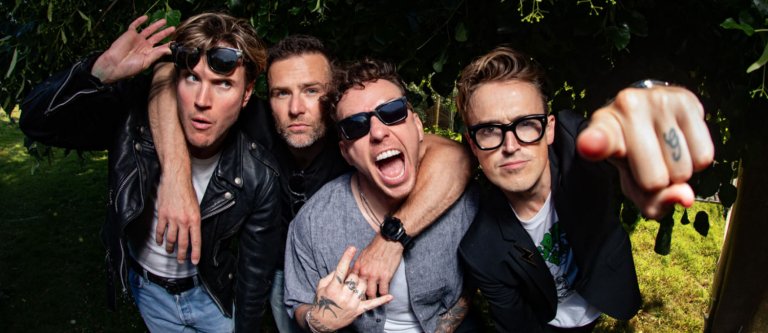
I should warn you upfront: this post contains scenes of a 44-year-old married man unashamedly fangirling over Danny Jones. Viewer discretion is advised. My wife has already been advised. She remains unimpressed.

I’ve always had what music snobs might diplomatically call an “eclectic” taste, and what everyone else would call completely unhinged. On any given day, my playlist will swing from Garth Brooks singing about his friends in low places, to Mika shrieking joyfully about big girls, to The Beatles rewriting the rules of everything, to Michael Jackson moonwalking directly into your central nervous system, to McFly doing something so infectiously melodic that you forget you’re a grown adult with a mortgage and responsibilities.

And I love all of it. Equally. Fiercely. Without a single trace of embarrassment.


The Bit Where People Give Me The Look

You know The Look. It’s the one people give you when you tell them your favourite artists in one breath. The Beatles, Michael Jackson, Garth Brooks, Mika, McFly. It’s the look that says: “I’m trying to find the through-line here and I’m coming up empty.” It’s the look my friends give me approximately every time music comes up in conversation, followed shortly by the look my wife gives me when I fangirl — and I use that word deliberately and without shame — over Danny Jones and Garth Brooks in completely equal measure. Two very different men. One very consistent reaction from my wife.

She knows. She’s heard the argument. She could probably deliver it herself at this point. She chooses not to.

But here’s the thing: there absolutely is a through-line. It just takes a little squinting to see it, like one of those Magic Eye posters. Except once you see it, you can’t unsee it — and suddenly my playlist makes complete sense, and everyone else’s taste seems oddly, tragically limited by comparison.


The Golden Rule of the Irresistible Hook

Every single artist I love is, at their core, a melodic populist. They don’t just write songs. They write songs that feel like you’ve always known them — even the very first time you hear them. That particular alchemy is rarer than people realise, and it is the invisible spine running through my entire musical life.

The Beatles established the blueprint. They proved, definitively, in the 1960s, that you could be both wildly popular and genuinely sophisticated — that a perfect hook and genuine craft weren’t mutually exclusive concepts, but were in fact the same thing wearing different clothes. Every artist I love is, knowingly or not, a direct descendent of that philosophy.

Michael Jackson took it and supercharged it with rhythm and production genius, but strip back Billie Jean or Man in the Mirror to its bones and you’ve got a melody so clean, so inevitable, it could have been written on an acoustic guitar in someone’s kitchen. He was a craftsman first. The glove was secondary.

Garth Brooks — and this is the bit that always surprises people — is essentially a rock musician in a very convincing hat. He grew up idolising Kiss, Billy Joel and James Taylor and it shows in everything he does. His live shows are stadium rock concerts with fiddles. His emotional directness, the sheer lack of irony in everything he commits to, is what puts him in exactly the same category as everyone else on this list. When Garth sings, he means it in a way that makes you feel slightly embarrassed about how little you mean most things you say.

McFly grew up believing, correctly, that pop music was a serious art form worth taking seriously. The harmonies, the key changes, the sheer bloody-minded commitment to the idea that a chorus should make you feel something — these are four lads who clearly did their homework and came back with a distinction.

And then there’s Mika. Glorious, ridiculous, completely committed Mika — who sounds like what would happen if Freddie Mercury and Elton John had a musical child who was raised exclusively on 1970s AM radio and given unlimited access to a falsetto. Grace Kelly alone contains more pure pop craft than most artists manage in entire careers. The man is not subtle. The man does not do subtle. I respect this enormously.


The Three Things They All Share (Yes, This Is The Analytical Bit)

Right, this is where the pub discussion gets surprisingly deep, so bear with me.

First: emotional sincerity. None of them do ironic detachment. Not one. Even when the song is light, even when it’s fun, even when Mika is singing about lollipops, it means it (Yes I am aware of the song’s metaphor). There’s a full commitment to the moment that I find completely irresistible, possibly because sincerity is increasingly unfashionable, and I have never once cared about what’s fashionable.

Second: the unconditional hook. Not a vibe. Not a texture. Not an aesthetic. An actual, singable, hummable, whistle-in-the-shower melody that burrows into your brain and pays rent indefinitely. I regularly go to sleep in a Room on the Third Floor with a Star Girl, my dreams often take me to Transylvania and I’m investigating where all the guitars went, and I wake up to Obviously. Obviously.

Third: broad humanity. These are artists whose music doesn’t belong to one tribe. You don’t have to be a country fan to be flattened by The Dance. You don’t have to be a pop kid to recognise that Five Colours in Her Hair is simply a perfect song. The music reaches out and grabs you regardless of which particular box you’ve put yourself in, which I think is the highest compliment you can pay any artist.


In Conclusion: I Regret Nothing

So yes. I am a 44-year-old happily married man who will fangirl over Danny Jones and Garth Brooks in exactly equal measure, who owns McFly albums without irony, who considers Mika criminally underappreciated, and who thinks Michael Jackson and The Beatles between them essentially invented the emotional language of popular music as we know it. And that Garth Brooks is God.

My taste is not eclectic. It is not confused. It is not, as has been suggested by people I thought were my friends, “a lot.”

It is, in fact, exceptionally consistent — united by craft, sincerity, and the firm belief that a great song should stop you in your tracks at least once before it’s finished.

Now if you’ll excuse me, Five Colours in Her Hair just came on shuffle, and I have fangirling to attend to.

Every filmmaker gets asked the same question eventually. Sometimes it comes from a curious friend, sometimes from a nervous newcomer at a workshop, and sometimes — if you’re honest — you ask it of yourself at two in the morning when the cursor is blinking and the page is empty.

Where do the ideas come from?

The truthful answer is: everywhere. And nowhere in particular. But that’s not especially helpful, so let’s dig a little deeper.

Start With What Moves You

The most reliable source of a good idea isn’t a clever concept or a marketable premise. It’s an emotional response to something that already exists. A film you saw. A song you can’t get out of your head. A TV show you watched twenty years ago that still sits with you.


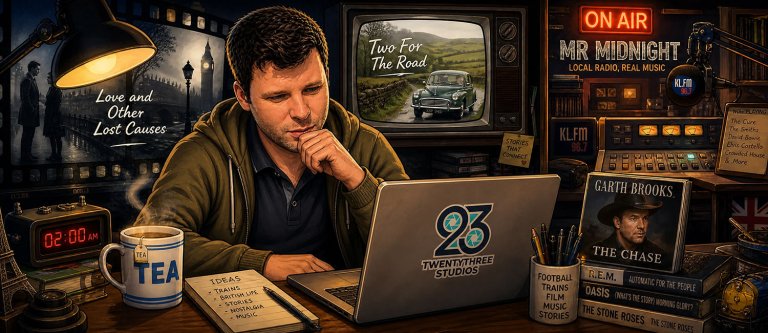
One of my own projects in development, Two For The Road, started exactly there. Growing up, I was captivated by Tim Grundy and his cameraman — known simply as The Eye — in their Discovery Home & Leisure series Two’s Country. There was something magical about their dynamic: warm, funny, genuinely informative without ever feeling like it was trying to teach you anything. Tim was one of the greatest TV and radio presenters this country ever produced, and I wanted to do something that honoured that legacy. The idea for Two For The Road was born not from a gap in the market, but from love — for a show, for a style, for a man whose work deserved a tip of the hat.

That’s as good a reason to make something as any.

Chase a Feeling, Not Just a Story

Here’s something film schools don’t always tell you: you don’t have to start with a story. Sometimes you start with a feeling — a mood, an aesthetic, an atmosphere — and build the story around it afterwards.

Love and Other Lost Causes came from exactly that. I used to run a film festival in Folkestone, and one short film I screened stopped me in my tracks. Not necessarily because of the story, but because of how it felt — the grade, the texture, the emotional temperature of it. I knew immediately that I wanted to capture something of that feeling in my own work, even if the story I told was entirely different.

The actual plot of Love and Other Lost Causes came later — a two in the morning brainstorming session, as it happens (there’s something about that particular hour that loosens the creative mind). But the seed of it was purely sensory. If a piece of work makes you feel something, ask yourself why. Then ask whether you can make something that makes someone else feel the same way.

Let Other Art Forms In

Film doesn’t exist in isolation. The best filmmakers are readers, music lovers, theatre-goers, gallery wanderers. Ideas cross borders all the time, and some of the most interesting projects begin somewhere other than a screenplay.

My project Mr Midnight began with a Garth Brooks song. If you know the track, you’ll understand immediately why it sparked something. If you don’t, I’d suggest looking it up. What I took from it wasn’t the literal narrative but the emotional world it suggested — and from there, with my own creative licence, I’ve been building a story largely set inside a small local radio station. The first draft is in progress. The song remains on the playlist.

Music, in particular, is a gift to filmmakers. A great song can hand you a tone, a character, a world, or a theme in three and a half minutes. Don’t ignore it.

Practical Tips for Finding Your Idea

If you’re stuck, here are a few starting points worth trying:

Write down five things that have genuinely moved you in the last year — films, songs, books, overheard conversations, places, memories. Don’t filter. Just list them. Then look for the thread that connects them. That thread is probably something you care about deeply, and something you care about deeply is worth making something about.

Ask yourself what you haven’t seen. Not in a commercial sense — not “what’s missing from the marketplace” — but personally. What story do you wish existed? What character do you never see represented? What place, what moment, what feeling has never quite been captured on screen in a way that felt true to you?

Don’t wait for the perfect idea. Start with the good-enough idea and let it become something better in the writing and the development. Love and Other Lost Causes was a 2am brainstorm. Mr Midnight started as a feeling about a song. Two For The Road started as gratitude. None of them arrived fully formed.

The Idea Is Just the Beginning

Finding the idea is only the first step, of course. There’s the writing, the rewriting, the pre-production, the endless logistics of actually getting something made. Two For The Road is ready to shoot — we’re just locking in the dates. Love and Other Lost Causes is written and moving into pre-production. Mr Midnight is still taking shape on the page.

Each one started somewhere different. Each one started with a feeling that refused to go away.

That’s the real test of an idea worth pursuing: not whether it sounds good in a pitch, but whether it’s still there in the morning.

Today I’m very happy. In October 2019 I was diagnosed with stage 4 non-Hodgkin Lymphoma, or more specifically a rare and incurable type called Splenic Marginal Zone Lymphoma. I underwent six months of chemotherapy and came out the other side in complete remission. Today I am still in remission.

Hearing the words stage 4 and all the connotations associated with that panicked me but I was told that I should treat it more like a chronic disease as opposed to incurable cancer. The haematologists said I will probably die with it as opposed to dying from it as it’s such a slow-growing disease. Splenic Marginal Zone Lymphoma (SMZL) is a slow-growing (indolent) B-cell non-Hodgkin lymphoma (NHL). It usually affects the spleen, bone marrow and blood. It can sometimes affect lymph nodes in the abdomen. I had a massive spleen (two to three times its normal size) and a 30% involvement of the bone marrow and I lost almost two stone prior to diagnosis. It was classified at stage 4 because of the bone marrow involvement.

I was supposed to have six months of chemotherapy and immunotherapy followed by two years of bi-monthly immunotherapy (what they call “Maintenance” treatment). However, due to Covid-19, the decision was made to cancel the maintenance so my immune system could recover just in case I caught Covid. With maintenance the average remission time is 2-6 years. Without maintenance it would likely be shorter.

Well today I am now 15 months post-treatment and I’m still in complete remission, in fact, my bloodwork is better today than it was six months ago.

I don’t want to say the word “cured” as there is no way of telling if I am cured of this incurable disease but: my bloodwork has improved; my folate (folic acid) levels are now normal; the liver seems to have made a full recovery after the damage caused by chemotherapy; and I have had no symptoms whatsoever that virtually crippled me at periods leading up to the diagnosis. If I can make ten years without a relapse then “cured” possibly could be said but for now I just have to keep taking one day/week/month at a time.

Needless to say, after today’s consultation, I am incredibly happy and thankful for the wonderful treatment, care and attention given to me by my haematologists (Dr Munisamy and Dr Osborne) and the chemo nurses at the Celia Blakey unit at the William Harvey Hospital in Ashford.

Dr Munisamy told me when I was diagnosed that it was his mission to get me to 100-years-old. I’m holding him to that otherwise I’m going to haunt him! I also recently got a message from my musical idol, Garth Brooks, who told me he hopes I will “die of old age, like record old age”. I’m holding you to that too Garth!

Forward to 13:23 in the video…

Garth Brooks: https://fb.watch/68w2bw1OQ-/