Posts

Warning: This article contains academic terminology applied to a joke about a chicken. Side effects may include mild existential confusion, an urge to re-examine your relationship with poultry, and the dawning realisation that you have been laughing at nothing for thirty years.


Introduction: The Question That Has Haunted Humanity

There are questions that define civilisation. Why are we here? What is consciousness? Is time linear? And then, sitting somewhere near the top of that pile with a look of complete indifference, is this:

“Why did the chicken cross the road?”

To get to the other side.

That’s it. That’s the whole thing. Six words of setup. Five words of punchline. And somehow, it has survived for over 170 years, been retold by every world leader, comedian, primary school teacher, and drunk uncle in recorded history, and spawned thousands of variations — none of which are as funny as the original, and the original isn’t even funny.

So what is going on? What cosmic joke is being played on us? And more importantly: why did the chicken cross the road?

Let us investigate. Properly. With far more effort than this deserves.


Part One: A Brief and Surprisingly Dignified History

The First Documented Crossing

The earliest known written appearance of the joke dates to 1847, published in The Knickerbocker, a New York monthly magazine. It appeared not as a headline act but buried in a section of miscellaneous wit under the heading “Gossip with Readers and Correspondents” — which tells you a great deal about how seriously the 19th century took it.

The original reads:

“There are ‘quips and quillets’ which seem actual conundrums, but yet are none. Of such is this: ‘Why does a chicken cross the street?’ Because it wants to get on the other side.”

Note the phrasing: “which seem actual conundrums, but yet are none.” Even in 1847, people understood immediately that this joke was breaking the rules of jokes. They just couldn’t quite explain why they were telling it anyway.

The Victorian Comedy Circuit

Nineteenth-century joke formats tended toward elaborate riddles with clever or punning punchlines — the kind of joke that rewards intelligence. “Why did the chicken cross the road?” does the opposite. It lures you in with the structure of an intelligent riddle and delivers the comedic equivalent of a shrug.

By the early 20th century it had become a fixture of vaudeville, American comedy almanacs, and schoolyard culture. By the mid-century, it was so ubiquitous that comedians were already using it as shorthand for the world’s oldest, most boring joke — which is itself a joke about the joke, meaning the meta-commentary predates the internet by about sixty years.


Part Two: The Psychological Architecture of the Joke

Why Is It Funny? (An Uncomfortable Question)

To understand this, we need to briefly dip into the three dominant theories of humour:

1. The Superiority Theory (Hobbes, 17th century): We laugh when we feel superior to something. The stumbling clown, the fool, the person who slips on a banana peel. Humour = watching someone else fail.

2. The Relief Theory (Freud, early 20th century): Laughter is a release of psychological tension. Jokes create pressure — a knot of expectation — and the punchline releases it. The relief is pleasurable. We laugh.

3. The Incongruity Theory (Kant, Schopenhauer, and basically everyone since): Humour arises when two incompatible mental frameworks collide unexpectedly. The setup pulls you in one direction; the punchline yanks you in another. The gap between expectation and reality is where comedy lives.

Now apply all three to our chicken:

Superiority? There’s nothing to feel superior to. The chicken crossed a road. Successfully. Good for it.

Relief? There’s no real tension built. The setup is a simple question. The “punchline” dissolves the question without creating any twist. There is no knot. There is no release. There is just… an answer.

Incongruity? Barely. You expect a clever twist. You get the literal answer. The incongruity is not between two clever ideas but between expecting cleverness and receiving nothing.

Which brings us to the real psychological mechanism at work here.

Anti-Humour: The Joke That Isn’t One

“Why did the chicken cross the road?” is one of the earliest and most effective examples of anti-humour in the English language.

Anti-humour is a comedic mode that deliberately subverts the expectations of joke structure. Instead of a surprising or clever punchline, it delivers something painfully obvious, deadpan, or meaningless. The joke is the absence of a joke. The comedy is in the betrayal of the contract.

When someone asks “Why did the chicken cross the road?”, your brain — having been trained by thousands of riddles to expect a pun or twist — immediately starts constructing possibilities. A pun on “other side”? A reference to something? A subversion? Your brain is doing work, and it expects to be rewarded.

“To get to the other side.”

Your brain receives nothing. Less than nothing. The answer is so obvious it almost insults the question. And your brain, faced with this bizarre cognitive anticlimax, does the only sensible thing: it laughs. Not because something is funny, but because something is wrong, and laughter is your nervous system’s way of saying “I don’t know how to process this, so I’m going to make a noise.”

Sigmund Freud would call this a failure of the pleasure economy of expectation. The setup invested cognitive energy; the punchline returned nothing. The laughter is not of joy — it is of confused disappointment, and we’ve somehow agreed as a species to call that entertainment.

The “Other Side” Double Meaning — Or Is There One?

Some analysts — yes, analysts; this is what academia sometimes does — have pointed to a second reading: “the other side” as a euphemism for death. The chicken crossed the road to get to the afterlife. It’s a death joke dressed as a children’s riddle.

This reading gained traction in the late 20th century and gives the joke an unexpectedly dark second layer. Under this interpretation, “Why did the chicken cross the road?” is an absurdist meditation on mortality — the chicken, like all of us, was simply moving toward its inevitable end.

Whether this is intentional or the result of academics having too much spare time is, as yet, undetermined. Both seem equally likely.


Part Three: The Structural and Linguistic Mechanics

The Perfect Joke Skeleton

For all its apparent emptiness, “Why did the chicken cross the road?” is technically a masterclass in joke construction. Let’s break it down:

The setup follows a classic riddle format — a question beginning with “why,” applying agency to a specific subject (the chicken), in a mundane real-world scenario (a road). It is entirely unremarkable, which is the point. It primes you to expect cleverness by wearing the clothes of a proper riddle.

The punchline does something sneaky: it is simultaneously the most literal answer possible and a complete non-answer. It resolves the question without satisfying it. “To get to the other side” explains the mechanical action while telling us absolutely nothing about why the chicken wanted to cross. The motivation remains entirely unknown. The chicken is, philosophically speaking, inexplicable.

The misdirection — and this is the engine of the joke — lies in the word “why.” In a standard riddle, “why” invites a clever or hidden reason. Here, “why” is answered with pure physical causality. It crossed the road because crossing roads results in being on the other side. It’s the logical equivalent of answering “Why did you eat the cake?” with “Because I put it in my mouth and chewed.”

Phonetics and Rhythm

The joke has nearly perfect comic rhythm. The setup (7 syllables) and punchline (6 syllables) create a near-symmetrical cadence:

Why did the CHICK-en CROSS the ROAD? — 7 syllables, three natural stresses
To GET to the OTH-er SIDE. — 6 syllables, three natural stresses

This rhythm is close to iambic, the metre of natural English speech and of Shakespeare’s verse. The joke, consciously or not, scans. It is phonetically pleasant. Your mouth enjoys saying it even when your brain is unimpressed by it.

This partly explains why it survives. It is easy to remember, satisfying to deliver, and rhythmically complete. The chicken joke is, structurally speaking, well made. It is just that what it is well made to do is produce absolutely nothing.


Part Four: The Variants — An Archaeology of Desperation

Over 170 years, the joke has accumulated variants the way a neglected coat accumulates lint. Let us examine the main categories and what they reveal about human psychology.

The Celebrity Variant

The most common mutation: replace “the chicken” with a famous person, and their answer becomes a window into their worldview.

Albert Einstein: Whether the chicken crossed the road or the road crossed the chicken depends upon your frame of reference.

Isaac Newton: Chickens at rest tend to stay at rest. Chickens in motion cross roads.

Julius Caesar: To come, to see, to conquer.

Hamlet: To cross or not to cross — that is the question.

These variants work on a straightforward comedic principle: they take the absurdity of applying intellectual frameworks to a chicken and produce a miniature parody of the person in question. They are mildly funny, endlessly repeatable, and say more about our desire to reduce famous people to catchphrases than anything else.

Note how each variant is essentially a different theory of motivation being applied to a creature that has no theory of motivation. The chicken doesn’t know it crossed the road to fulfil Newton’s First Law. The chicken crossed the road because it was a chicken, and chickens do things.

The Self-Referential Variant

At some point, comedians discovered they could put the original joke inside the answer to the original joke:

Why did the chicken cross the road? To get to the other side.
Why did the other side cross the road? To get back to the chicken.

This is recursion as comedy — an infinite loop dressed as a punchline. It resolves nothing and creates a closed system of chickens and roads from which there is no escape. Philosophers call this kind of structure an aporia. The rest of us call it “the moment the pub quiz goes off the rails.”

The Dark Variant

Why did the chicken cross the road? Because the farmer was on the other side.

Why did the chicken cross the road? It didn’t. KFC is on this side.

These variants restore the dark undertone — death is involved, as it often is with chickens in human civilisation — and reframe the whole joke as a tragedy. The chicken crossed the road toward its own demise. We were laughing at a condemned animal the whole time.

Well done, everyone.

The Postmodern Variant

Why did the chicken cross the road? Because the concept of a chicken is a social construct, and roads are merely the hegemonic infrastructure of—

This variant began in academic circles and has since colonised Twitter, where it is deployed whenever someone wishes to appear clever while expending the absolute minimum intellectual effort. It takes the anti-humour of the original and adds an additional layer of performative inaccessibility. The joke has now transcended comedy entirely and become a vehicle for mild insufferability.

This is, somehow, progress.


Part Five: What the Chicken Reveals About Us

The Joke as Cultural Mirror

A joke that survives 175 years is not surviving on comedy alone. It is doing something structural, cultural, even social. The chicken joke endures because:

It requires no context. Unlike topical humour, it is not tethered to an era. The chicken is eternal. The road is eternal. The other side is eternal.

It is universal. Roads exist in every culture. Chickens are farmed on every continent. The situation requires no translation of cultural experience. The only English-specific element is the slight ambiguity of “the other side,” and even that translates adequately in most languages.

It is a test. When you tell this joke to a child, you are teaching them the mechanics of riddles — setup, expectation, subversion. The joke is, in a very real sense, an introduction to the grammar of humour. It is comedy school for five-year-olds, which explains why adults still tell it to children and children still find it confusing in the exact same way they find most adult behaviour confusing.

It is a trap. The joke persists because people still fall for it. There will always be someone constructing an elaborate punchline in their head while the setup is being delivered. The joke is a self-replenishing prank. Every new generation encounters it fresh.

The Chicken as Existential Hero

Strip away the anti-humour mechanics, the variant analysis, and the phonetic theory, and what remains is actually rather poignant. The chicken crossed the road. It had a goal. It moved toward it. It got there.

The chicken did not overthink the road. It did not spiral into existential paralysis about what “the other side” would bring, whether the crossing was meaningful, or whether, once it arrived, it would simply want to cross back. The chicken identified an objective and pursued it with single-minded, beak-forward commitment.

In this reading, the chicken is not the butt of the joke. The chicken is the only character in the joke who knows exactly what it wants and goes and gets it.

The rest of us are still standing here asking why.


Conclusion: To Get to the Other Side

After subjecting this joke to more rigorous analysis than it has any right to receive, we can conclude the following:

The chicken crossed the road because it is a masterwork of anti-humour — a trap built from the grammar of riddles, powered by subverted expectations, and preserved by its own rhythmic simplicity. It is a small philosophical puzzle about motivation and causality. It is possibly a death joke. It is definitely a joke about jokes. And it is, at its structural core, a remarkably well-constructed nothing that has outlasted virtually every piece of comedy from its era.

It is the cockroach of jokes. Everything around it has died. The chicken endures.

Why?

To get to the other side, obviously.

References

Attardo, S. and Raskin, V. (1991) ‘Script theory revis(it)ed: Joke similarity and joke representation model’, Humor: International Journal of Humor Research, 4(3–4), pp. 293–347.

Freud, S. (1905) Der Witz und seine Beziehung zum Unbewußten. Leipzig and Vienna: Franz Deuticke. [Trans. Strachey, J. (1960) Jokes and Their Relation to the Unconscious. London: Routledge & Kegan Paul. The Standard Edition of the Complete Psychological Works of Sigmund Freud, Vol. VIII.]

Giddins, G. (2001) Commentary in Burns, K. (dir.) Jazz. PBS Documentary Series. Washington, D.C.: Public Broadcasting Service.

Hobbes, T. (1640) The Elements of Law, Natural and Politic. [Published 1650.] Ch. 9, §13.

Hobbes, T. (1651) Leviathan, or The Matter, Forme, and Power of a Common-wealth Ecclesiasticall and Civill. London: Andrew Crooke. Pt. I, Ch. 6.

Kant, I. (1790) Kritik der Urteilskraft. Berlin: Lagarde. [Trans. Meredith, J.C. (1952) The Critique of Judgement. Oxford: Clarendon Press.] §54, p. 199.

The Knickerbocker, or New-York Monthly Magazine (1847) ‘Gossip with Readers and Correspondents’, Vol. 29, March, p. 283. New York.

Morreall, J. (2009) Comic Relief: A Comprehensive Philosophy of Humor. Oxford: Wiley-Blackwell.

Morreall, J. (ed.) (1987) The Philosophy of Laughter and Humor. Albany: State University of New York Press.

Raskin, V. (1985) Semantic Mechanisms of Humor. Synthese Language Library, Vol. 24. Dordrecht: D. Reidel / Springer.

Schopenhauer, A. (1818) Die Welt als Wille und Vorstellung. Leipzig: F.A. Brockhaus. [Trans. Haldane, R.B. and Kemp, J. (1883) The World as Will and Idea, 6th edn. London: Routledge & Kegan Paul.] Vol. 1, pp. 76–77; Vol. 2, p. 271.

San Francisco Bulletin (1872) Supplement, 8 June, p. 2.


Enjoyed this entirely unnecessary investigation? Share it with someone who definitely needed 2,500 words about a chicken today.

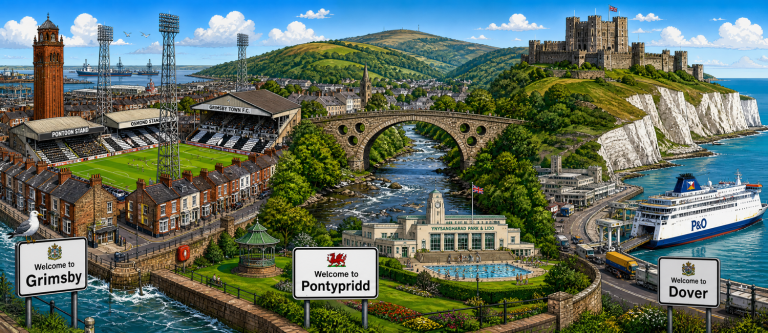
I live in Dover. Have done for a few years now, after nine years in Folkestone before that. Sadie’s here, Reggie the three-legged cat is here, work’s here, half of my adult life is built on this particular stretch of coastline. And yet if you read enough of what I write — the screenplays, the novels — you’d be forgiven for thinking I’d never actually left Grimsby. Or possibly that I’d quietly relocated to Pontypridd without telling anyone, including myself.

Neither is true. I’ve lived in Kent for thirteen years. I’ve spent a grand total of two weeks in Wales, ever. And yet my imagination appears to have filed a permanent change-of-address form with both places without consulting me first.

I find this mildly ridiculous, so naturally I’m writing a blog post about it.


Grimsby: Explainable, At Least

Let’s deal with the sensible one first. A novel called Small Fish, set in a fictionalised version of the town I called Grimhaven, twenty-four chapters deep, seven of them actually written, which for a writer is basically a personal best. A chunk of my zombie novel, End of the Line, is set in Grimsby too, because apparently even the apocalypse has to start somewhere familiar. Ideas that keep wandering back up the A180 whether I’ve invited them to or not.

This one I can explain. I grew up there. The better part of thirty years, give or take, versus just over a decade in Kent — so when my hands go back to Grimsby on the page, that’s not nostalgia, that’s just basic arithmetic. Kent is where I live. Grimsby is apparently where my subconscious still has a season ticket.

Small Fish became Grimhaven rather than literal Grimsby, mostly because I wasn’t trying to write a documentary about a real place that’s continued existing without my permission since I left it. I wanted the feeling of the place — the grit, the football, the very specific grey of a sky over the docks — without having to be accurate about, say, whether a particular chip shop is still open. (It’s probably not. They never are.) End of the Line, on the other hand, just goes ahead and uses the real place, possibly on the basis that if the dead are going to rise anywhere, it might as well be somewhere I know the geography of well enough to write a decent chase scene.

So: Grimsby makes sense. Moving on.

Wales: Does Not Make Sense, At All

Here’s the bit where I lose the plot slightly, so bear with me.

I’ve been to Wales twice in my entire life. A week each time — once in 1992, when I was a child and had approximately zero say in the itinerary, and again in 2025, as a fully grown adult who really should know better by now. Of that second trip, exactly one hour was spent in Pontypridd, the town where my grandmother was born. One hour. I’ve spent longer than that queuing for a gig.

And somehow, that one hour appears to have rewired something. Not the two weeks of general, perfectly pleasant Welsh holidaying. Not the scenery, not the castles, or the Blaenau Festiniog Light Railway, not whatever I had for lunch on either trip, which I genuinely cannot recall. Just the hour. In Pontypridd. Specifically.

I have no rational explanation for this, and I want to be clear that I’ve tried. My grandmother was from there, which is the only actual evidence I’ve got, and on paper it’s not much to build an entire emotional attachment on. People meet their actual living relatives for longer than an hour and feel less moved by it. I’m half convinced my own ancestors are mildly embarrassed on my behalf — “he was here for sixty minutes and now he wants to retire here, bless him.”

Because that’s the other thing. Sadie has mentioned, more than once, that when we eventually retire, Wales might be the answer. And the genuinely baffling part is that I don’t immediately laugh this off. Some small, currently unsupervised part of my brain goes “yeah, alright then,” based entirely on an hour I spent there once, in a town I couldn’t confidently find again without a satnav.

I have, if I’m honest, more feeling toward Wales as a concept than I have toward England, despite having lived in England my entire life and visited Wales for a combined total of roughly two weeks. This is not a sensible ratio. I am aware it is not a sensible ratio. I have made my peace with the fact that my sense of belonging apparently does not consult a spreadsheet before making decisions.

So What’s Actually Going On Here

I think — and this is very much a working theory, subject to change without notice — that creative work, and maybe identity generally, doesn’t care all that much about how long you’ve spent somewhere. It cares about whatever’s load-bearing. Kent is where my actual life happens: the bills, the cat, the theatre, the back pain, the whole functioning-adult operation. Grimsby is the thirty-year foundation underneath it, fully explicable, no mystery required. And Wales is just… in there. Uninvited. Unexplained. Possibly ancestral, possibly just a really good hour, possibly both.

I’ve stopped trying to force a tidy answer out of the Wales thing, mostly because I don’t think there is one, and partly because demanding logic from your own feelings is a famously losing battle. Some places just get under your skin regardless of how much actual time you’ve clocked there, like a song you’ve heard once and now can’t stop humming, except the song is a Welsh valley town and the humming is a vague but persistent desire to live there one day.

So if you ever read something of mine set in a windswept fictional fishing town, you’ll know where that’s from. And if, decades from now, you hear I’ve retired to a small house somewhere near Pontypridd having visited the place for a cumulative total of sixty minutes, please don’t act surprised. Some of us were always going to end up exactly where we couldn’t logically explain.

Does anyone else feel inexplicably tied to somewhere they’ve barely been? Or is it just me, romanticising a single hour like it owes me a mortgage? Let me know in the comments — I could use the company.


If you enjoy what I do, consider supporting me! Every little bit means the world!

Gary grew up in Grimsby, lives in Dover, Kent, and has a worrying amount of feelings about a Welsh town he’s visited once, for sixty minutes.

UPDATE: I’ve finally seen sense and reverted back to the normal design. It was fun while it lasted.

So. The website’s gone full pirate.

Not “a small nautical flourish in the footer” pirate. Not “tasteful rope-border in the header” pirate. Full pirate. Skull and crossbones somewhere in the navigation, a colour palette that’s basically just every shade of “weathered wood” and “treasure chest,” and I’m fairly sure there’s a font in there now that I can only describe as Ransom Note’s slightly more seafaring cousin.

I’ve spent two decades building websites professionally. I know what good, restrained, on-brand design looks like. I have opinions about whitespace. And despite all of that, I sat down a few weeks ago and apparently decided that what my personal site — the one with my actual name on it, the one prospective clients might visit — really needed was to look like it was being run out of a beach hut by a man who recently lost an argument with a parrot.


The Honest Answer Is: I Don’t Fully Know

I’d love to give you a clean, sensible origin story here. Something like “it ties into a creative project” or “it’s a clever metaphor for charting your own course,” delivered with a knowing wink, the kind of thing that sounds great in a portfolio case study.

It isn’t that. I genuinely don’t have a tidy explanation. One day I was looking at the site thinking it needed a refresh, and somewhere between “needs a refresh” and “actually opening the design files,” my brain quietly filed a motion for pirates, the motion passed unopposed because nobody else was in the room to object, and that was that. There was no committee meeting. There was no mood board. There was just me, a laptop, and an alarming amount of confidence in galleon iconography.

If this is starting to sound familiar, it’s because it is — I’ve written before about how my best ideas arrive at 2am and don’t survive breakfast. This was very much one of those. Whether it was the heat — British people, as a species, are simply not built for warm weather, our internal thermostats are calibrated for “drizzle” and nothing else — or the four custard doughnuts and a Toblerone I’d apparently decided constituted a balanced evening meal, something sent me doollally enough to greenlight an entire pirate rebrand without consulting anyone, including, crucially, myself at a more sensible hour. Normally these ideas don’t make it past the morning read-back. This one, against all precedent, just… stuck.

This is, if I’m honest, a known pattern by now. 2am-Gary has form. He’s the same one who once tried to give Small Fish a secret underground tunnel system and convinced End of the Line’s zombies needed an entire chemical-spill backstory, complete with a name he’d apparently already settled on. Normally Daytime-Gary catches these at the door — reads them back over breakfast, winces, quietly deletes them, no harm done. This time Daytime-Gary just… didn’t. He looked at the pirate idea, shrugged, and let it through. I’d love to tell you why this one got past the bouncer when the tunnel system and the chemical spill didn’t. I don’t have an answer. Maybe a website doesn’t have the same structural consequences as a 24-chapter outline, so there was simply less for sensible-hours-me to object to. Maybe the doughnuts were just that good. Either way, this is, as far as I can tell, the first 2am idea to survive all the way to a full site overhaul, which feels like it should mean something, even if I can’t say what.

If you’re after deep psychological insight into why a man in his forties with a bad back and a strong professional design background has chosen this particular hill to die on, I can’t help you. I’ve asked myself the same question. The honest answer, every time, is something close to a shrug.

In My Defence (Such As It Is)

I do live on the Kent coast. There’s a sea nearby. There’s a long and genuinely storied history of smuggling, shipping and general seafaring nonsense around these parts, so it’s not a complete non-sequitur. I could, if pressed by a sufficiently patient interviewer, construct a reasonably convincing argument that this is “coastal heritage-inspired branding” rather than “bloke gets the urge to add a skull to his website and simply does not stop himself.”

But if I’m honest with you, and I try to be honest with you on this blog even when it’s mildly humiliating, the coastal heritage thing is a justification I built afterwards. It’s the kind of explanation you give a client when really the truth is “I just wanted to.”

What This Says About Me As a Designer

Probably nothing good, professionally speaking. If a client came to me and said “I’d like my entire web presence themed around 18th century maritime criminals, no particular reason,” I would, as a responsible designer, ask several follow-up questions before reaching for the cutlass clip art. I would want to understand the audience. The brand strategy. Whether this serves the user journey or simply serves my own desire to use the word “plunder” in a call-to-action button.

For myself, apparently, none of that scrutiny applies. I am both the client and the designer in this scenario, and it turns out I am an extremely easy client to please. I pitched myself one idea. I said yes immediately. There was no negotiation. I didn’t even ask myself for a deposit.

Full Site Overhaul, No Half Measures

And this isn’t a “just the homepage” situation either, for anyone hoping I’ll come to my senses on the inner pages. This is a full overhaul. Every corner of the site is getting the treatment. If you land on a contact form on my website in the near future and it doesn’t at least gesture vaguely toward “message in a bottle,” I will personally consider that a missed opportunity, and so, increasingly, will the site itself.

I’ve made my peace with the fact that some people who land on it will think “ah, coastal branding, lovely, very on-brand for a man in Kent.” And others will think “has he been at sea for several months without proper supervision.” Both reactions are valid. I am prepared to stand behind this decision with the same unwavering confidence with which I apparently made it, which is to say: very little actual reasoning, but enormous commitment.

So that’s the story, such as it is. No deep meaning. No grand rebrand strategy document. Just a man, a laptop, and an unsupervised impulse that nobody was around to talk him out of.

Oh, and yes I am aware my hand in the picture has five fingers and a thumb. You can’t expect AI to get everything right!

There is a very specific kind of confidence that only exists between the hours of midnight and roughly half past two in the morning, and I want to talk about it, because it has given me no end of grief over the years.

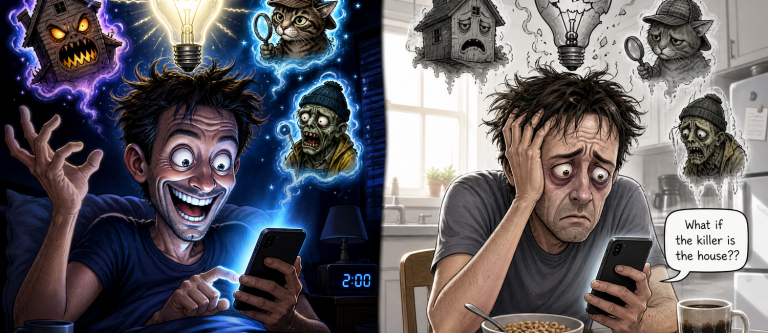
You know the one. You’re lying in bed, supposedly asleep, and your brain — having clocked off from anything useful hours ago — suddenly clears its throat and goes “right, here’s a thought.” And it’s not just a small thought. It’s a plot twist so perfectly constructed that you genuinely sit up in the dark and think: I am a genius, I’ll be fielding calls from Netflix before my toast goes cold.

I get my phone. I type it into my Notes app with the shaky urgency of a man defusing a bomb, because if I don’t capture this exact wording right now, in this exact moment, the universe will swallow it up and consign it to the annals of history. Then I go back to sleep, deeply satisfied, basically already drafting my awards speech.

Then it’s 7am, and I read it back.


The Morning Read-Back: A Crime Scene

Here is a small sample of things 2am-Gary has typed into my phone with absolute, unshakeable conviction:

“What if the killer is a poltergeist”

“Grimhaven but it’s in an alternative universe?”

“What if they push criminals through a time machine so they have to serve their punishment dodging dinosaurs?”

That last one, for the record, I stand by slightly more than the others. But the broader point remains: not one of these, read in daylight, with actual blood sugar in my system, survives contact with reality. They read less like notes from a working novelist and more like the rambling words of a madman who hasn’t slept for weeks and is living off copious amounts of caffeine.

It’s not that the ideas are always bad, exactly. It’s that 2am-Gary has access to none of the things that make an idea actually usable — things like plot logic, structural consequences, or any memory whatsoever of what happened in chapter six. 2am-Gary is a wildfire with ideas but no thought on whether any of them are actually any good.

Small Fish Has Survived Several Assassination Attempts

Small Fish — my football novel, currently twenty-four chapters planned, seven actually written, which is either a healthy work-in-progress or a crime scene depending on the day — has been “saved” by 2am ideas more times than I can count, and “saved” is doing an enormous amount of heavy lifting in that sentence.

At various points, 2am-Gary has decided that Grimhaven needed a secret underground tunnel system, that one of the central characters was secretly somebody’s long-lost brother for reasons that made perfect sense at 2am and absolutely no sense by Tuesday, and — my personal favourite — that the entire third act should be told backwards. Not flashback-backwards. Properly backwards, like Memento, except I am not Christopher Nolan, I am a man with a bad back trying to finish a novel about lower-league football, and the two things do not need to intersect.

None of these ideas made it into the actual manuscript. All of them felt, in the moment, like the missing piece I’d been searching for. This is the great cruelty of 2am: it doesn’t just generate bad ideas, it generates bad ideas that feel exactly identical to good ones, with none of the usual warning signs. There’s no flashing light. No klaxon. Just pure, false certainty, delivered straight to your nervous system at the worst possible hour for critical thinking.

End of the Line Got It Even Worse

My zombie novel, End of the Line, partly set in Grimsby because apparently even the undead have hometown pride, has weathered its own share of 2am interference. There was a stretch of about a fortnight where I was completely convinced the zombies needed an origin involving the docks, some kind of industrial chemical spill with a name I’d apparently already decided on, fully formed, like I’d seen the safety data sheet myself in a dream.

I wrote two pages of this at, predictably, gone midnight. I read it back the next morning with the specific horror of a man finding out what he did at a party he doesn’t remember attending. It wasn’t unsalvageable. It was, worse than that, almost good — good enough that I had to sit with it for an actual half hour before admitting it didn’t fit, which is far more time than a chemical-spill zombie subplot has any right to occupy in a grown man’s Tuesday.

So Why Does This Keep Happening

I’ve got a theory, which is that your brain, late at night, with all its usual inhibitions switched off, finally gets to do the thing it actually wants to do, which is be reckless. Daytime-Gary has deadlines, structural concerns, the nagging awareness that a 24-chapter outline doesn’t actually want a tunnel system shoved into chapter fifteen. 2am-Gary has none of that. 2am-Gary just wants to see what happens if the cat solves the murder.

And honestly, I don’t think the answer is to stop having the ideas. Every so often — rarely, but often enough to keep the habit alive — something genuinely good survives the morning read-back. The trick, as far as I can tell, isn’t suppressing 2am-Gary. It’s just refusing to let him anywhere near the actual manuscript without a chaperone. Write it down, by all means. Just don’t act on it until you’ve had breakfast, regained the use of your frontal lobe, and confirmed that no, the killer cannot, in fact, be the house.

Does anyone else’s brain turn into an unsupervised intern the second the lights go off? I’d love to know I’m not the only one waking up to notes I have no memory of writing and even less ability to explain. Tell me your worst 2am idea in the comments — bonus points if you also wrote it down and have since had to live with it.


Gary writes novels, mostly during the day, despite his best efforts to convince himself otherwise at 2am.