

Posts

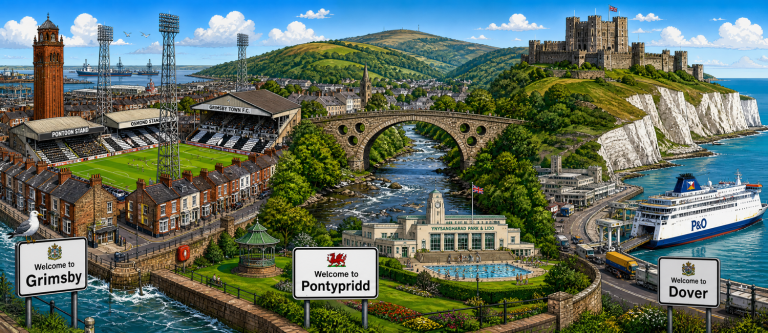
I live in Dover. Have done for a few years now, after nine years in Folkestone before that. Sadie’s here, Reggie the three-legged cat is here, work’s here, half of my adult life is built on this particular stretch of coastline. And yet if you read enough of what I write — the screenplays, the novels — you’d be forgiven for thinking I’d never actually left Grimsby. Or possibly that I’d quietly relocated to Pontypridd without telling anyone, including myself.

Neither is true. I’ve lived in Kent for thirteen years. I’ve spent a grand total of two weeks in Wales, ever. And yet my imagination appears to have filed a permanent change-of-address form with both places without consulting me first.

I find this mildly ridiculous, so naturally I’m writing a blog post about it.


Grimsby: Explainable, At Least

Let’s deal with the sensible one first. A novel called Small Fish, set in a fictionalised version of the town I called Grimhaven, twenty-four chapters deep, seven of them actually written, which for a writer is basically a personal best. A chunk of my zombie novel, End of the Line, is set in Grimsby too, because apparently even the apocalypse has to start somewhere familiar. Ideas that keep wandering back up the A180 whether I’ve invited them to or not.

This one I can explain. I grew up there. The better part of thirty years, give or take, versus just over a decade in Kent — so when my hands go back to Grimsby on the page, that’s not nostalgia, that’s just basic arithmetic. Kent is where I live. Grimsby is apparently where my subconscious still has a season ticket.

Small Fish became Grimhaven rather than literal Grimsby, mostly because I wasn’t trying to write a documentary about a real place that’s continued existing without my permission since I left it. I wanted the feeling of the place — the grit, the football, the very specific grey of a sky over the docks — without having to be accurate about, say, whether a particular chip shop is still open. (It’s probably not. They never are.) End of the Line, on the other hand, just goes ahead and uses the real place, possibly on the basis that if the dead are going to rise anywhere, it might as well be somewhere I know the geography of well enough to write a decent chase scene.

So: Grimsby makes sense. Moving on.

Wales: Does Not Make Sense, At All

Here’s the bit where I lose the plot slightly, so bear with me.

I’ve been to Wales twice in my entire life. A week each time — once in 1992, when I was a child and had approximately zero say in the itinerary, and again in 2025, as a fully grown adult who really should know better by now. Of that second trip, exactly one hour was spent in Pontypridd, the town where my grandmother was born. One hour. I’ve spent longer than that queuing for a gig.

And somehow, that one hour appears to have rewired something. Not the two weeks of general, perfectly pleasant Welsh holidaying. Not the scenery, not the castles, or the Blaenau Festiniog Light Railway, not whatever I had for lunch on either trip, which I genuinely cannot recall. Just the hour. In Pontypridd. Specifically.

I have no rational explanation for this, and I want to be clear that I’ve tried. My grandmother was from there, which is the only actual evidence I’ve got, and on paper it’s not much to build an entire emotional attachment on. People meet their actual living relatives for longer than an hour and feel less moved by it. I’m half convinced my own ancestors are mildly embarrassed on my behalf — “he was here for sixty minutes and now he wants to retire here, bless him.”

Because that’s the other thing. Sadie has mentioned, more than once, that when we eventually retire, Wales might be the answer. And the genuinely baffling part is that I don’t immediately laugh this off. Some small, currently unsupervised part of my brain goes “yeah, alright then,” based entirely on an hour I spent there once, in a town I couldn’t confidently find again without a satnav.

I have, if I’m honest, more feeling toward Wales as a concept than I have toward England, despite having lived in England my entire life and visited Wales for a combined total of roughly two weeks. This is not a sensible ratio. I am aware it is not a sensible ratio. I have made my peace with the fact that my sense of belonging apparently does not consult a spreadsheet before making decisions.

So What’s Actually Going On Here

I think — and this is very much a working theory, subject to change without notice — that creative work, and maybe identity generally, doesn’t care all that much about how long you’ve spent somewhere. It cares about whatever’s load-bearing. Kent is where my actual life happens: the bills, the cat, the theatre, the back pain, the whole functioning-adult operation. Grimsby is the thirty-year foundation underneath it, fully explicable, no mystery required. And Wales is just… in there. Uninvited. Unexplained. Possibly ancestral, possibly just a really good hour, possibly both.

I’ve stopped trying to force a tidy answer out of the Wales thing, mostly because I don’t think there is one, and partly because demanding logic from your own feelings is a famously losing battle. Some places just get under your skin regardless of how much actual time you’ve clocked there, like a song you’ve heard once and now can’t stop humming, except the song is a Welsh valley town and the humming is a vague but persistent desire to live there one day.

So if you ever read something of mine set in a windswept fictional fishing town, you’ll know where that’s from. And if, decades from now, you hear I’ve retired to a small house somewhere near Pontypridd having visited the place for a cumulative total of sixty minutes, please don’t act surprised. Some of us were always going to end up exactly where we couldn’t logically explain.

Does anyone else feel inexplicably tied to somewhere they’ve barely been? Or is it just me, romanticising a single hour like it owes me a mortgage? Let me know in the comments — I could use the company.


If you enjoy what I do, consider supporting me! Every little bit means the world!

Gary grew up in Grimsby, lives in Dover, Kent, and has a worrying amount of feelings about a Welsh town he’s visited once, for sixty minutes.

UPDATE: I’ve finally seen sense and reverted back to the normal design. It was fun while it lasted.

So. The website’s gone full pirate.

Not “a small nautical flourish in the footer” pirate. Not “tasteful rope-border in the header” pirate. Full pirate. Skull and crossbones somewhere in the navigation, a colour palette that’s basically just every shade of “weathered wood” and “treasure chest,” and I’m fairly sure there’s a font in there now that I can only describe as Ransom Note’s slightly more seafaring cousin.

I’ve spent two decades building websites professionally. I know what good, restrained, on-brand design looks like. I have opinions about whitespace. And despite all of that, I sat down a few weeks ago and apparently decided that what my personal site — the one with my actual name on it, the one prospective clients might visit — really needed was to look like it was being run out of a beach hut by a man who recently lost an argument with a parrot.


The Honest Answer Is: I Don’t Fully Know

I’d love to give you a clean, sensible origin story here. Something like “it ties into a creative project” or “it’s a clever metaphor for charting your own course,” delivered with a knowing wink, the kind of thing that sounds great in a portfolio case study.

It isn’t that. I genuinely don’t have a tidy explanation. One day I was looking at the site thinking it needed a refresh, and somewhere between “needs a refresh” and “actually opening the design files,” my brain quietly filed a motion for pirates, the motion passed unopposed because nobody else was in the room to object, and that was that. There was no committee meeting. There was no mood board. There was just me, a laptop, and an alarming amount of confidence in galleon iconography.

If this is starting to sound familiar, it’s because it is — I’ve written before about how my best ideas arrive at 2am and don’t survive breakfast. This was very much one of those. Whether it was the heat — British people, as a species, are simply not built for warm weather, our internal thermostats are calibrated for “drizzle” and nothing else — or the four custard doughnuts and a Toblerone I’d apparently decided constituted a balanced evening meal, something sent me doollally enough to greenlight an entire pirate rebrand without consulting anyone, including, crucially, myself at a more sensible hour. Normally these ideas don’t make it past the morning read-back. This one, against all precedent, just… stuck.

This is, if I’m honest, a known pattern by now. 2am-Gary has form. He’s the same one who once tried to give Small Fish a secret underground tunnel system and convinced End of the Line’s zombies needed an entire chemical-spill backstory, complete with a name he’d apparently already settled on. Normally Daytime-Gary catches these at the door — reads them back over breakfast, winces, quietly deletes them, no harm done. This time Daytime-Gary just… didn’t. He looked at the pirate idea, shrugged, and let it through. I’d love to tell you why this one got past the bouncer when the tunnel system and the chemical spill didn’t. I don’t have an answer. Maybe a website doesn’t have the same structural consequences as a 24-chapter outline, so there was simply less for sensible-hours-me to object to. Maybe the doughnuts were just that good. Either way, this is, as far as I can tell, the first 2am idea to survive all the way to a full site overhaul, which feels like it should mean something, even if I can’t say what.

If you’re after deep psychological insight into why a man in his forties with a bad back and a strong professional design background has chosen this particular hill to die on, I can’t help you. I’ve asked myself the same question. The honest answer, every time, is something close to a shrug.

In My Defence (Such As It Is)

I do live on the Kent coast. There’s a sea nearby. There’s a long and genuinely storied history of smuggling, shipping and general seafaring nonsense around these parts, so it’s not a complete non-sequitur. I could, if pressed by a sufficiently patient interviewer, construct a reasonably convincing argument that this is “coastal heritage-inspired branding” rather than “bloke gets the urge to add a skull to his website and simply does not stop himself.”

But if I’m honest with you, and I try to be honest with you on this blog even when it’s mildly humiliating, the coastal heritage thing is a justification I built afterwards. It’s the kind of explanation you give a client when really the truth is “I just wanted to.”

What This Says About Me As a Designer

Probably nothing good, professionally speaking. If a client came to me and said “I’d like my entire web presence themed around 18th century maritime criminals, no particular reason,” I would, as a responsible designer, ask several follow-up questions before reaching for the cutlass clip art. I would want to understand the audience. The brand strategy. Whether this serves the user journey or simply serves my own desire to use the word “plunder” in a call-to-action button.

For myself, apparently, none of that scrutiny applies. I am both the client and the designer in this scenario, and it turns out I am an extremely easy client to please. I pitched myself one idea. I said yes immediately. There was no negotiation. I didn’t even ask myself for a deposit.

Full Site Overhaul, No Half Measures

And this isn’t a “just the homepage” situation either, for anyone hoping I’ll come to my senses on the inner pages. This is a full overhaul. Every corner of the site is getting the treatment. If you land on a contact form on my website in the near future and it doesn’t at least gesture vaguely toward “message in a bottle,” I will personally consider that a missed opportunity, and so, increasingly, will the site itself.

I’ve made my peace with the fact that some people who land on it will think “ah, coastal branding, lovely, very on-brand for a man in Kent.” And others will think “has he been at sea for several months without proper supervision.” Both reactions are valid. I am prepared to stand behind this decision with the same unwavering confidence with which I apparently made it, which is to say: very little actual reasoning, but enormous commitment.

So that’s the story, such as it is. No deep meaning. No grand rebrand strategy document. Just a man, a laptop, and an unsupervised impulse that nobody was around to talk him out of.

Oh, and yes I am aware my hand in the picture has five fingers and a thumb. You can’t expect AI to get everything right!

Let me set the scene.

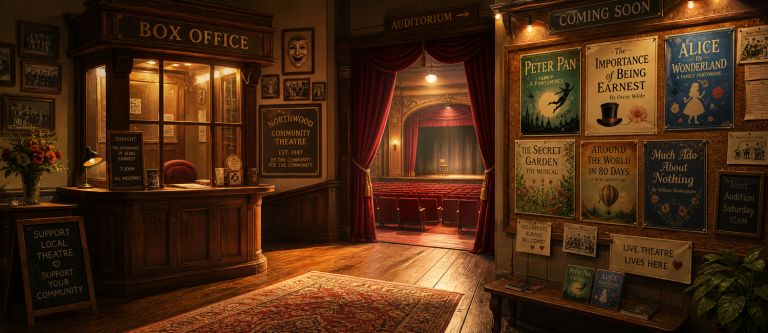
It’s a Friday or Saturday night — we don’t tend to put shows on midweek unless it’s panto season, when all bets and all weeknights are off. The house lights are about to go down, the cast are pacing backstage doing whatever it is actors do to summon the nerve to go on, and I’m standing in the foyer of the Tower Theatre doing the maths I try not to do too often. Tonight’s audience versus tonight’s costs. It’s not always a flattering equation.

If you work in theatre anywhere in the South East right now, you’ll know the feeling. Slower ticket sales. Shows pulled or rescheduled because the numbers simply don’t add up. Patrons who’d normally book without thinking twice now waiting until the last minute, watching their bank balance before they watch the curtain rise. It’s not dramatic in the way theatre is supposed to be dramatic. It’s just quietly, persistently harder than it used to be.

So is this it, then? Is the great British tradition of people putting on costumes in draughty halls and convincing other people to watch them finally winding down, defeated by energy bills and the price of a pint?

No. But we do need to have an honest conversation about why it feels that way, and what we can actually do about it.

The Bit Where I Show You Some Numbers (Don’t Worry, It’s Quick)

Here’s the genuinely strange thing about the current state of UK theatre nationally: more people are going than ever before. Over 37 million people attended theatres across the UK in 2025, with the West End alone welcoming a record-breaking 17.64 million theatregoers. Nationally, audiences aren’t the problem.

But here in the South East, that’s not quite the story on the ground — at least not this year. It’s worth being precise about that: the full-year national statistics are largely looking backwards, and don’t yet capture what’s actually happening right now. This year specifically, many of us have watched ticket sales slow noticeably, and more than a few shows across the region have had to be cancelled or rescheduled simply because the numbers didn’t stack up. The national picture and the local, current picture aren’t telling quite the same story, which makes it harder, not easier, to know what’s actually going on.

What both pictures agree on is the cost side. Production budgets have climbed steadily as labour, materials, energy, and building maintenance costs have increased, while theatres have largely held ticket prices steady to protect access. Translation: venues are eating the cost increases themselves rather than passing them on, which is admirable and also financially unsustainable in roughly equal measure. More than a third of theatres are forecasting an operating deficit this year, rising past half in the subsidised sector.

And that’s before you get to the funding picture, which is its own special kind of bleak. Public funding for arts and culture has dropped significantly per capita since 2010, with local authority contributions falling by as much as 48 per cent. Closer to home, the Astor Theatre in Deal — a proper community venue, not unlike ours — went public last year about a £20,000 shortfall, citing rising energy and supply costs squeezing them from every direction.

So nationally it’s “theatre has got harder and more expensive to make, just as people have less spare cash.” Here in the South East, we’re living that and watching the ticket sales dip on top of it. Two trends heading straight at each other like a particularly slow-motion car crash, with venues like ours caught in the middle, holding a clipboard and a slightly too-optimistic box office target.

What This Actually Looks Like From Where I’m Standing

The data is useful, but I work front of house, not in a spreadsheet, so let me tell you what it actually feels like.

This year so far we’ve put on Noises Off, Patio/Porch, and Dare to Dream Jr, with Two, Gypsy, Frankenstein and My Fair Lady still to come — My Fair Lady opens next Thursday. A real spread already, from farce to youth theatre to intimate drama, with a two-hander, a full-blown musical, and gothic horror still ahead of us — exactly the kind of varied programming a venue like ours should be proud of. And yet it’s been a noticeably harder year to fill seats than it has been in the past, with more of that variety still to sell. It’s the conversation with a regular who loves the show, genuinely does, but is now choosing between this and something else this month because they can’t do both. It’s watching a show that should sell out limp along at sixty per cent because people are booking later and later, holding out to see if anything more pressing comes up first. It’s the slightly sick feeling of having to have the “do we cancel or do we run it at a loss” conversation, which is a conversation nobody goes into theatre management hoping to have.

Panto is, as ever, the exception that proves the rule. Last year’s Jack and the Beanstalk did exactly what panto always does — packed the house, weeknights included, because pantomime occupies a strange and wonderful place in people’s budgets that other theatre doesn’t quite reach. This Christmas we’re bringing you Dick Whittington, and if history is anything to go by, it’ll once again be the one production of the year where the cost-of-living conversation politely steps aside for an hour and a half so everyone can boo the villain in peace. There’s probably a lesson in that, even if I haven’t fully worked out what it is yet.

None of this is anyone’s fault. Nobody’s villain here. People aren’t choosing not to come to the theatre because they’ve stopped caring about it — they’re choosing not to come because the heating bill won. That’s not a value judgement on theatre. That’s just maths, and maths doesn’t care how good your set design is.

So Can We Buck the Trend?

Yes. I genuinely believe that, and not in a forced “stay positive!” way that ignores the reality of the situation — more in a “we’ve actually got more tools than we think” way. Here’s where I think the fight gets won.

Make the price barrier softer, not lower. Slashing ticket prices isn’t sustainable when costs have gone the other way, but flexible pricing is genuinely effective. Pay-what-you-can performances, even just one per run, signal that you’re not trying to extract maximum value from people who don’t have it. Schemes like this have already shown that audiences from less affluent backgrounds, who are markedly less likely to attend otherwise, will come when the financial barrier is genuinely removed rather than just nudged.

Lean harder into community, because that’s the one thing the multiplex can’t compete with. A cinema chain cannot offer you the feeling of watching your neighbour’s kid nail their first ever solo line on stage. Community and amateur theatre has something the West End, for all its budget, doesn’t: people watching people they actually know. That’s not a consolation prize. That’s the entire point, and we undersell it constantly.

Marketing matters more than ever, and it’s relentless work. This isn’t a knock on anyone — marketing a theatre programme well is genuinely hard, thankless, never-finished work, and the people doing it across this industry deserve far more credit than they get. Audiences need to be told a show exists, repeatedly, in places they actually look, which means constant social media, local press, partnerships with other community groups — none of it flashy, all of it essential. I’ve huge respect for anyone holding that particular plate spinning, ours included.

And the best marketing isn’t ours to do at all. No poster, post, or press release beats a friend turning to you and saying “you have to see this.” Word of mouth is still the single most powerful tool in theatre’s box, and it doesn’t cost a venue a penny — it just needs patrons to actually use it. If you saw something you loved, tell someone. Tag the theatre, leave a review, mention it to a colleague over coffee, drag a reluctant partner along next time. Audiences have more power to keep their local theatre alive than most of them realise, and it costs nothing but a sentence.

Diversify what “coming to the theatre” means. Talks, workshops, youth productions, am-dram showcases, even just the bar being a nice place to sit on a Friday — every reason someone walks through the door that isn’t strictly “buy a ticket to a play” builds the habit of choosing you. Habit is worth more than any single sale.

Be honest with your audience about the squeeze. People are remarkably understanding when you tell them the truth. “We need your support to keep doing this” lands better than silence followed by sudden closure. The Astor Theatre’s crowdfunder worked, in part, because they said the quiet part out loud instead of pretending everything was fine until it very publicly wasn’t.

The Show Goes On (Probably With a Slightly Smaller Budget)

I don’t think we’re watching the end of theatre. I think we’re watching theatre get squeezed into proving, all over again, why it matters — and honestly, slightly annoyingly, I think it’ll manage it. It always has. Theatre has survived plagues, world wars, the invention of the television, and at least one period where everyone thought immersive Shakespeare in a car park was a good idea. It’ll survive this too.

But survival isn’t automatic, and it isn’t somebody else’s job. It’s box office numbers and bar takings and that one person who tells two friends about a show they loved. It’s every front of house manager doing slightly anxious maths in a foyer on a Friday, hoping the room fills up.

So if you’ve got a local theatre — and in Kent, you almost certainly have several rather good ones — go. Book the ticket. And don’t just think of it as plays, either. A venue like the Tower isn’t only Two and Gypsy and Frankenstein; it’s tribute acts that’ll have you up dancing, comedy nights that’ll have you in stitches, kids’ shows that’ll make a Saturday morning magic for someone small, and panto that’ll have the whole family booing a villain together. There is very likely something on at your local theatre this month that’s exactly what you fancy, whatever mood you’re in.

So go. Book the ticket, whatever it’s for. Bring someone who’s never been. Buy the interval ice cream even though it’s mysteriously the same price as a small car. Tell someone about it afterwards. It genuinely, actually helps more than you’d think — and it’s the difference between a theatre that survives this and one that quietly doesn’t.

What’s your local theatre, and what’s keeping you coming back — or keeping you away? I’d love to hear it in the comments.


*Gary is the Front of House Manager at the Tower Theatre in Folkestone, and has the spreadsheets to prove it.*