
Posts

Let me paint you a picture.

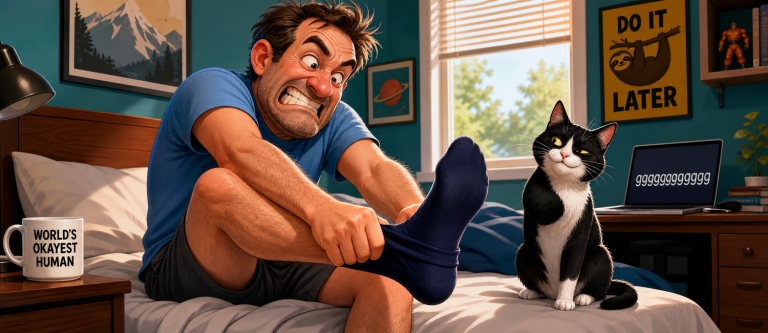
It’s morning. I’m sitting on the edge of the bed, sock in hand, preparing for what has become the daily ritual that most accurately summarises my relationship with my own body. My foot needs to reach the sock. The sock is approximately thirty centimetres away. This should not be a problem. It is, nonetheless, a significant problem.

What follows can only be described as a man attempting to kickstart a motorbike with his foot while simultaneously being electrocuted. There is lunging. There is twisting. There is a level of grim determination usually reserved for people attempting Everest. Eventually — eventually — the sock goes on. Victory.

This is my life now. And honestly? It’s the funniest part of my morning, right up until it isn’t.


I’ve been thinking lately about the accumulation of it all. The full inventory of what my body has put me through over the years, laid out plainly. Not for sympathy — I’m not built that way — but because I think there’s something worth saying about how you carry it. How you keep going. How you find the dark laugh in it when the alternative is just sitting with it, and sitting with it is no fun at all.

So here it is. The full list. Don’t say I didn’t warn you.

In 2012 I had surgery for pectus excavatum — a congenital chest wall deformity where the breastbone sinks inward, asymmetrically in my case. The surgery to correct it is called the Ravitch procedure, and it is not, to put it mildly, a minor operation. My surgeon broke ten ribs and my sternum, repositioned everything, and held it all together with titanium bars. I was out of action for a year. A full year. I joke that I’m part robot now, which is true. That was the opening act.

Then there are the knees. Brittle cartilage, both of them, a gift I’m fairly confident I earned by jumping twelve to fifteen feet off Cleethorpes Pier onto the sand in my younger and considerably more stupid days. At the time it felt brilliant. My knees have been filing a formal complaint about it ever since.

Then, in 2019, came the diagnosis nobody wants: stage 4 SMZL — Splenic Marginal Zone Lymphoma. Cancer. I’ll let that land for a second. Six months of chemotherapy followed, ending in March 2020. Two weeks later, the country went into lockdown. I’d like to say the timing was darkly poetic. It was, in fact, just dark. The world shutting down precisely as I emerged from the other side of chemo — when you’re supposed to start rebuilding, seeing people, feeling human again — is something I don’t talk about much. But it happened, and it cost something.

It cost more than I realised at the time. Because my immune system had taken such a battering from the chemo, I had to shield for the entire first year of lockdown. I did not leave the four walls of my home for twelve months, other than a couple of hospital follow-up appointments. Twelve months. No fresh air, no wandering, no pub, no people. Just the walls, the silence, and a body I was still learning to live in after everything it had been through. I don’t say this to make anyone feel sorry for me. I say it because it happened, and it shaped things, and pretending otherwise would be dishonest.

The cancer is currently in remission. The less good news is that it’s incurable — I’ll carry it for the rest of my life, managing it, monitoring it, living alongside it like an uninvited lodger who won’t leave but has at least learned to keep the noise down. I’ve made my peace with it. You have to.

In February 2024, I tore a muscle in my back hauling ten-stone beer barrels at work. The tear itself was bad enough. What followed was worse: bone spurs developing along my spine, my body attempting to repair itself and making a fairly poor job of it. Now I live with constant pain. Some days it’s manageable — background noise, a dull ache I’ve learned to work around. Other days I can barely stand. The socks, as you now know, are every day regardless.

Four months later, in June 2024, I was diagnosed with type 2 diabetes. Of course I was. At this point my body was clearly just working through a list.

And then there’s the ADHD. Not yet officially confirmed, but we’re heading there — the pieces fit too well to pretend otherwise. Here’s the thing about having ADHD when you also have a back injury that’s stripped most of the hyperactivity out of you: the H has largely gone quiet. My body isn’t bouncing off walls anymore. My brain, however, absolutely is. It will pick a song — usually, inexplicably, a McFly song — and play it on a loop for weeks. When I wake up. When I go to sleep. In my dreams, sometimes. Full production. No fade out. No mercy. Thank fuck I like McFly, genuinely, because I think a Coldplay phase would finish me off entirely.


And then there’s Sadie.

My wife lives with her own long-term chronic health conditions — I won’t share the details here because they’re hers to share, not mine — but what I will say is that managing my own health while also being her carer is something I carry with a lot of love and, occasionally, a lot of weight. I have a Carers Card. An actual, official Carers Card. I am, technically, a registered carer. If you’d told me that ten years ago I’d have laughed. Now I carry it in my wallet and feel, if anything, quietly proud of it. We look after each other. That’s what it comes down to.


So. Did I do something very bad in a past life? Statistically, it’s starting to feel that way. Titanium ribs. Lymphoma. Knees that haven’t forgiven me for a pier jump in my twenties. A back staging a slow mutiny. Diabetes. ADHD. A wife I love deeply and care for practically, every day.

The thing is, I don’t say any of this from a place of despair. I say it from a place of — I don’t know, exhausted honesty? There’s a version of this post where I wrap it up neatly with something about resilience and perspective and silver linings. But that would be a bit dishonest, and I’m not really in the business of performing okayness at the moment.

What I am in the business of is getting through the day. Doing the work I love. Looking after Sadie. And spending time with Reggie — our three-legged cat, adopted at the end of April, who has brought more light into this house than I can properly explain. He gets around better on three legs than I currently do on two, which says something, though I’m not entirely sure what. He also likes to help me write. Daily. Usually by walking across the keyboard at a critical moment and contributing a paragraph of his own — ggggggggggggg, typically, or perhaps xxxxxcccc if he’s feeling creative. I’ve learned to save regularly. He has not learned to care.

And talking about it. Because I think a lot of people are carrying their own version of this list — the accumulation of things, the ways their body has let them down or surprised them or just refused to cooperate — and not saying much about it. So consider this me saying something.

What’s on your list? Drop it in the comments. I’d genuinely love to know I’m not the only one having a one-sided argument with my own spine every morning.


*Gary is a designer, developer, theatre FOH Manager, and occasional filmmaker songwriter based in Dover, Kent. He puts his socks on every day. It takes a while.*