
Posts

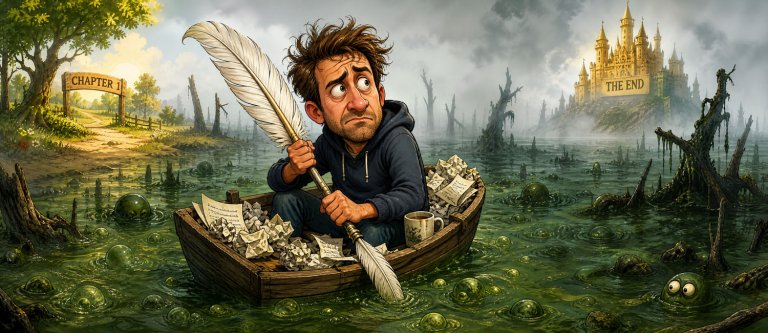
At some point, almost every novelist finds themselves stuck writing a novel they were absolutely convinced they had figured out. The initial excitement has evaporated. The opening chapters, which came so easily, are now a distant memory. The ending — which seemed so clear in your head three months ago — might as well be in another country. And between you and it sits a vast, featureless expanse of story that refuses to cooperate. This is called the murky middle, and it is completely, thoroughly, miserably normal.

The murky middle has derailed more novels than bad ideas, busy lives, and imposter syndrome combined. It is the place where most unfinished manuscripts live. The good news is that being stuck writing a novel is a solvable problem. The less good news is that the solution usually involves actually writing. That is precisely the thing you’ve stopped doing. However, here’s how to get back on track.


Step One: Diagnose Before You Medicate

There is no single reason for being stuck, which means there is no single fix. Before you try anything else, spend ten minutes working out which of the following most accurately describes your situation.

You have run out of plot. You know your beginning and you know your ending, but the middle — the long, complicated, consequential middle — has turned out to be much harder to fill than anticipated. This is a planning problem with a planning solution.

You have lost faith in the story. The idea that seemed so brilliant in October now seems embarrassing and derivative and probably not worth anyone’s time. This is not a plot problem. This is a confidence problem, and it lies to you constantly.

You have written yourself into a corner. A character has done something that made perfect sense at the time, and now you have no idea how to continue from where you’ve left them. Additionally, going back feels like admitting defeat. This is a fixable craft problem.

You have not actually been writing. Life happened. Work got busy. A box set appeared. You stopped writing for two weeks and then three and then somehow it’s been two months and the document feels like something from a previous life. This is a habit problem.

Each of these needs a different response. Therefore, picking the right one matters.

If You’ve Run Out of Plot: Outline the Next Five Chapters Only

When you’re stuck writing a novel because the middle has collapsed, the instinct is often to outline the entire remaining book from where you are to the end. Resist this. It’s exhausting, it usually produces an outline you don’t follow, and it delays actually writing by another fortnight.

Instead, outline the next five chapters only. Just five. What needs to happen to move things forward? What does your protagonist need, what’s stopping them getting it, and who or what is going to complicate that in the next five scenes? Write rough notes for each chapter — a paragraph is plenty — and then write the first of them.

Five chapters is achievable. It’s also enough to generate momentum, which will tell you what comes next better than any amount of staring at a planning document.

If You’ve Lost Faith: Put the Manuscript Away for a Week

This sounds like permission to procrastinate. It isn’t. The distinction matters enormously when you’re stuck writing a novel.

When you’re too close to a piece of writing, you lose the ability to read what’s actually on the page. Instead, you read what you remember writing, which is invariably worse than the reality. A week away from the manuscript — a genuine week, in which you do not open the document, think about the document, or tell anyone about the document — restores the necessary distance to read it as something approaching a reader would.

After the week, re-read from the beginning. Don’t edit. Don’t make notes. Just read it through as if someone else wrote it. For most writers, this produces one of two results: either it’s considerably better than they remembered, or they find exactly where the problem actually is, which is usually not where they thought it was.

Either outcome is progress. Furthermore, knowing where the real problem is beats endlessly reworking the wrong chapter.

Write the Next Scene Terribly on Purpose

This is one of the more counterintuitive solutions when you’re stuck writing a novel, but it works surprisingly often.

Set a timer for twenty minutes. Open the document. Write the next scene as badly as you possibly can. Don’t think about whether it’s good. Don’t edit as you go. Don’t stop when it feels wrong. Write placeholder dialogue like “THEY HAVE AN ARGUMENT ABOUT SOMETHING, FIGURE OUT LATER” if necessary. Write “[INSERT DESCRIPTION OF LOCATION HERE]” if the words won’t come. The goal is not a good scene. The goal is a scene that exists, because a scene that exists can be fixed, and a blank page cannot.

Moreover, what happens with this approach more often than not is that somewhere in the middle of writing badly on purpose, you accidentally start writing well. The permission to be terrible removes the pressure that was blocking you in the first place. Don’t tell anyone. It’s embarrassing. It works.

Jump Ahead and Write the Scene You’re Excited About

There is, very likely, a scene somewhere later in your novel that you have been looking forward to writing since you started. You can see it clearly. You know what happens in it. You might even have some of the dialogue already written in your notes.

Go write that scene now.

Non-linear drafting is not cheating. It is a legitimate way of maintaining creative momentum when the sequential approach has stalled. Write the scene you can write. The hole it leaves in the middle can be filled in later, and often the act of writing ahead clarifies what needs to happen to get there. Additionally, finishing something — even a scene that’s technically out of sequence — reminds your brain that forward motion is possible, which is useful information when you’ve been stuck for weeks.

Interview Your Characters

This sounds like the sort of advice you’d find in a creative writing workshop run by someone who uses the word “journey” too freely. Nevertheless, it is genuinely useful, so bear with it.

When you’re stuck writing a novel, particularly when you’ve written yourself into a corner, the problem is frequently that a character is being made to do something they wouldn’t actually do. The plot requires them to go left. However, the person they’ve become over the previous ten chapters would emphatically go right. You’ve been staring at this scene for two weeks because somewhere below the level of conscious thought, you know something is wrong with it.

Open a blank document. Ask your protagonist, in writing, what they want. Then ask what they’re afraid of. Ask what they would do next if you — the author with your plot requirements — weren’t in the way. Write their answers in their voice. You are not losing your mind. You are debugging a character, and the answer to why you’re stuck is often in there somewhere.

Stuck Writing a Novel? Try Changing Something Dramatic

Sometimes a story needs to be broken before it can be fixed.

If you’ve been stuck for a long time and none of the gentler approaches have worked, consider doing something drastic to the plot. Kill a secondary character who wasn’t supposed to die. Add a new character who shouldn’t be there yet. Move the story to a different location. Have your protagonist make a catastrophic decision and then work out the consequences. Change the timeline.

This is not vandalism. It is diagnosis by experimentation. Many of the changes you make won’t survive into the final draft. However, they might unlock a direction you hadn’t considered, and even the ones that don’t work tell you something useful about why the story is stuck. As a result, you end up knowing your own book better, which is never wasted.

Set Micro-Targets: The Two-Hundred-Word Rule

When you’ve been stuck writing a novel for a while, the target word count at the top of your document becomes the enemy. Fifty thousand words remaining feels like a geological timeframe. Therefore, stop looking at the total. Focus on today’s target only, and make that target absurdly small.

Two hundred words. That is approximately the length of two decent paragraphs. It takes most writers less than fifteen minutes. It is so achievable that refusing to do it starts to feel faintly ridiculous, which is precisely the psychological leverage you need.

Two hundred words a day is 73,000 words in a year. That is a complete first novel. The trick is not the number. The trick is re-establishing the habit of showing up, because writing is significantly easier to continue than it is to restart from cold.

Once the habit is re-established, the targets can grow. For now, small and consistent beats ambitious and occasional every time.

The Trusted Reader: Handle With Extreme Care

Showing your unfinished manuscript to someone else is a double-edged sword of the sharpest possible kind.

On one hand, a trusted reader — specifically, someone who reads widely in your genre and can give useful critical feedback — can often see exactly where the story has gone wrong. Fresh eyes are valuable. They haven’t been staring at the same document for four months.

On the other hand, the wrong reader at the wrong moment can destroy the confidence of a first-time novelist in a single conversation. Consequently, be exceptionally selective about who you show an unfinished draft to. Not your mum. Not your most enthusiastic friend. Ideally, someone who can separate what they personally like from what’s working or not working in the story.

Also, share only the chapters you feel represent the work fairly. Sharing the section you’re stuck on specifically — the rough, placeholder-heavy disaster zone — and asking someone to assess the plot from it is not a useful exercise for either of you.

The Proper Break vs the Procrastination in Disguise

There is a difference between taking a deliberate break from your novel and simply not writing it for an increasingly long time while feeling bad about not writing it. One of these is a creative tool. The other is a comfortable waiting room with no exit.

A deliberate break has a fixed end date. You decide in advance that you will not work on the novel for one week, and that on a specific day you will return to it. In the meantime, you do things that feed your creativity: read in your genre, watch films, go for walks, notice things. You are not avoiding the novel. You are letting it rest while you fill the tank.

Indefinite not-writing, by contrast, involves a lot of time thinking about writing while doing other things, and a low-level guilt that follows you around but doesn’t actually produce any pages. If this describes your current situation, set a date to return and put it in your calendar. Then keep it.

What Not to Do When You’re Stuck Writing a Novel

This section exists because some of the most popular advice for getting unstuck is, with the greatest respect to whoever came up with it, completely counterproductive. Knowing what to avoid saves time.

Don’t tell everyone you’re stuck. Talking about being stuck writing a novel is not the same as solving the problem. In fact, it often releases just enough creative pressure to delay actually doing anything about it. Pick one person who can help and talk to them. Don’t post about it online, where well-meaning but useless advice will arrive in large quantities.

Don’t delete anything. The temptation when you’re stuck is to conclude that everything you’ve written is the problem, and that starting fresh would fix it. It almost never fixes it. Cut the chapters you no longer want into a separate document called something like “Outtakes” or “Not Sure About This Bit.” Keep them. You may need them later, and you will certainly feel better knowing they still exist.

Don’t start researching. Research is the comfort food of the writer who is stuck writing a novel. It feels productive. It fills hours. It produces the satisfying sensation of doing something useful without actually moving the story forward by a single word. If you need specific research to write a specific scene, do the minimum required and write the scene. The deep-dive can happen in revision.

Don’t compare your draft to published books. When you’re stuck writing a novel and feeling low about the whole enterprise, the worst possible thing you can do is pick up a book you admire and compare it to your unfinished draft. You are comparing a rough, incomplete, unedited document to a finished, professionally edited, sometimes-decades-in-the-making piece of work. They are not comparable things, and measuring yourself against them will tell you nothing useful.

Don’t wait for inspiration. Inspiration is real. It also arrives reliably for people who are already sitting at the keyboard, and much less reliably for people who are waiting until they feel like writing. The feeling of wanting to write and the act of writing are two different things. One follows the other, but not necessarily in the order you’d expect.

Remember Why You Started

This is the last resort, not the first, because it requires a degree of honesty that’s easier to access when everything else has been tried.

Go back to whatever you had before the first word of the novel — your original notes, the email you sent yourself at midnight when the idea arrived, the scrap of paper with a half-formed premise on it. Read it. Find the emotional reason you wanted to write this particular story. Not the practical reason — “it seemed like a good idea” or “I’ve always wanted to write a novel” — but the specific, personal reason this story needed to exist.

That reason is still there. The murky middle has buried it under self-doubt and plot problems and the accumulated weight of every chapter that didn’t go as planned. However, it hasn’t gone anywhere. Getting back to it, and reminding yourself that the story is worth the difficulty, is sometimes the only thing that matters.

If you’re just getting started and haven’t hit the murky middle yet — lucky you — my guide on how to start writing a novel covers the first-chapter fundamentals that make the middle less likely to collapse in the first place. And if it’s creative projects of the non-novel variety giving you grief, the same stubborn principle applies: the only way out is through, and through is always worth it.