
Posts

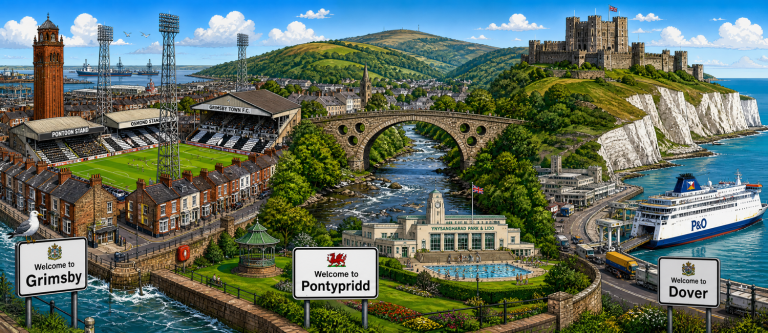
I live in Dover. Have done for a few years now, after nine years in Folkestone before that. Sadie’s here, Reggie the three-legged cat is here, work’s here, half of my adult life is built on this particular stretch of coastline. And yet if you read enough of what I write — the screenplays, the novels — you’d be forgiven for thinking I’d never actually left Grimsby. Or possibly that I’d quietly relocated to Pontypridd without telling anyone, including myself.

Neither is true. I’ve lived in Kent for thirteen years. I’ve spent a grand total of two weeks in Wales, ever. And yet my imagination appears to have filed a permanent change-of-address form with both places without consulting me first.

I find this mildly ridiculous, so naturally I’m writing a blog post about it.


Grimsby: Explainable, At Least

Let’s deal with the sensible one first. A novel called Small Fish, set in a fictionalised version of the town I called Grimhaven, twenty-four chapters deep, seven of them actually written, which for a writer is basically a personal best. A chunk of my zombie novel, End of the Line, is set in Grimsby too, because apparently even the apocalypse has to start somewhere familiar. Ideas that keep wandering back up the A180 whether I’ve invited them to or not.

This one I can explain. I grew up there. The better part of thirty years, give or take, versus just over a decade in Kent — so when my hands go back to Grimsby on the page, that’s not nostalgia, that’s just basic arithmetic. Kent is where I live. Grimsby is apparently where my subconscious still has a season ticket.

Small Fish became Grimhaven rather than literal Grimsby, mostly because I wasn’t trying to write a documentary about a real place that’s continued existing without my permission since I left it. I wanted the feeling of the place — the grit, the football, the very specific grey of a sky over the docks — without having to be accurate about, say, whether a particular chip shop is still open. (It’s probably not. They never are.) End of the Line, on the other hand, just goes ahead and uses the real place, possibly on the basis that if the dead are going to rise anywhere, it might as well be somewhere I know the geography of well enough to write a decent chase scene.

So: Grimsby makes sense. Moving on.

Wales: Does Not Make Sense, At All

Here’s the bit where I lose the plot slightly, so bear with me.

I’ve been to Wales twice in my entire life. A week each time — once in 1992, when I was a child and had approximately zero say in the itinerary, and again in 2025, as a fully grown adult who really should know better by now. Of that second trip, exactly one hour was spent in Pontypridd, the town where my grandmother was born. One hour. I’ve spent longer than that queuing for a gig.

And somehow, that one hour appears to have rewired something. Not the two weeks of general, perfectly pleasant Welsh holidaying. Not the scenery, not the castles, or the Blaenau Festiniog Light Railway, not whatever I had for lunch on either trip, which I genuinely cannot recall. Just the hour. In Pontypridd. Specifically.

I have no rational explanation for this, and I want to be clear that I’ve tried. My grandmother was from there, which is the only actual evidence I’ve got, and on paper it’s not much to build an entire emotional attachment on. People meet their actual living relatives for longer than an hour and feel less moved by it. I’m half convinced my own ancestors are mildly embarrassed on my behalf — “he was here for sixty minutes and now he wants to retire here, bless him.”

Because that’s the other thing. Sadie has mentioned, more than once, that when we eventually retire, Wales might be the answer. And the genuinely baffling part is that I don’t immediately laugh this off. Some small, currently unsupervised part of my brain goes “yeah, alright then,” based entirely on an hour I spent there once, in a town I couldn’t confidently find again without a satnav.

I have, if I’m honest, more feeling toward Wales as a concept than I have toward England, despite having lived in England my entire life and visited Wales for a combined total of roughly two weeks. This is not a sensible ratio. I am aware it is not a sensible ratio. I have made my peace with the fact that my sense of belonging apparently does not consult a spreadsheet before making decisions.

So What’s Actually Going On Here

I think — and this is very much a working theory, subject to change without notice — that creative work, and maybe identity generally, doesn’t care all that much about how long you’ve spent somewhere. It cares about whatever’s load-bearing. Kent is where my actual life happens: the bills, the cat, the theatre, the back pain, the whole functioning-adult operation. Grimsby is the thirty-year foundation underneath it, fully explicable, no mystery required. And Wales is just… in there. Uninvited. Unexplained. Possibly ancestral, possibly just a really good hour, possibly both.

I’ve stopped trying to force a tidy answer out of the Wales thing, mostly because I don’t think there is one, and partly because demanding logic from your own feelings is a famously losing battle. Some places just get under your skin regardless of how much actual time you’ve clocked there, like a song you’ve heard once and now can’t stop humming, except the song is a Welsh valley town and the humming is a vague but persistent desire to live there one day.

So if you ever read something of mine set in a windswept fictional fishing town, you’ll know where that’s from. And if, decades from now, you hear I’ve retired to a small house somewhere near Pontypridd having visited the place for a cumulative total of sixty minutes, please don’t act surprised. Some of us were always going to end up exactly where we couldn’t logically explain.

Does anyone else feel inexplicably tied to somewhere they’ve barely been? Or is it just me, romanticising a single hour like it owes me a mortgage? Let me know in the comments — I could use the company.


If you enjoy what I do, consider supporting me! Every little bit means the world!

Gary grew up in Grimsby, lives in Dover, Kent, and has a worrying amount of feelings about a Welsh town he’s visited once, for sixty minutes.

There is a very specific kind of confidence that only exists between the hours of midnight and roughly half past two in the morning, and I want to talk about it, because it has given me no end of grief over the years.

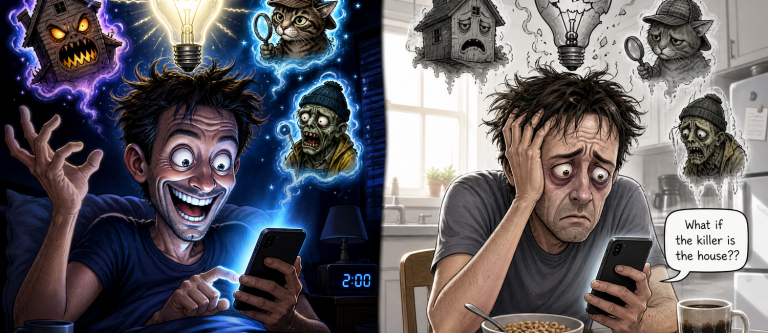
You know the one. You’re lying in bed, supposedly asleep, and your brain — having clocked off from anything useful hours ago — suddenly clears its throat and goes “right, here’s a thought.” And it’s not just a small thought. It’s a plot twist so perfectly constructed that you genuinely sit up in the dark and think: I am a genius, I’ll be fielding calls from Netflix before my toast goes cold.

I get my phone. I type it into my Notes app with the shaky urgency of a man defusing a bomb, because if I don’t capture this exact wording right now, in this exact moment, the universe will swallow it up and consign it to the annals of history. Then I go back to sleep, deeply satisfied, basically already drafting my awards speech.

Then it’s 7am, and I read it back.


The Morning Read-Back: A Crime Scene

Here is a small sample of things 2am-Gary has typed into my phone with absolute, unshakeable conviction:

“What if the killer is a poltergeist”

“Grimhaven but it’s in an alternative universe?”

“What if they push criminals through a time machine so they have to serve their punishment dodging dinosaurs?”

That last one, for the record, I stand by slightly more than the others. But the broader point remains: not one of these, read in daylight, with actual blood sugar in my system, survives contact with reality. They read less like notes from a working novelist and more like the rambling words of a madman who hasn’t slept for weeks and is living off copious amounts of caffeine.

It’s not that the ideas are always bad, exactly. It’s that 2am-Gary has access to none of the things that make an idea actually usable — things like plot logic, structural consequences, or any memory whatsoever of what happened in chapter six. 2am-Gary is a wildfire with ideas but no thought on whether any of them are actually any good.

Small Fish Has Survived Several Assassination Attempts

Small Fish — my football novel, currently twenty-four chapters planned, seven actually written, which is either a healthy work-in-progress or a crime scene depending on the day — has been “saved” by 2am ideas more times than I can count, and “saved” is doing an enormous amount of heavy lifting in that sentence.

At various points, 2am-Gary has decided that Grimhaven needed a secret underground tunnel system, that one of the central characters was secretly somebody’s long-lost brother for reasons that made perfect sense at 2am and absolutely no sense by Tuesday, and — my personal favourite — that the entire third act should be told backwards. Not flashback-backwards. Properly backwards, like Memento, except I am not Christopher Nolan, I am a man with a bad back trying to finish a novel about lower-league football, and the two things do not need to intersect.

None of these ideas made it into the actual manuscript. All of them felt, in the moment, like the missing piece I’d been searching for. This is the great cruelty of 2am: it doesn’t just generate bad ideas, it generates bad ideas that feel exactly identical to good ones, with none of the usual warning signs. There’s no flashing light. No klaxon. Just pure, false certainty, delivered straight to your nervous system at the worst possible hour for critical thinking.

End of the Line Got It Even Worse

My zombie novel, End of the Line, partly set in Grimsby because apparently even the undead have hometown pride, has weathered its own share of 2am interference. There was a stretch of about a fortnight where I was completely convinced the zombies needed an origin involving the docks, some kind of industrial chemical spill with a name I’d apparently already decided on, fully formed, like I’d seen the safety data sheet myself in a dream.

I wrote two pages of this at, predictably, gone midnight. I read it back the next morning with the specific horror of a man finding out what he did at a party he doesn’t remember attending. It wasn’t unsalvageable. It was, worse than that, almost good — good enough that I had to sit with it for an actual half hour before admitting it didn’t fit, which is far more time than a chemical-spill zombie subplot has any right to occupy in a grown man’s Tuesday.

So Why Does This Keep Happening

I’ve got a theory, which is that your brain, late at night, with all its usual inhibitions switched off, finally gets to do the thing it actually wants to do, which is be reckless. Daytime-Gary has deadlines, structural concerns, the nagging awareness that a 24-chapter outline doesn’t actually want a tunnel system shoved into chapter fifteen. 2am-Gary has none of that. 2am-Gary just wants to see what happens if the cat solves the murder.

And honestly, I don’t think the answer is to stop having the ideas. Every so often — rarely, but often enough to keep the habit alive — something genuinely good survives the morning read-back. The trick, as far as I can tell, isn’t suppressing 2am-Gary. It’s just refusing to let him anywhere near the actual manuscript without a chaperone. Write it down, by all means. Just don’t act on it until you’ve had breakfast, regained the use of your frontal lobe, and confirmed that no, the killer cannot, in fact, be the house.

Does anyone else’s brain turn into an unsupervised intern the second the lights go off? I’d love to know I’m not the only one waking up to notes I have no memory of writing and even less ability to explain. Tell me your worst 2am idea in the comments — bonus points if you also wrote it down and have since had to live with it.


Gary writes novels, mostly during the day, despite his best efforts to convince himself otherwise at 2am.