
Posts

Let me paint you a picture.

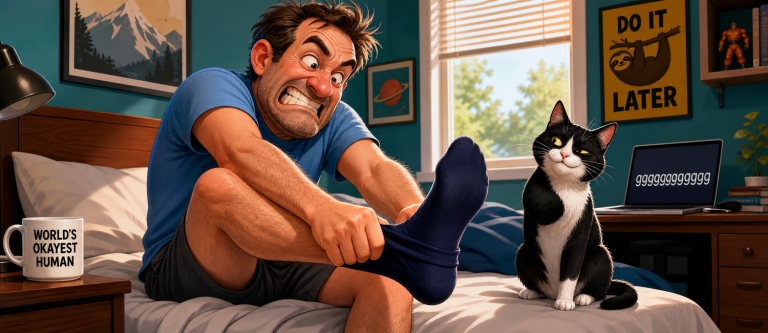
It’s morning. I’m sitting on the edge of the bed, sock in hand, preparing for what has become the daily ritual that most accurately summarises my relationship with my own body. My foot needs to reach the sock. The sock is approximately thirty centimetres away. This should not be a problem. It is, nonetheless, a significant problem.

What follows can only be described as a man attempting to kickstart a motorbike with his foot while simultaneously being electrocuted. There is lunging. There is twisting. There is a level of grim determination usually reserved for people attempting Everest. Eventually — eventually — the sock goes on. Victory.

This is my life now. And honestly? It’s the funniest part of my morning, right up until it isn’t.


I’ve been thinking lately about the accumulation of it all. The full inventory of what my body has put me through over the years, laid out plainly. Not for sympathy — I’m not built that way — but because I think there’s something worth saying about how you carry it. How you keep going. How you find the dark laugh in it when the alternative is just sitting with it, and sitting with it is no fun at all.

So here it is. The full list. Don’t say I didn’t warn you.

In 2012 I had surgery for pectus excavatum — a congenital chest wall deformity where the breastbone sinks inward, asymmetrically in my case. The surgery to correct it is called the Ravitch procedure, and it is not, to put it mildly, a minor operation. My surgeon broke ten ribs and my sternum, repositioned everything, and held it all together with titanium bars. I was out of action for a year. A full year. I joke that I’m part robot now, which is true. That was the opening act.

Then there are the knees. Brittle cartilage, both of them, a gift I’m fairly confident I earned by jumping twelve to fifteen feet off Cleethorpes Pier onto the sand in my younger and considerably more stupid days. At the time it felt brilliant. My knees have been filing a formal complaint about it ever since.

Then, in 2019, came the diagnosis nobody wants: stage 4 SMZL — Splenic Marginal Zone Lymphoma. Cancer. I’ll let that land for a second. Six months of chemotherapy followed, ending in March 2020. Two weeks later, the country went into lockdown. I’d like to say the timing was darkly poetic. It was, in fact, just dark. The world shutting down precisely as I emerged from the other side of chemo — when you’re supposed to start rebuilding, seeing people, feeling human again — is something I don’t talk about much. But it happened, and it cost something.

It cost more than I realised at the time. Because my immune system had taken such a battering from the chemo, I had to shield for the entire first year of lockdown. I did not leave the four walls of my home for twelve months, other than a couple of hospital follow-up appointments. Twelve months. No fresh air, no wandering, no pub, no people. Just the walls, the silence, and a body I was still learning to live in after everything it had been through. I don’t say this to make anyone feel sorry for me. I say it because it happened, and it shaped things, and pretending otherwise would be dishonest.

The cancer is currently in remission. The less good news is that it’s incurable — I’ll carry it for the rest of my life, managing it, monitoring it, living alongside it like an uninvited lodger who won’t leave but has at least learned to keep the noise down. I’ve made my peace with it. You have to.

In February 2024, I tore a muscle in my back hauling ten-stone beer barrels at work. The tear itself was bad enough. What followed was worse: bone spurs developing along my spine, my body attempting to repair itself and making a fairly poor job of it. Now I live with constant pain. Some days it’s manageable — background noise, a dull ache I’ve learned to work around. Other days I can barely stand. The socks, as you now know, are every day regardless.

Four months later, in June 2024, I was diagnosed with type 2 diabetes. Of course I was. At this point my body was clearly just working through a list.

And then there’s the ADHD. Not yet officially confirmed, but we’re heading there — the pieces fit too well to pretend otherwise. Here’s the thing about having ADHD when you also have a back injury that’s stripped most of the hyperactivity out of you: the H has largely gone quiet. My body isn’t bouncing off walls anymore. My brain, however, absolutely is. It will pick a song — usually, inexplicably, a McFly song — and play it on a loop for weeks. When I wake up. When I go to sleep. In my dreams, sometimes. Full production. No fade out. No mercy. Thank fuck I like McFly, genuinely, because I think a Coldplay phase would finish me off entirely.


And then there’s Sadie.

My wife lives with her own long-term chronic health conditions — I won’t share the details here because they’re hers to share, not mine — but what I will say is that managing my own health while also being her carer is something I carry with a lot of love and, occasionally, a lot of weight. I have a Carers Card. An actual, official Carers Card. I am, technically, a registered carer. If you’d told me that ten years ago I’d have laughed. Now I carry it in my wallet and feel, if anything, quietly proud of it. We look after each other. That’s what it comes down to.


So. Did I do something very bad in a past life? Statistically, it’s starting to feel that way. Titanium ribs. Lymphoma. Knees that haven’t forgiven me for a pier jump in my twenties. A back staging a slow mutiny. Diabetes. ADHD. A wife I love deeply and care for practically, every day.

The thing is, I don’t say any of this from a place of despair. I say it from a place of — I don’t know, exhausted honesty? There’s a version of this post where I wrap it up neatly with something about resilience and perspective and silver linings. But that would be a bit dishonest, and I’m not really in the business of performing okayness at the moment.

What I am in the business of is getting through the day. Doing the work I love. Looking after Sadie. And spending time with Reggie — our three-legged cat, adopted at the end of April, who has brought more light into this house than I can properly explain. He gets around better on three legs than I currently do on two, which says something, though I’m not entirely sure what. He also likes to help me write. Daily. Usually by walking across the keyboard at a critical moment and contributing a paragraph of his own — ggggggggggggg, typically, or perhaps xxxxxcccc if he’s feeling creative. I’ve learned to save regularly. He has not learned to care.

And talking about it. Because I think a lot of people are carrying their own version of this list — the accumulation of things, the ways their body has let them down or surprised them or just refused to cooperate — and not saying much about it. So consider this me saying something.

What’s on your list? Drop it in the comments. I’d genuinely love to know I’m not the only one having a one-sided argument with my own spine every morning.


*Gary is a designer, developer, theatre FOH Manager, and occasional filmmaker songwriter based in Dover, Kent. He puts his socks on every day. It takes a while.*

Today I’m very happy. In October 2019 I was diagnosed with stage 4 non-Hodgkin Lymphoma, or more specifically a rare and incurable type called Splenic Marginal Zone Lymphoma. I underwent six months of chemotherapy and came out the other side in complete remission. Today I am still in remission.

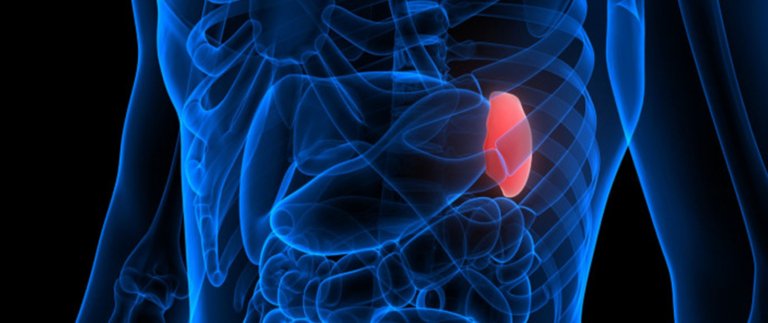
Hearing the words stage 4 and all the connotations associated with that panicked me but I was told that I should treat it more like a chronic disease as opposed to incurable cancer. The haematologists said I will probably die with it as opposed to dying from it as it’s such a slow-growing disease. Splenic Marginal Zone Lymphoma (SMZL) is a slow-growing (indolent) B-cell non-Hodgkin lymphoma (NHL). It usually affects the spleen, bone marrow and blood. It can sometimes affect lymph nodes in the abdomen. I had a massive spleen (two to three times its normal size) and a 30% involvement of the bone marrow and I lost almost two stone prior to diagnosis. It was classified at stage 4 because of the bone marrow involvement.

I was supposed to have six months of chemotherapy and immunotherapy followed by two years of bi-monthly immunotherapy (what they call “Maintenance” treatment). However, due to Covid-19, the decision was made to cancel the maintenance so my immune system could recover just in case I caught Covid. With maintenance the average remission time is 2-6 years. Without maintenance it would likely be shorter.

Well today I am now 15 months post-treatment and I’m still in complete remission, in fact, my bloodwork is better today than it was six months ago.

I don’t want to say the word “cured” as there is no way of telling if I am cured of this incurable disease but: my bloodwork has improved; my folate (folic acid) levels are now normal; the liver seems to have made a full recovery after the damage caused by chemotherapy; and I have had no symptoms whatsoever that virtually crippled me at periods leading up to the diagnosis. If I can make ten years without a relapse then “cured” possibly could be said but for now I just have to keep taking one day/week/month at a time.

Needless to say, after today’s consultation, I am incredibly happy and thankful for the wonderful treatment, care and attention given to me by my haematologists (Dr Munisamy and Dr Osborne) and the chemo nurses at the Celia Blakey unit at the William Harvey Hospital in Ashford.

Dr Munisamy told me when I was diagnosed that it was his mission to get me to 100-years-old. I’m holding him to that otherwise I’m going to haunt him! I also recently got a message from my musical idol, Garth Brooks, who told me he hopes I will “die of old age, like record old age”. I’m holding you to that too Garth!

Forward to 13:23 in the video…

Garth Brooks: https://fb.watch/68w2bw1OQ-/

I’m often reminded that if I am to call myself a blogger then I should actually – you know – blog. I’m not very good at that so I’m now officially declaring myself not a blogger. I do have some news though.

So in my last blog post, An Indescribable Pain, I described the hell I’ve been going through with the loss of my best friend Snoopy and my health issues. It seems the hell isn’t quite over yet. I told you about having a bone marrow biopsy at the end of September, I got the results in the middle of October and my worst fears were realised.

On 16th October was called by the haematologist and asked to take a trip to the Kent & Canterbury Hospital that day. I arrived at 3pm and was immediately invited into the haematologist’s consultation room. He explained to me that the biopsy confirmed that I have Splenic Marginal Zone Lymphoma (SMZL), a rare slow-growing (indolent) B-cell non-Hodgkin lymphoma. Cancer. This explains the enlarged spleen and the biopsy revealed that I have a 30% infiltration of the bone marrow. As it is in two places it means that the cancer is at stage four. The haematologist told me that I would be beginning a course of chemotherapy within two weeks. As far as understatements go “devastated” is the ultimate understatement. I would, however, now be keeping my spleen. The haematologist also explained to me that there is no known cure for this cancer although I probably won’t die from it, I would more likely die with it. I should consider it more of a chronic disease than an incurable cancer and I will probably die from something else like old age or being hit by a bus. I may go into full remission but it is likely to return within a few years in which case I would undergo more chemotherapy to put it back into hiding for a few more years.

Chemotherapy begins

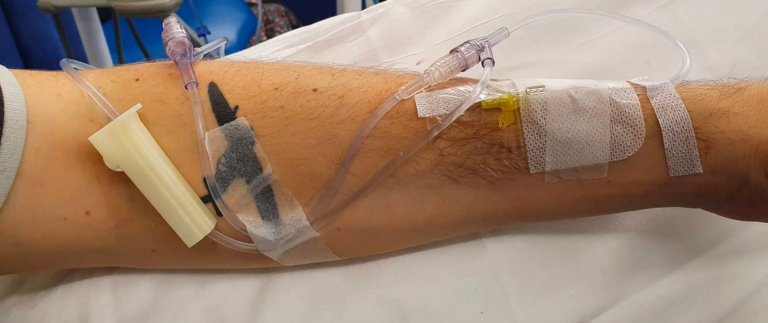
On 30th October chemotherapy started. I arrived at the William Harvey Hospital’s Celia Blakey Day Unit in Ashford around 8.30am and was taken through to the treatment ward. An IV drip was inserted into my arm and the first cycle began. Several hours of an immunotherapy drug called Rituximab followed by an hour of the chemotherapy drug Bendamustine. I finally left the hospital around 5.45pm. The following day I just had an hour of Bendamustine.

I have heard so many stories of how bad chemotherapy can be. Being violently sick, hair loss, fatigue, skin turning grey. To my surprise and huge relief none of this happened. The first cycle went very smoothly, I had no reactions at all and, most importantly I didn’t feel ill apart from very slight nausea. Around three weeks later I did develop a strange reaction though. Every joint and muscle in my body ached to the point where I completely lost all use of my left hand and my right hand was severely weakened. I called the cancer emergency line and the nurse told me to take paracetamol. Within 24 hours my hands returned to normal but my legs, neck and jaw ached for a full week.

My second cycle began on the 27th November. Within fifteen minutes of the Rituximab entering my arm I felt weird. My face felt like it was burning, I felt drowsy and my chest went very tight so I struggled to breathe. My wife Sadie was present with me and she said my face was bright red and my eyes had gone completely bloodshot. I called the nurse. She immediately stopped the infusion while another nurse called the pharmacist and haematologist. I was given second course of steroids and antihistamines (the first course is always given prior to starting the treatment), given a 30 minute rest and I had returned to normal. The Rituximab then started again but at a much slower rate. Luckily I had no repeat of that horrible reaction. At the end of the course of Rituximab I quickly developed a big rash all over my upper body. My arms, armpits, chest and neck was all blotchy red. No treatment was needed for this as it didn’t last long although I had a small rash near my belly and on my wrist (where I had been wearing my watch) for the next three days. The Bendamustine that afternoon went well with no reactions. Due to the earlier reactions and the delay it caused I didn’t leave the hospital until 6.45pm, over ten hours! On the second day of Bendamustine my sister Tina kept me company and I had no reactions.

After two cycles of immunotherapy and chemotherapy I feel fine. I have a few days in the first week of each cycle where I feel under the weather but it’s totally manageable. The fatigue is another matter though. I find that regardless of what I do during the day – lots of activity or nothing at all – I get tired around 6pm and need a nap for an hour. After that I’m fine until midnight. I’ve also noticed that my spleen has shrunk considerably. Around the time of diagnosis I could clearly feel my spleen when I pressed down to the left of my belly. It was quite prominent. Now I can’t feel it at all although the area does ache. To me this means the therapy is working. I won’t know for certain until I have another CT scan or ultrasound but from being able to easily feel my spleen before to not feeling it at all now does seem, to me, that I’m going in the right direction.

Back to work

For five and a half months I’ve been off work because of my chest issues then followed by the spleen problem and then the diagnosis and chemotherapy. Last week I saw my GP to discuss the matter of me possibly being able to return to work. He said he was confident the treatment is working and I’m having no real side effects so he feels I am ready to return to work. On Monday this week I had a meeting with my manager (at the theatre) and she was happy for me to return. I got a little emotional as it meant I could get a little bit of normality back into my life as I’ve literally done almost nothing since the end of June barring the odd day here and there filming when I’ve felt well enough to.

So today, Wednesday 11th December, I had my first shift in almost half a year. It’s only when you spend so much time away from work do you realise just how much you love your job and the people you work with. Every single colleague wished me well, said how happy they are to see me again and I got a few hugs too. I felt emotional but I don’t think anyone noticed. I will be working just part time for the next two weeks before the theatre closes for the Christmas break and I will hopefully return to full time work in January.

The two week Christmas break will give me plenty of time to do some research and get a few scripts for The History Guys written. I know I’ve had five months to do that but for one reason or another I’ve not really been in the mood to.

So there you have it, I blogged. It was a long one and not the happiest of subjects but ultimately I know I am going to be fine, it may just take two years (that’s how long the treatment will last). Knowing what I’m like on the blogging front I may not blog again this side of Christmas, if that’s the case I’d like to wish you a very merry Christmas and Happy New Year. I’m certainly hoping 2020 will be much happier than this year!