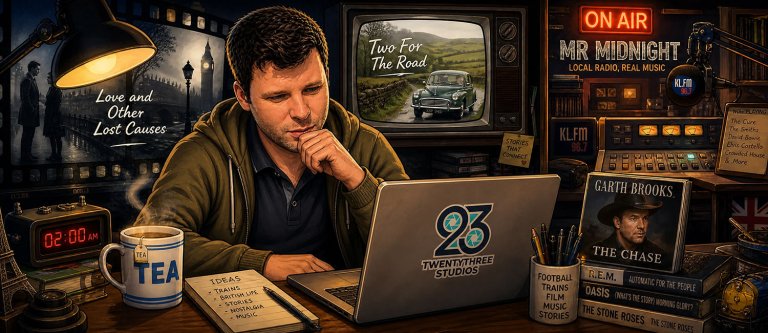

Every filmmaker gets asked the same question eventually. Sometimes it comes from a curious friend, sometimes from a nervous newcomer at a workshop, and sometimes — if you’re honest — you ask it of yourself at two in the morning when the cursor is blinking and the page is empty.
Where do the ideas come from?
The truthful answer is: everywhere. And nowhere in particular. But that’s not especially helpful, so let’s dig a little deeper.
Start With What Moves You
The most reliable source of a good idea isn’t a clever concept or a marketable premise. It’s an emotional response to something that already exists. A film you saw. A song you can’t get out of your head. A TV show you watched twenty years ago that still sits with you.
One of my own projects in development, Two For The Road, started exactly there. Growing up, I was captivated by Tim Grundy and his cameraman — known simply as The Eye — in their Discovery Home & Leisure series Two’s Country. There was something magical about their dynamic: warm, funny, genuinely informative without ever feeling like it was trying to teach you anything. Tim was one of the greatest TV and radio presenters this country ever produced, and I wanted to do something that honoured that legacy. The idea for Two For The Road was born not from a gap in the market, but from love — for a show, for a style, for a man whose work deserved a tip of the hat.
That’s as good a reason to make something as any.
Chase a Feeling, Not Just a Story
Here’s something film schools don’t always tell you: you don’t have to start with a story. Sometimes you start with a feeling — a mood, an aesthetic, an atmosphere — and build the story around it afterwards.
Love and Other Lost Causes came from exactly that. I used to run a film festival in Folkestone, and one short film I screened stopped me in my tracks. Not necessarily because of the story, but because of how it felt — the grade, the texture, the emotional temperature of it. I knew immediately that I wanted to capture something of that feeling in my own work, even if the story I told was entirely different.
The actual plot of Love and Other Lost Causes came later — a two in the morning brainstorming session, as it happens (there’s something about that particular hour that loosens the creative mind). But the seed of it was purely sensory. If a piece of work makes you feel something, ask yourself why. Then ask whether you can make something that makes someone else feel the same way.
Let Other Art Forms In
Film doesn’t exist in isolation. The best filmmakers are readers, music lovers, theatre-goers, gallery wanderers. Ideas cross borders all the time, and some of the most interesting projects begin somewhere other than a screenplay.
My project Mr Midnight began with a Garth Brooks song. If you know the track, you’ll understand immediately why it sparked something. If you don’t, I’d suggest looking it up. What I took from it wasn’t the literal narrative but the emotional world it suggested — and from there, with my own creative licence, I’ve been building a story largely set inside a small local radio station. The first draft is in progress. The song remains on the playlist.
Music, in particular, is a gift to filmmakers. A great song can hand you a tone, a character, a world, or a theme in three and a half minutes. Don’t ignore it.
Practical Tips for Finding Your Idea
If you’re stuck, here are a few starting points worth trying:
Write down five things that have genuinely moved you in the last year — films, songs, books, overheard conversations, places, memories. Don’t filter. Just list them. Then look for the thread that connects them. That thread is probably something you care about deeply, and something you care about deeply is worth making something about.
Ask yourself what you haven’t seen. Not in a commercial sense — not “what’s missing from the marketplace” — but personally. What story do you wish existed? What character do you never see represented? What place, what moment, what feeling has never quite been captured on screen in a way that felt true to you?
Don’t wait for the perfect idea. Start with the good-enough idea and let it become something better in the writing and the development. Love and Other Lost Causes was a 2am brainstorm. Mr Midnight started as a feeling about a song. Two For The Road started as gratitude. None of them arrived fully formed.
The Idea Is Just the Beginning
Finding the idea is only the first step, of course. There’s the writing, the rewriting, the pre-production, the endless logistics of actually getting something made. Two For The Road is ready to shoot — we’re just locking in the dates. Love and Other Lost Causes is written and moving into pre-production. Mr Midnight is still taking shape on the page.
Each one started somewhere different. Each one started with a feeling that refused to go away.
That’s the real test of an idea worth pursuing: not whether it sounds good in a pitch, but whether it’s still there in the morning.
