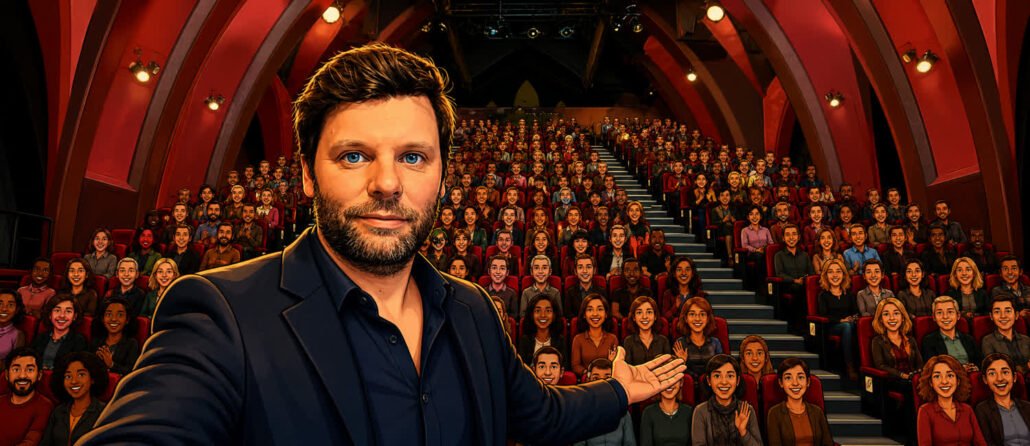
“Must be nice, you just watch the show for free.” I get some version of this a lot, usually from people who’ve only ever seen theatre from a seat. I understand why they think it — front of house shows you to your seat, and then, as far as most people can tell, vanishes. It doesn’t. The cast are performing, the backstage crew are working flat out the whole way through with no let-up at all, our ushers are sat in the auditorium by the doors watching the show just as closely as they’re watching the audience — who, to be fair, usually behave themselves — and the technicians are fiddling with lighting and sound desks for the full two hours. Meanwhile the rest of us — myself, my deputies Keith and Dai, and the bar staff — are back in the foyer, entirely out of sight, and just as busy.
I’ve spent enough evenings doing this job to have a genuine hour-by-hour shape to it now, and it’s nothing like what I pictured when I started. Here’s roughly how a show night actually goes, from where I’m standing.
6:15 PM — The Quiet Before
The building is empty except for us, and there’s a specific ritual to it. Bar stocked, programmes counted, ushers briefed, box office reconciled against the final ticket count. It’s the closest thing theatre has to a pre-flight checklist, and it’s oddly meditative — the last stretch of time where the show still exists purely as an idea, before three hundred opinions about it start arriving through the door.
I used to find this window tense. These days it’s genuinely my favourite hour of the job. Everything is still possible. Nothing has gone wrong yet.
6:30 PM — Doors
Main doors open, bar’s live, and the ushers are out front selling souvenir programmes to the early arrivals — the ones who’ve clearly done this before and know that turning up right on curtain gets you the scraps of the merchandise table and a rushed trip to the loo. The auditorium itself doesn’t open for another forty-five minutes, so for a while the whole building exists in the foyer: people milling, queuing for a G&T, deciding whether the programme is worth the money (it is, obviously, I’m contractually obliged to think so).
This is also where I do my own reading of the room. You can tell whether it’s going to be a warm house or a stiff one long before a single line’s been spoken, purely from how people are talking to each other in the queue for drinks. It’s not a science, exactly, but I’m rarely wrong.
7:15 PM — Auditorium Doors
The bell goes, the bar clears, and the auditorium opens. This is the real crunch point — everybody piles in more or less at once, three hundred people trying to find row F, seat 14, carrying the drink they bought at the bar (which is fine, we allow that) and, occasionally, smuggling in popcorn, which is not fine, because we don’t sell it. We never have. It’s a deliberate policy, because popcorn and a packed auditorium bring out something deeply, inexplicably British in people — a compulsion to throw it. I genuinely don’t understand the impulse, but the cleaner does, and he has strong feelings about it, usually delivered to me directly the next morning, standing in the middle of a carpet that’s either been through a popcorn fight or has an ice cream melted so thoroughly into it that it’s basically load-bearing now.
It’s controlled chaos for about fifteen minutes, and then, almost suddenly, the house is full and quiet and waiting.
7:30 PM — Curtain Up
Curtain goes up, and for the length of the performance the building belongs to someone else.
Except, of course, for the family. At precisely 7:32pm, without fail, one arrives. Late. All of them need the toilet. All of them, apparently, decided a drink was worth stopping for on the way in, despite everyone else already being sat in the auditorium and curtain having gone up two minutes prior. It happens genuinely every single show, some configuration of it, without fail, and there is a version of me that finds it maddening and a version of me that has made peace with it as one of the few constants in an unpredictable job. You try to get them seated with the minimum possible disruption to row F, and you fail, slightly, every time, because there is no dignified way to usher a family of four to their seats mid-scene.
8:45 PM — Interval (Allegedly)
We’re given an interval time in advance, which is more of a polite suggestion than a guarantee, because every so often act one finishes early and the whole building has to catch up in real time. That’s the cue for the mad scramble — interval drinks being made and slammed onto the station at speed while Keith, or Dai (pronounced “die,” he’ll correct you if you get it wrong) — whichever of my deputies is on that night — is frantically loading the ice cream trolley and legging it to the auditorium as the queue’s already forming before they’re even through the doors. Twenty minutes of interval, and about four of those minutes are spent recovering from the shock of it starting early.
And then, without fail, just as act two is about to begin, that same family reappear — toilet again, or a drink, or both — while we’re standing there with a strict no-restart-until-everyone’s-seated policy and an auditorium full of people who are, understandably, ready to go. Every single time. It’s less a coincidence at this point and more a law of physics specific to that one family and every family like them.
10:00 PM — House Lights Up
The bit I find myself thinking about most, on the way home, is the walk-out. Three hundred people who were somewhere else entirely thirty seconds ago — grieving, laughing, sat in a stranger’s living room in 1953 — have to become themselves again in the time it takes to walk from their seat to the foyer.
You can watch it happen if you’re looking for it. There’s a beat where people are still half in the play, wiping their eyes and pretending it’s the scarf’s fault, turning to a stranger just to say “wasn’t that something” because the feeling needs somewhere to go. It’s a genuinely strange thing to witness on repeat, and it never quite stops being one of the better parts of the job.
Locking Up
Once the audience are gone and the ushers and bar staff have finished up and headed home — could be half ten, could be well past eleven, depending entirely on the show — that’s when the real race starts. Me against the technician — whoever finishes first gets to leave, and whoever loses gets the final walkaround.
My side of it: cashing up the bar, the confectionery, the ice creams, the programmes, and the box office takings, then washing every glass and closing the bar properly. Their side: shutting down all the auditorium equipment and locking the space down ready for tomorrow night. It’s an unofficial competition that’s never once been formally agreed to and is nonetheless taken completely seriously by both of us.
Whoever loses does the walkaround — checking every external door, making sure the dressing room lights and heaters are off, and locking the front gates on the way out. It can take the best part of an hour, it’s the least glamorous stretch of the entire job, and also, in a strange way, my favourite — the bookend to that quiet hour at 6.15pm, except now the idea has actually happened, gone well or not, and either way it’s done.
In Conclusion: The Best Seat in the House Isn’t in the House
I don’t think anyone grows up dreaming of front of house work the way people grow up dreaming of the stage. I certainly didn’t. But I’ve come round to thinking it’s the best seat in the building for actually understanding what theatre does — not to the people performing it, but to the people receiving it.
The cast get the bow. I get the walk-out, the mad scramble when act one finishes early, the six o’clock quiet, and a genuinely privileged view of what an audience looks like before, during, and immediately after being moved by something. I’ll take that trade.

Bluesky Discussion
View on BlueskyNo replies yet. Be the first to comment on Bluesky!