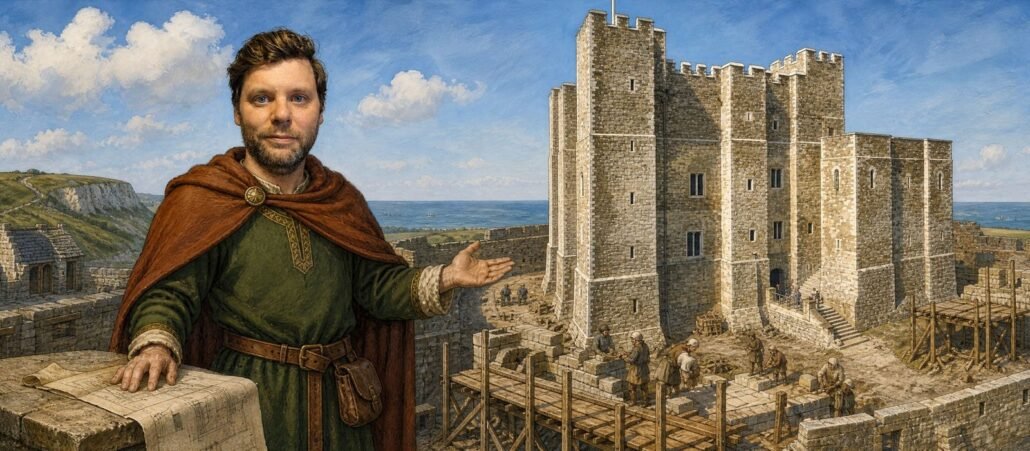
Prologue: A Hill That Simply Would Not Stop Being Important
Some hills get a nice view and a trig point. The hill above Dover got an Iron Age fort, a Roman lighthouse, a Saxon church, a Norman siege, the most expensive castle in England, two medieval wars, a set of Napoleonic tunnels, the command centre for Dunkirk, and a Cold War nuclear bunker — all stacked on top of one another like some geological layer cake nobody ever quite got around to slicing. It has been called the “Key to England” for so long that the nickname has practically fossilised.
A Roman surveyor, arriving in the 2nd century AD, allegedly:
“Right, apparently people have already been fortifying this hill for centuries before we even got here. Fine. We’ll just add a lighthouse. Nobody’s ever once complained about a nice lighthouse.”
Chapter One: The Lighthouse That Refused to Retire
The Romans built their pharos — a proper lighthouse, one of only three still standing anywhere in the former Roman Empire — in the early 2nd century AD, to guide ships into the harbour below. It had a matching twin across the water on Western Heights, which has since vanished entirely, leaving this one to do the job alone for the next nineteen hundred years or so.
The lighthouse keeper’s twin on Western Heights, watching his own tower slowly crumble while the Dover one gets a preservation order, imagined:
“One of us gets restored, celebrated, and put on postcards. The other one gets quietly demolished and forgotten. I am not saying this is unfair. I am simply noting it, for the record, forever, from wherever lighthouses go when they die.”
When the Romans eventually left, the Anglo-Saxons did something magnificently practical: around AD 1000 they built a church right next door using recycled Roman bricks, saving themselves the trouble and expense of quarrying and firing new ones. At some point in the medieval centuries that followed — historians differ on exactly when — someone also bolted a belfry onto the top of the old lighthouse itself, turning a centuries-old navigational tool into a bell tower without so much as a change of address.
A Saxon builder, eyeing up the pile of Roman bricks left lying around the old fort, imagined:
“We could ship in fresh stone from across the Channel at enormous expense. Or we could simply use the bricks the Romans left behind, already cut, already fired, already free. I have made my decision and I am extremely proud of it.”
Chapter Two: Henry II’s Extremely Expensive Guilty Conscience
The castle everyone actually recognises today is largely the work of King Henry II, who between 1180 and 1185 poured an eye-watering fortune into rebuilding Dover as the most lavish castle project of its age — new stone curtain walls, fourteen square towers, and a colossal keep at the centre of it all, all overseen by a man whose actual job title was, wonderfully, Maurice the Engineer.
Here is the part that makes it funnier: historians widely agree Henry didn’t spend this staggering sum purely for military reasons. Ten years earlier, four of his own knights had murdered the Archbishop of Canterbury, Thomas Becket, apparently believing they were carrying out the king’s wishes. Becket quickly became a canonised saint and an enormously popular pilgrimage figure, and pilgrims travelling to Canterbury from the Continent landed at, of all places, Dover. Henry, badly needing to be seen doing something pious and impressive, built the most extravagant castle in England directly in their path.
Henry II, reviewing the building costs, allegedly:
“My knights murdered an Archbishop in a cathedral because they thought that’s what I wanted. Now half of Europe thinks I ordered it. Solution: build the most expensive castle anyone has ever seen, put it directly on the pilgrim route, and hope everyone is sufficiently impressed to stop asking questions. Maurice, how much more marble do we have?”
Maurice the Engineer, presenting the final budget, imagined:
“You asked for ‘appropriately penitent.’ I have delivered ‘the single most expensive building project of the entire century.’ I am not saying you overcorrected. I am saying the fourteen towers alone could have covered a considerably smaller sin.”
Chapter Three: The Siege That Nearly Wasn’t a Story At All
In 1216, during the chaos of the First Barons’ War, Prince Louis of France invaded England at the invitation of rebel barons fed up with King John, and marched straight for Dover, held loyally by Hubert de Burgh. The attackers dug beneath the north gate and brought part of it crashing down — and the garrison, remarkably, held the breach anyway, refusing to let the castle fall.
Prince Louis, staring at the collapsed gate that somehow hadn’t ended the siege, imagined:
“We tunnelled under their gate. We brought down their gate. Their gate is, structurally speaking, no longer a gate. They are still successfully defending the gate. I would like someone to explain to me what exactly a gate is for, at this point, philosophically.”
Hubert de Burgh, rallying the garrison at the breach, probably:
“Yes, the wall has a French-shaped hole in it. No, that does not mean the French are allowed through it. Everybody who still has a sword, please stand approximately where the wall used to be.”
Afterwards, the north gate’s defences were entirely rebuilt and reinforced with a new underground complex of tunnels and sally ports — early versions of the very tunnels that, seven centuries later, would end up doing something considerably more famous.
Chapter Four: The Tunnels Get a Second Career, Then a Third
Those medieval tunnels were dug out further during the Napoleonic Wars to serve as barracks — Dover’s hill, it turned out, was extremely good at storing soldiers underground, whatever century it happened to be. Then, in 1939, they were pressed into service again as an air-raid shelter, before quietly becoming something rather more significant.
In May 1940, with the British Expeditionary Force trapped on the beaches at Dunkirk and early estimates suggesting perhaps 45,000 men might be saved, Vice-Admiral Bertram Ramsay ran the entire evacuation from a command centre carved into these same tunnels. Over nine frantic days, using a mixture of naval vessels and a scrappy flotilla of civilian “little ships,” his team brought home not 45,000 but 338,000 Allied troops.
Vice-Admiral Ramsay, receiving the initial estimate that only 45,000 men could realistically be saved, allegedly:
“Forty-five thousand. Right. I have nine days, a badly damaged harbour, and apparently every fishing boat and pleasure cruiser in southern England is now, technically, part of the Royal Navy. Let’s see how wrong that estimate can possibly be.”
A junior officer, watching the tally climb past 300,000, imagined:
“Sir, we appear to have rescued considerably more men than the entire operation was originally designed to save, using boats that, in several cases, were built for a gentle Sunday paddle around the harbour.”
More than three miles of brand-new tunnels were dug by hand during the war to expand the complex further, giving the Army, Navy, and Air Force each their own separate underground headquarters — which is either extremely sensible operational planning or the most elaborate game of hide-and-seek in military history, depending on how charitable you’re feeling.
Chapter Five: A Nuclear Bunker Nobody Ever Got to Use, Thankfully
The tunnels’ final career came during the Cold War. From 1958, the deepest level — codenamed Dumpy — was gradually adapted into one of just twelve Regional Seats of Government, ready to house 300 civil servants, police, scientists, and even BBC staff, who would run South East England from underground in the event of nuclear war. By October 1962, when the Cuban Missile Crisis brought the world to the brink of catastrophe, the bunker was fully equipped and had just been quietly tested in secret NATO exercises days before the crisis broke. It remained on stand-by until 1986, when officials finally concluded that the White Cliffs, for all their romantic durability, were not actually much use against radiation.
A Home Office planner, touring the newly kitted-out nuclear bunker, imagined:
“We’ve built beds, generators, a working kitchen, and a direct phone line to Whitehall, all inside a chalk cliff. Someone has just pointed out that chalk doesn’t really stop radiation. We’re going to go ahead and not mention that part in the briefing.”
Thankfully, the bunker never had to house anyone for real, and in 1986 it was decommissioned for good — leaving Dover’s hill, for the first time in roughly two thousand years, without an active military job to do.
Epilogue: The Key to England, Now Mostly Opening Gift Shops
Today Dover Castle is cared for by English Heritage, its Great Tower restored to something close to Henry II’s original glittering vision, its Roman lighthouse still the tallest of its kind left standing anywhere in the old empire, and its tunnels open for tours that walk visitors through two thousand years of the hill’s various emergencies, one after another, floor by floor.
A modern-day visitor, descending into the tunnels with an audio guide, probably:
“So this hill has been a fort, a lighthouse, a church, a castle, a siege, a barracks, a hospital, the command centre for Dunkirk, and a nuclear bunker — in that order. Incredible. Anyway, is the gift shop before or after the Roman bit?”
Note: the historical framework here — the Iron Age hillfort, the Roman pharos, the Anglo-Saxon church of St Mary in Castro, Henry II’s 1180s rebuilding and its likely connection to the murder of Thomas Becket, the 1216 siege by Prince Louis of France, the tunnels’ Napoleonic, Second World War, and Cold War roles, and Vice-Admiral Ramsay’s command of Operation Dynamo — reflects the real historical record. The quotations, however, are entirely invented for comic effect and were not said by anyone, ever, probably.
About Two For The Road
Two For The Road is a walking history series following Gary as he journeys through Britain’s most historically significant locations — guided, unseen, by The Oracle. Gary’s Ramblings are the long-form historical (and comical) write-ups he puts together between takes.


Bluesky Discussion
View on BlueskyNo replies yet. Be the first to comment on Bluesky!