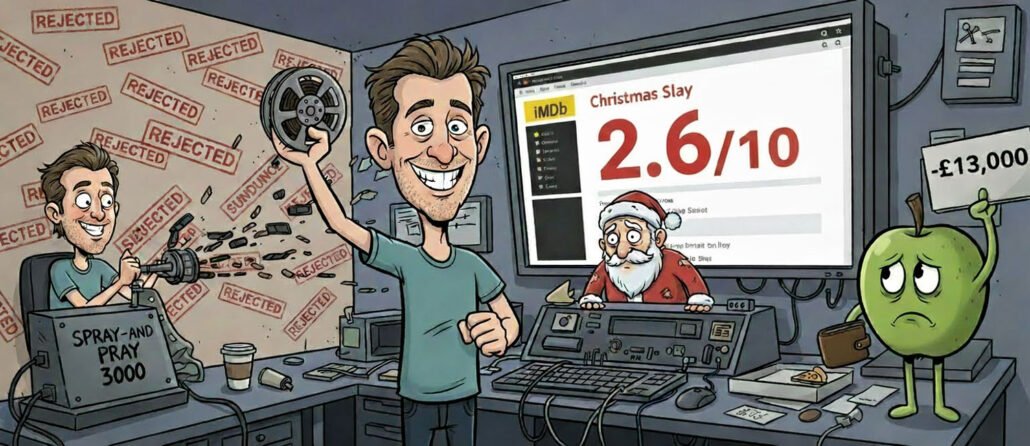
There is a film with my name in the credits that sits on IMDb at 2.6 out of 10, from 287 people who took the time to rate it and, in a remarkable number of cases, also took the time to explain exactly why. That film is Christmas Slay, a horror comedy I co-produced and edited between 2013 and 2015, and I mention the rating first because I think you need it in your head before anything else in this article makes sense. This is not a story about a good film that struggled to find its audience. This is a story about a genuinely bad film that got picked up by a distributor anyway — and the distributor still lost money on it.
I didn’t run the submission process or negotiate the distribution deal. That was writer/director who went and did the unglamorous work of trying to get it seen. What follows is what I watched happen from the edit bay and from the sidelines — not a first-hand account of pitching festivals, but an honest one of what the process actually looked like, and what it taught me about the gap between “we got a distribution deal” and “this was a good outcome.”
The Spray-and-Pray Submission Strategy
Here’s what the festival submission strategy for Christmas Slay actually was, as far as I could tell from where I was sitting: submit to every festival that was either free to enter or close enough to free that the fee didn’t sting. Not festivals that programmed horror-comedy specifically. Not festivals whose past lineups suggested any particular taste that our film might have matched. Just volume — the theory being that if you throw enough at the wall, something has to stick.
I understand the logic, even if I’ve since come to think it’s the wrong logic. Submission fees add up fast, and a low-budget production doesn’t have much room to be picky about where that money goes. If you can enter fifteen festivals for the price of five higher-tier ones, the maths looks tempting. The problem is that the maths only works if getting into a festival is the goal. If the actual goal is getting into the right festival — one where your film’s tone, genre and audience genuinely fit what that festival’s crowd shows up for — then twenty low-effort submissions to whatever’s cheapest isn’t a strategy. It’s just spending money in a slightly more organised way than not spending it at all.
What Actually Happened When Nothing Stuck
Nothing stuck. I want to be straightforward about that rather than build any false suspense: the blanket approach didn’t get Christmas Slay into a single festival. Not one. Given the film’s eventual IMDb standing, this will surprise approximately nobody who’s seen it, but it’s worth saying plainly, because a lot of the advice out there implies that submitting widely enough is itself a kind of insurance policy. It isn’t. A film that isn’t a strong fit for any given festival’s programme doesn’t become a better fit by being one of two hundred other submissions a programmer has to get through that month.
Then, Somehow, Someone Wanted It Anyway
Which is what makes what happened next so genuinely strange. Despite zero festival success — despite, again, a film that currently sits at 2.6 out of 10 — a distributor found it and wanted it. Green Apple Entertainment picked up Christmas Slay for distribution, entirely outside the festival circuit that the whole submission strategy had been built around.
I think this is the bit that surprised all of us the most at the time, and I think it’s genuinely useful for anyone assuming there’s one clean, linear path from “finished film” to “distribution deal.” There isn’t. Festivals are one route in, and probably still the most talked-about one, but they’re not the only door, and plenty of distributors are out there looking for content directly, on their own criteria, entirely separate from who did or didn’t get programmed anywhere. It felt, from where I was standing, less like validation and more like a stroke of luck nobody had specifically planned for.
What “Getting Distribution” Actually Means
If you’ve never been near one, “we got a distribution deal” sounds like the finish line. It isn’t. A distribution deal is a licensing arrangement — someone else is taking on the cost and risk of getting your film in front of an audience, in exchange for a cut of whatever it makes, and often in exchange for the distributor putting up their own money first for marketing, deliverables, and everything else that goes into actually releasing something. None of that is free, and none of it is guaranteed to come back.
Which is exactly what happened here. Green Apple Entertainment ended up losing roughly £13,000 on Christmas Slay. Nobody involved — not the production, not the distributor — made money from a deal that, on paper, looked like the good outcome everyone chasing distribution says they want.
The £13,000 Nobody Talks About
This is the number I think about most when I see other first-time filmmakers treat “getting picked up” as the goal in itself. A distribution deal isn’t proof that a film is good, isn’t proof that it’ll make money, and isn’t the end of the story where everyone involved gets paid. It’s a new set of numbers, with real costs attached, and a genuinely bad film with a 2.6 rating can absolutely get one of those deals — and lose someone else’s money in the process — without anyone doing anything obviously wrong along the way. Nobody defrauded anybody. The distributor genuinely believed there was an audience for it. They were wrong, and it cost them.
If you’re in the position of celebrating a distribution offer landing in your inbox, that’s a fair thing to celebrate. Just be honest with yourself about what it actually is: an opportunity for the film to make money, not a guarantee, and not remotely the same thing as critical or commercial success.
What Fit-Based Submission Actually Looks Like
None of the above means festival submission is pointless — just that the version of it we ran wasn’t a strategy so much as a hope. If I were doing this properly, rather than watching someone else do it under-resourced, here’s roughly what a fit-based approach looks like instead.
Start with festivals that programme your genre specifically, rather than general open-submission festivals that take everything. A horror-comedy has a real home at horror festivals and genre-specific fringe events, and a much weaker case at a festival whose last five years of winners were all quiet character dramas. Look at what a festival has actually shown before you submit, not just what it says it’s open to — the submission call is usually broader than the programming turns out to be.
Regional and identity-specific festivals matter too, if your film has any genuine connection to a place, community or theme they focus on. A festival built around regional filmmaking, or a specific cultural angle, is often more receptive to a smaller, rougher film than a huge open-genre festival fielding thousands of entries a year.
Budget for submissions properly rather than chasing whatever’s cheapest. I’ve written more about where festival and submission costs actually sit in a production budget — the short version is that entry fees for the festivals that are actually worth entering tend to cost more than the ones that aren’t, and it’s worth budgeting for quality over quantity from the start rather than working backwards from whatever’s left over.
And be honest with yourself, early, about whether the film is actually finished and strong enough for the tier of festival you’re aiming at. A film submitted before it’s really ready doesn’t get a second chance at that particular festival’s attention.
What This Means If You’re Chasing a Distribution Deal
The wider lesson, I think, sits alongside something I’ve said before about funding: the overwhelming majority of independent films do not return their production budget, and that’s true whether or not a distributor eventually picks the film up. A deal is not the same thing as the film being good, and it’s not the same thing as anyone actually making money. It’s a bet someone else has decided to place, and like any bet, it can lose.
If an offer does come in, don’t treat the excitement of the moment as a reason to skip the boring bits. Get the paperwork looked at properly — I’ve covered some of what that actually involves, including errors and omissions insurance and the wider legal groundwork distributors will expect to see, in more detail elsewhere. Know what you’re actually signing, what happens if it underperforms, and what your own exposure looks like either way.
So What Should You Actually Do
Build a genuinely short list of festivals based on where your film actually fits, not on entry price. Budget for it properly rather than treating submissions as an afterthought. Understand, going in, that a distribution deal is an opportunity and a set of obligations, not a finish line and not proof of anything. And if the offer does land, get someone who actually knows the paperwork to look at it before you sign, because “someone wants to distribute it” and “this is a good deal” are two completely different sentences, and the gap between them is exactly where Green Apple’s £13,000 went.
Christmas Slay is still, by any honest measure, a bad film. It’s the one I’m proudest of, for reasons that have very little to do with its Rotten Tomatoes score and quite a lot to do with what it taught everyone involved — at no extra charge to us, and at some considerable charge to somebody else.