Posts

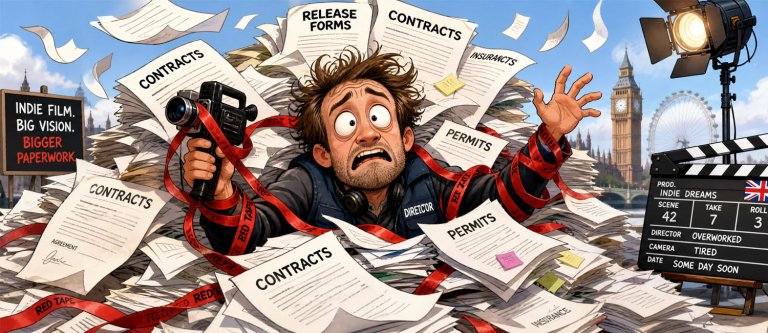
Getting your UK film legal basics sorted is not why anyone picks up a camera. You get into filmmaking for the itch to tell a story, the thrill of watching something you imagined turn into something you can actually point a lens at. Then, somewhere around your second short film, you discover that half the job is paperwork you didn’t know existed, signed by people who’d much rather be acting than reading small print.

I learned most of this the hard way, which is the traditional method for indie filmmakers everywhere. If you’ve already worked through funding your production, this is the natural next step: here’s the legal groundwork every UK indie production needs, minus the bits that only apply if you’re shooting a car chase through Piccadilly Circus.


Contracts: Get It In Writing, Even When You Trust Everyone

The awkward truth about working with friends, or friends-of-friends, on a low-budget shoot is that goodwill doesn’t hold up when someone’s unpaid invoice becomes a dispute six months later. A basic deal memo or contract for cast and crew doesn’t need to run to twenty pages, but it does need to cover who’s doing what, for how much (even if that’s “expenses only” or “deferred payment”), and what happens to the footage afterwards.

Clear job descriptions and agreed terms aren’t just good practice — they’re the difference between a smooth shoot and a group chat that goes very quiet after wrap.

Cast and crew contracts don’t need to be identical, because they’re covering different risks. A cast agreement should nail down the role, the shoot dates you actually need them for, any nudity or intimacy clauses if relevant (and whether an intimacy coordinator is involved), credit billing, and — critically — a clear grant of rights to use their likeness and performance in the finished film and any promotional material. Without that last part, you can end up with a finished film you’re not actually allowed to distribute.

A crew contract cares less about likeness and more about scope of work, equipment responsibility, and ownership of anything they create. If your DOP is bringing their own kit, say so and say who’s liable if it’s damaged. If your composer is writing an original score, the contract needs to specify who owns the copyright afterwards — by default, this can get murky, and “we’ll sort it out later” is how indie films end up unable to license their own soundtrack.

If you’re working with anyone under a union banner, it’s worth knowing the landscape. Equity covers performers, BECTU covers the wider crew and broadcasting side, and the Writers’ Guild of Great Britain covers scriptwriters. You don’t have to be a union production to benefit from knowing their guidance on pay rates and working practices, even as a benchmark for what’s reasonable.

Funding, Crowdfunding and the Legal Small Print

I’ve covered UK indie film funding properly in a separate guide, so I won’t repeat all of it here — but it’s worth flagging where funding and legal paperwork overlap, because they overlap more than people expect.

If you’re running a crowdfunding campaign, transparency isn’t just good manners, it’s a legal expectation: be accurate about what backers are actually funding and deliver on whatever rewards you promised, because unfulfilled crowdfunding rewards can and do end up as consumer disputes. If you’re paying cast or crew on deferred terms — “you’ll get paid once the film sells” — put the deferral in writing with clear conditions for when and how that payment triggers. A verbal “you’ll get paid eventually” is not a contract, and it’s not something anyone can enforce.

Insurance: The Bit That Actually Lets You Film

Insurance sits slightly apart from the rest of this because in practice, it’s often the gatekeeper: most UK locations and councils won’t grant filming permission without proof of public liability insurance in hand, so it needs sorting in early pre-production rather than as an afterthought.

Public liability insurance covers injury or property damage caused during your shoot — the classic scenario being a light stand going through someone’s window, or a member of the public tripping over a cable. Beyond that, most productions also want equipment insurance in case anything you’ve hired or borrowed is damaged or stolen, and if you’re paying cast or crew, employer’s liability insurance is a legal requirement in the UK the moment you have anyone working for you in an employment-like relationship, even briefly.

Short-term production insurance policies exist specifically for indie and student productions and are usually far cheaper than people assume for a single shoot or short run. It’s worth getting quotes before you lock your shoot dates, not after, since some insurers want notice.

Release Forms: Your Get-Out-Of-Lawsuit Card

Here’s a fact that surprises most first-time filmmakers: you don’t legally need permission to film identifiable members of the public in the UK, because there’s no general expectation of privacy in a public space. But that’s the floor, not the ceiling — and if you’re publishing footage commercially, especially with someone as the clear focus of a shot, a signed model release form is standard practice, not paranoia.

If you’re filming for a business purpose and collecting footage of identifiable people, you may well count as a “data controller” under GDPR and the Data Protection Act 2018, which brings its own obligations around consent, transparency, and what happens if someone later asks you to take their face out of your film. Getting a signature at the time saves an enormous amount of grief later.

Location releases are the other half of this. If you want to film on someone’s property — private or council-owned — you need explicit permission from whoever actually has the authority to give it. That sounds obvious until you’re standing in a leased shop unit and the person saying yes turns out to be a sub-tenant with no legal standing to authorise anything. A proper release should nail down the exact site (postal address, not “that café near the station”), the dates and times you need access including set-up and breakdown, what you’re allowed to do while you’re there, and whether you’re changing anything about the space that needs restoring afterwards.

Health and Safety: The Risk Assessment You Can’t Skip

This is the one that gets treated as pure box-ticking right up until something goes wrong, at which point it becomes the single most important document on the production. If you have anyone working for you — paid, deferred, or favour-based — you have a duty of care towards them, and a written risk assessment covering your locations, equipment, and any specialist activity (stunts, weapons, animals, working at height, night shoots) is the standard way of showing you’ve actually thought about it rather than just hoping for the best.

It doesn’t need to be complicated. For most low-budget shoots it’s a page or two: what could go wrong, how likely it is, what you’re doing to reduce the risk, and who’s responsible for checking it on the day. If anything involving explosives, armourers, or specialist stunt work is on your shoot, the relevant practitioners should hold recognised qualifications through the Joint Industry Grading Scheme, and the police need to be informed in advance if weapons of any kind — including replicas — are being used.

Film Permits in the UK: When “Just Turning Up” Isn’t an Option

Small-crew filming on public land like streets and parks generally doesn’t need a permit in the UK. It gets complicated fast, though, the moment your shoot blocks a pavement, uses large equipment or artificial lighting, involves drones, or lands somewhere with its own filming policy — which increasingly includes major cities and busy public spaces. The rule of thumb: if your shoot could plausibly annoy a council officer, ring the council first. Bring your public liability insurance documents when you ask — most councils will want to see them before granting permission.

Drones are their own small nightmare of bureaucracy, governed by the Civil Aviation Authority rather than your local council, and flying one over residential rooftops without the right permissions is a good way to turn a low-budget short into an unplanned legal case study.

Errors and Omissions Insurance: The One Nobody Thinks About Until Distribution

This is the insurance that catches indie filmmakers out precisely because it’s not needed until later — and by then, half your paperwork trail is scattered across old email threads and someone’s WhatsApp. Errors and omissions (E&O) insurance covers legal claims arising from your finished film: defamation, copyright infringement, unauthorised use of someone’s likeness, that sort of thing. Distributors and streaming platforms increasingly won’t touch a film without it, because they want that risk covered before they’ll agree to release it.

The practical takeaway is this: every release form, every music clearance, every location agreement you signed during production is exactly what an E&O insurer — and later, a distributor’s legal team — will want to see. Keep a single folder, physical or digital, with every signed document from day one. Future you, trying to close a distribution deal eighteen months after wrap, will be very grateful.

The Bits People Forget

A handful of smaller things trip up more indie productions than you’d expect:

  • Child performers need to be licensed through the local education authority in the area where you’re filming, and the licence dictates working hours and safeguarding requirements. This one’s non-negotiable and worth sorting weeks in advance, not the night before your shoot day.
  • Weapons on set — including replicas and non-functioning props — require you to inform the police beforehand, even on private land.
  • Music and copyrighted material caught in shot or used on the soundtrack needs clearing. A song playing on a car radio in the background of your scene is still someone’s copyrighted work.
  • Defamation applies even to fictional characters if they’re recognisably based on a real, living person. “Based on a true story” is doing a lot of legal heavy lifting in your opening titles for a reason.

None Of This Is a Substitute for an Actual Solicitor

I’ll say the obvious bit plainly: I’m a filmmaker, not a lawyer, and this post is the “know what to ask about” guide, not the “here’s your legally binding advice” guide. For anything with real money, real risk, or a location owner who seems litigious, get a solicitor who actually knows UK media law to look over your paperwork. Organisations like the British Film Commission also publish up-to-date regulatory guidance worth bookmarking. It costs less than you think, and considerably less than the alternative.

What I can tell you from experience is that the productions which sail through smoothly are almost always the ones where someone sat down before day one and got the boring bits sorted. Treat your contracts and releases as part of the craft, not an obstacle to it, and the actual filmmaking gets to be a lot more fun.

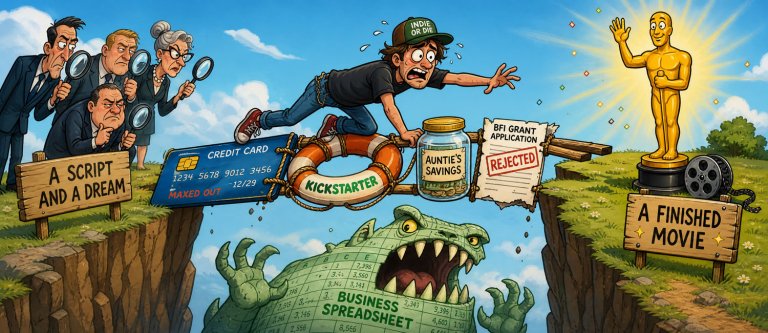
There is a particular kind of madness that afflicts filmmakers. Not the creative kind — that one’s useful, even necessary — but the financial kind. The kind that has you staring at a spreadsheet at two in the morning, wondering whether you can convince your aunt to part with her savings in exchange for an executive producer credit and a thank-you in twelve-point font. The kind that makes crowdfunding platforms look like lifelines and your own credit card look like a perfectly reasonable production budget. If you are reading this, you are probably afflicted. Welcome. Sit down. Let’s talk money.


Why Indie Film Funding Is Its Own Particular Beast

Traditional industries have banks. Tech startups have venture capital. Indie filmmakers have optimism, a hard drive full of reference clips, and — if they’re lucky — a distant relative who once said they thought movies were “interesting.” The gap between having a script you believe in and actually getting it made is not merely a financial one; it is a fundamental one. You are asking people to invest in something intangible, something that doesn’t exist yet, something that might lose money, and — this is the truly audacious part — you are asking them to trust you to make it. That takes a particular kind of pitch, a particular kind of persistence, and, frankly, a particular kind of nerve.

The good news is that people have done it. The better news is that some of them have done it spectacularly. The news you didn’t ask for is that most of them had a plan — and the ones who didn’t have a plan mostly have a cautionary tale instead.


Know What You’re Asking For Before You Ask Anyone

The single most common mistake early-career filmmakers make is approaching funding before they have any real sense of what they need the money for. Not “to make the film” — that is not an answer, that is a sentence. Funders, whether they are grant panels, crowdfunding backers, or private investors, want to know how their contribution translates into something tangible. A location. A day of shooting. Post-production sound. Catering for a crew of eight for three days in a field in Shropshire (this one will cost more than you think).

Before you approach a single person with a cheque book, build a proper budget breakdown. Know your above-the-line costs — talent, writer, director — and your below-the-line costs — crew, equipment, locations, insurance, catering, transport. Know your post-production budget and your contingency (which should be no less than ten per cent, and will almost certainly not be enough). Know the difference between what you need and what would be nice. The moment a funder asks “where does the money go?” and you hesitate, the conversation is already over.


The Crowdfunding Chapter (The One Where Everyone Thinks It’s Easy)

Crowdfunding has democratised indie film financing in ways that would have been unthinkable twenty years ago, and it has also produced more failed campaigns than any other single approach, which tells you something important about democracy. Platforms like Kickstarter and Indiegogo have enabled genuinely remarkable projects to find their audiences before a frame was ever shot — but they have also taught an entire generation of filmmakers the hard way that “if you build it, they will come” is a line from a film, not a funding strategy.

The case study that defined crowdfunding for independent film is the Veronica Mars Movie. In 2013, creator Rob Thomas and star Kristen Bell launched a Kickstarter campaign to revive the cancelled television series as a feature film. They hit their $2 million target in less than eleven hours. They ultimately raised over $5.7 million from nearly 92,000 backers. The lesson most people took from this was “crowdfunding works.” The lesson they should have taken was “crowdfunding works when you have an existing, passionate, and sizeable fanbase who have been waiting years for exactly this thing.” Rob Thomas did not build his audience during the campaign. He had built it over three seasons of television. The campaign was the harvest, not the planting.

A more instructive example for first-time filmmakers is Blue Ruin (2013), directed by Jeremy Saulnier. Saulnier raised $37,000 on Kickstarter — a modest sum by any measure — to complete a film that went on to win the FIPRESCI Prize at Cannes and earn widespread critical acclaim. His campaign worked not because of a pre-existing audience but because of a clear creative vision, transparent communication about what the money would do, and compelling early footage that made backers believe in what they were funding. He also clearly communicated what the project was. He didn’t promise the world. He promised a specific film, made in a specific way, by someone who demonstrably knew what they were doing.

If you are planning a crowdfunding campaign, the practical tips are these: set a realistic target (the all-or-nothing model means an overambitious goal just means you get nothing), build your audience before you launch (not during), offer meaningful rewards that don’t bankrupt you to fulfil (physical merchandise costs more to produce and ship than you will believe until you have done it once), and communicate obsessively throughout the campaign. Update your backers. Thank them publicly. Make them feel like co-conspirators rather than ATMs.


Grants: The Money That Doesn’t Want Anything Back (Mostly)

In the United Kingdom, the landscape of film grants is considerably more navigable than many filmmakers assume — which is to say, it is still quite difficult, but it is not a secret. The BFI Film Fund is the obvious starting point, offering development and production funding for projects with a demonstrable cultural footprint and a clear sense of their audience. Screen Scotland, Creative Wales, and Northern Ireland Screen operate equivalent bodies for projects with a strong regional identity and attachment. For short films — which remain the most viable entry point for emerging filmmakers — the BFI’s short film programmes, as well as schemes run by organisations like Film London and regional screen agencies, represent a realistic first rung.

The critical thing to understand about grant funding is that it is not simply a matter of having a good script. Grant panels fund filmmakers as much as they fund films. They want to see evidence that you understand the work, understand your audience, and have the team to deliver. Your director’s statement, your producer’s track record, your casting approach, your distribution strategy — these matter. A film with a mediocre script and an exceptional team will get further in grant applications than an exceptional script with no supporting evidence that anyone involved has made anything before. This is frustrating if you are at the beginning of your career, but it is not insurmountable. Build the track record with short films. Enter festivals. Win things, or at least submit things. The grant panel wants to fund someone who is going somewhere, not someone who intends to go somewhere.

One piece of advice that is less commonly given: read the rejection letters carefully. If a funding body takes the trouble to tell you why your application was unsuccessful, that is free development notes from people who have read thousands of applications. Use them.


Private Investment: The Art of the Room

Private film investment — sometimes called “soft money,” sometimes called “the conversation you have to have over dinner” — operates on a completely different logic to grants and crowdfunding. Where grants want cultural value and crowdfunding wants community, private investors want some combination of return, prestige, and the profound thrill of being able to tell people at parties that they’re in the film business. This is not cynicism; it is useful information. Understanding what your investor actually wants from the experience is the first step to giving it to them.

The SEIS (Seed Enterprise Investment Scheme) and EIS (Enterprise Investment Scheme) are the UK government’s gift to independent film producers — tax relief mechanisms that allow private investors to offset a significant portion of their investment against their income tax liability, reducing their effective risk considerably. An investor putting £50,000 into an SEIS-eligible production can claim back up to fifty per cent of that in income tax relief, which means their actual exposure is £25,000 before the film has earned a penny. This does not make the investment risk-free, and you should never imply that it does, but it makes the conversation considerably more interesting for a certain class of high-net-worth individual. If your production company is not set up to receive SEIS or EIS investment, fix that before you approach anyone.

The pitch itself is a skill that can be learned, and the most important thing to learn is this: lead with the story, not the business. Investors who are coming to independent film for purely financial reasons have better options. The ones who say yes are doing so at least partly because the project has moved them, excited them, or made them feel that they are part of something. Show them who the film is for. Show them the world. Let them feel the thing before you show them the spreadsheet. Then show them the spreadsheet.


Co-Productions, Partnerships, and the Creative Deals You Haven’t Thought Of

Not all film funding comes in the form of cash, and it is worth spending time thinking creatively about what resources you actually need rather than what money you need to buy those resources. Equipment can be borrowed, deferred, or bartered. Locations can be negotiated in exchange for credit, coverage, or a share of proceeds that will probably never materialise but cost nothing to offer. Post-production facilities sometimes offer discounted rates to emerging filmmakers in exchange for the association. Crew members at the beginning of their own careers may work at reduced rates for the right project.

International co-productions are a more formal version of the same logic. If your story has a genuine connection to another country — a location, a cast member, a thematic relevance — then a formal co-production arrangement with a production company in that territory can unlock their national funding schemes as well as your own. The Eurimages fund exists specifically to support European co-productions. The Creative Europe MEDIA programme offers development funding for projects with genuine cross-border potential. These are not easy routes, but they are real ones, and they are particularly worth exploring if your story has any international dimension at all.


The Big No-Nos (Or: How to Guarantee That Nobody Gives You Any Money, Ever)

We arrive, inevitably, at the cautionary portion of proceedings. The following are not theoretical errors. They are things that actual filmmakers have done, are doing right now, and will continue to do despite all available evidence.

Approaching investors without any development material. A logline and a dream is not a pitch package. At a minimum, you need a script or a treatment, a director’s vision document, a provisional budget, and some sense of who will be watching this film and how. Arriving at a meeting without these things does not communicate passion. It communicates unpreparedness, which communicates risk, which communicates the end of the meeting.

Promising returns you cannot guarantee. Independent film is a high-risk investment. The overwhelming majority of independent films do not return their production budget from theatrical release alone. You must be honest about this. Promising investors a specific return is not only misleading — in some circumstances, depending on how the investment is structured, it can be legally problematic. Speak to a film finance solicitor before you make any commitments. Yes, this costs money. No, it costs less than the alternative.

Launching a crowdfunding campaign with no audience and no plan. The campaign page going live is not the beginning of your marketing. It should be somewhere around the middle. If you have not spent weeks building awareness, identifying your community, and lining up early backers before the campaign launches, the algorithm will bury you and you will spend thirty days watching your total inch upward by single digits while sending increasingly desperate emails to people who went to school with you.

Spending development funding on production. This sounds obvious until it happens to you. Development money is for developing the project — writing, research, attachments, legal costs. If you spend it on a shoot day because you got excited, you have made the classic error of starting before you are ready, and you will either run out of money mid-production (catastrophic) or produce something you cannot finish (also catastrophic, but with the added grief of having footage you can’t use).

Failing to involve a producer early enough. Directors make films. Producers make films possible. If you are a writer-director working alone, you need a producer — someone whose specific job is to think about money, logistics, and the thousand practical considerations that creative people tend to find less interesting than the creative considerations. The best producer-director relationships in independent film are partnerships of genuine equals, and the best time to establish that relationship is before the funding conversations begin, not after.

Giving away too much too early. Equity investment comes with strings. Give away a significant share of your film too early, before you have established its value through grants, attachments, or festival interest, and you may find yourself with very little left to offer — or very little control over the project — by the time the serious money arrives. Understand what you are trading and what it is worth. Again: film finance solicitor. Worth every penny.


The Bit Where We Talk About Mindset (Bear With Me)

There is a version of this article that ends with a list of links — funding bodies, platforms, schemes — and that version would be useful, in the way that a map of a mountain is useful. But the thing about funding an independent film is that the obstacles are not primarily informational. The information is out there. The grants exist. The platforms exist. The investors exist. The obstacle, more often than not, is the sustained, cheerful, relentless willingness to keep making the case for your project in the face of rejection, silence, and the occasional well-meaning suggestion that you might want to consider a more stable career.

The filmmakers who get their films made are not always the ones with the best scripts or the most original ideas. They are, disproportionately, the ones who refuse to take no as a permanent answer. They are the ones who take the rejection letter, find the useful note in it, and use it to make the next application stronger. They are the ones who treat every conversation as a potential relationship rather than a transaction. They are the ones who understand that funding is not something that happens to your film — it is something you build, brick by brick, conversation by conversation, over a period of time that will test your patience and your conviction in roughly equal measure.

The money is out there. The film is in you. The gap between those two facts is bridgeable. It just requires a plan, a pitch, and the kind of persistence that would probably be considered unreasonable in any other industry.

Welcome to filmmaking.

Cinematography tips are the kind of thing nobody gives you before they hand you a camera. Which means most of us learn the hard way: by picking one up for the first time, thinking yes, I understand this, I have watched films before, how hard can it actually be — and then finding out, in fairly short order, that it is quite hard. Harder than it looks. Harder than any amount of Netflix consumption will have prepared you for. Because watching films and making films are related in roughly the same way that watching someone parallel park and actually parallel parking are related — you think you’ve absorbed the principles, and then suddenly you’re in the real world and everything is at the wrong angle and someone is honking.

1. The Rule of Thirds Is Called a Rule For a Reason

Every cinematography guide starts here, which means every beginner reads it, nods knowingly, and then promptly ignores it the moment they start shooting. I know this because I did exactly that. For approximately two years, I framed everything dead centre like I was taking passport photos, and then I’d watch the footage back and wonder why it looked oddly flat, oddly static, oddly like the shot was just waiting for someone to do something interesting in it.


The rule of thirds is simple: divide your frame into a three-by-three grid, and put your subject at one of the intersecting points rather than plonked in the middle like a trophy on a shelf. Your brain — and more importantly, everyone else’s brain — finds this more naturally pleasing to look at. There’s space for the eye to move. The frame breathes.

Put your subject dead centre for long enough and your audience will feel it even if they can’t say why. Like a dinner that’s slightly underseasoned — they won’t complain, but they won’t rave either.

2. Light Is Doing More Work Than You Think

Here is the thing about light that took me an embarrassingly long time to internalise: it’s not just there to make the image bright enough to see. It’s doing the storytelling. The direction it comes from, the quality of it, whether it’s hard and sharp or soft and diffused — all of that is character work. All of that is tone.

Harsh overhead light makes people look guilty and tired. Soft light from the side makes them look interesting and slightly haunted, which is good for drama and not ideal for corporate testimonials. Golden hour — the hour after sunrise and before sunset — makes everything look like a film regardless of budget, which is why every cinematographer on earth turns into a slightly manic person when it arrives and it’s already twenty minutes gone.

The single biggest upgrade I made to my footage was learning to stop fighting available light and start working with it. Move your subject relative to the light source. See what happens when the light comes from behind them. See what it does to the edge of a face, the texture of a wall, the shape of a shadow. You don’t need a van full of equipment if you understand what light is already doing.

3. Your Camera Moves Should Mean Something

I went through a phase — and I suspect most people do — of moving the camera constantly, under the impression that movement meant energy. It does not. Movement means emphasis. Movement means: something is changing, or something important is happening, or we are following something the audience needs to follow.

A slow push in towards a character’s face means we’re getting closer to something — a revelation, an emotion, a decision. A pull back means distance, loss, isolation. A handheld shot that wobbles slightly means presence, immediacy, the feeling of being in the room. All of these are a language, and like any language, using the words in the wrong order just produces noise.

The shot that moves for no reason is the cinematic equivalent of someone who gestures too much when they talk. You stop listening to what they’re saying because you’re distracted by their hands.

If you find yourself asking “should I move the camera here?” — ask yourself what the move would mean, first. If the answer is “nothing in particular, it just looks more interesting,” try the static shot. You might be surprised.

4. Shoot More Than You Think You Need (And Then More Than That)

This one is about protecting Future You, who is going to be sitting in an edit suite wanting to strangle Past You for not getting a cutaway.

Coverage is everything. Get your main shot, yes — but also get the close-up of the hands, the wide shot of the location, the reaction on someone’s face, the thing in the corner that might mean nothing and might mean everything. Edit in the camera if you have to, but give yourself options. A film made in the edit is only as good as the options you walked away from the shoot with.

I have lost count of the number of times I’ve been cutting something together, hit a join that doesn’t quite work, looked at my footage, and found that the one shot that would fix it is the one shot I didn’t think to get. Future You is not grateful. Future You is sat in the dark eating biscuits and wondering why Past You was in such a hurry.

5. Colour Is a Conversation You’re Having Without Words

The colour of your image — not just in post, but in how you light and what you put in front of the lens — is communicating mood before a single line of dialogue lands. Cold blues and greys say one thing. Warm ambers and greens say another. Desaturated palettes feel like memory or dread. Vibrant, punchy colours feel like energy and life and possibly a soft drink advertisement.

This doesn’t mean you need to spend three weeks in colour grade making everything look like a prestige drama. It means knowing, before you shoot, what you want the image to feel like — and making choices that get you there.

Ask yourself: if this film were a room, what colour would the walls be? That’s not a pretentious question. That’s the actual job.

6. The Best Equipment Is the Equipment You Actually Understand

I have seen gorgeous footage shot on a phone. I have seen footage shot on a camera worth more than a reasonably-priced car that looked like nothing. Equipment is not the variable. Understanding is the variable.

Know how your camera handles light. Know where it struggles and where it shines. Know how to expose correctly — not just what the settings mean technically, but what they look like in practice, in your actual shooting conditions, at the times of day you’re actually shooting. Every camera has a character. Learn yours before you go chasing someone else’s.

The camera you have, understood properly, will beat the camera you want, operated blindly, every single time.

7. For The Love of Everything, Get Off Auto

Let’s talk about the cardinal sin. The one that cinematographers whisper about in hushed, slightly haunted tones. The one that has cost people time, money, and quantities of stress that probably ought to be measured in clinical units.

Leaving your camera on Auto.

I understand the appeal. Auto feels safe. Auto feels like the camera is helping. Auto is the camera saying: don’t worry, I’ve got this, go and be creative, I’ll handle the technical bits. And then Auto quietly, cheerfully, and with absolutely no malice whatsoever, ruins your shot.

Because here’s what Auto is actually doing: it’s making decisions based on what it thinks is happening, which is not the same thing as what is actually happening, and definitely not the same thing as what you want to happen. Auto sees a bright window behind your subject and decides to expose for the window, leaving your subject as a silhouette. Auto decides, mid-sentence, that the light has changed slightly and bumps the exposure up — while you’re recording. Auto hunts for focus like a dog that’s caught a scent, locking onto the background, then your subject, then the background again, while you watch helplessly from behind the viewfinder.

The F-stop — your aperture — is not just a technical setting. It controls depth of field. It controls how much of your frame is sharp and how much melts away into beautiful soft blur. Leave that on Auto and you’re not making a creative decision, you’re accepting whatever decision the camera makes on your behalf, which is the photographic equivalent of asking someone else to order for you at a restaurant and then having to eat it anyway.

Manual focus, yes, is harder. Yes, it requires practice. Yes, there will be shots where you pull focus slightly too early and spend the rest of your life thinking about it. But at least those are your decisions. At least you are the author of what’s in the frame. The camera on Auto is not your collaborator. It’s a very confident intern who means well and has no idea what the film is supposed to feel like.

Take control of your settings before you start rolling. Learn what they do. Make the choices. The stress of getting it wrong manually is, I promise you, considerably less than the stress of watching perfectly good footage become unusable because the camera decided something on your behalf at exactly the wrong moment.

These Cinematography Tips Are a Starting Point, Not a Finish Line

So that’s what I’ve got. Seven things I wish someone had stapled to my forehead at the start, instead of leaving me to discover them the long way, which mostly involved a lot of footage I will never show anyone and a recurring sense of puzzled disappointment at the gap between what I’d pictured and what I’d actually captured.

The gap closes. It closes slowly and it closes imperfectly and it never quite closes all the way, which is probably why this is worth doing in the first place.

What’s the cinematography lesson you had to learn the hard way? Drop it in the comments — bonus points if there’s a specific shot you’re still quietly furious about.

Further Reading

Gary makes films, mostly on purpose, with varying degrees of success and a significant amount of post-shoot biscuits.