Posts

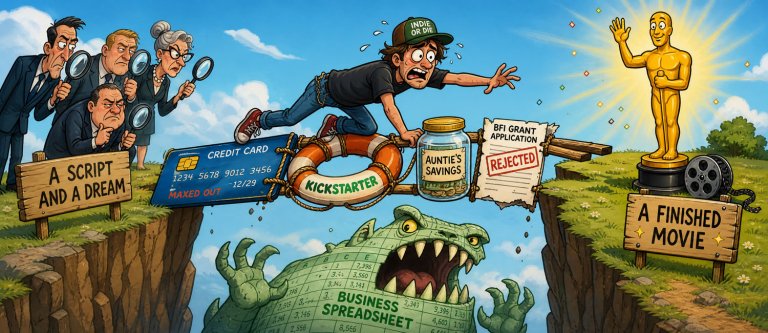
There is a particular kind of madness that afflicts filmmakers. Not the creative kind — that one’s useful, even necessary — but the financial kind. The kind that has you staring at a spreadsheet at two in the morning, wondering whether you can convince your aunt to part with her savings in exchange for an executive producer credit and a thank-you in twelve-point font. The kind that makes crowdfunding platforms look like lifelines and your own credit card look like a perfectly reasonable production budget. If you are reading this, you are probably afflicted. Welcome. Sit down. Let’s talk money.


Why Indie Film Funding Is Its Own Particular Beast

Traditional industries have banks. Tech startups have venture capital. Indie filmmakers have optimism, a hard drive full of reference clips, and — if they’re lucky — a distant relative who once said they thought movies were “interesting.” The gap between having a script you believe in and actually getting it made is not merely a financial one; it is a fundamental one. You are asking people to invest in something intangible, something that doesn’t exist yet, something that might lose money, and — this is the truly audacious part — you are asking them to trust you to make it. That takes a particular kind of pitch, a particular kind of persistence, and, frankly, a particular kind of nerve.

The good news is that people have done it. The better news is that some of them have done it spectacularly. The news you didn’t ask for is that most of them had a plan — and the ones who didn’t have a plan mostly have a cautionary tale instead.


Know What You’re Asking For Before You Ask Anyone

The single most common mistake early-career filmmakers make is approaching funding before they have any real sense of what they need the money for. Not “to make the film” — that is not an answer, that is a sentence. Funders, whether they are grant panels, crowdfunding backers, or private investors, want to know how their contribution translates into something tangible. A location. A day of shooting. Post-production sound. Catering for a crew of eight for three days in a field in Shropshire (this one will cost more than you think).

Before you approach a single person with a cheque book, build a proper budget breakdown. Know your above-the-line costs — talent, writer, director — and your below-the-line costs — crew, equipment, locations, insurance, catering, transport. Know your post-production budget and your contingency (which should be no less than ten per cent, and will almost certainly not be enough). Know the difference between what you need and what would be nice. The moment a funder asks “where does the money go?” and you hesitate, the conversation is already over.


The Crowdfunding Chapter (The One Where Everyone Thinks It’s Easy)

Crowdfunding has democratised indie film financing in ways that would have been unthinkable twenty years ago, and it has also produced more failed campaigns than any other single approach, which tells you something important about democracy. Platforms like Kickstarter and Indiegogo have enabled genuinely remarkable projects to find their audiences before a frame was ever shot — but they have also taught an entire generation of filmmakers the hard way that “if you build it, they will come” is a line from a film, not a funding strategy.

The case study that defined crowdfunding for independent film is the Veronica Mars Movie. In 2013, creator Rob Thomas and star Kristen Bell launched a Kickstarter campaign to revive the cancelled television series as a feature film. They hit their $2 million target in less than eleven hours. They ultimately raised over $5.7 million from nearly 92,000 backers. The lesson most people took from this was “crowdfunding works.” The lesson they should have taken was “crowdfunding works when you have an existing, passionate, and sizeable fanbase who have been waiting years for exactly this thing.” Rob Thomas did not build his audience during the campaign. He had built it over three seasons of television. The campaign was the harvest, not the planting.

A more instructive example for first-time filmmakers is Blue Ruin (2013), directed by Jeremy Saulnier. Saulnier raised $37,000 on Kickstarter — a modest sum by any measure — to complete a film that went on to win the FIPRESCI Prize at Cannes and earn widespread critical acclaim. His campaign worked not because of a pre-existing audience but because of a clear creative vision, transparent communication about what the money would do, and compelling early footage that made backers believe in what they were funding. He also clearly communicated what the project was. He didn’t promise the world. He promised a specific film, made in a specific way, by someone who demonstrably knew what they were doing.

If you are planning a crowdfunding campaign, the practical tips are these: set a realistic target (the all-or-nothing model means an overambitious goal just means you get nothing), build your audience before you launch (not during), offer meaningful rewards that don’t bankrupt you to fulfil (physical merchandise costs more to produce and ship than you will believe until you have done it once), and communicate obsessively throughout the campaign. Update your backers. Thank them publicly. Make them feel like co-conspirators rather than ATMs.


Grants: The Money That Doesn’t Want Anything Back (Mostly)

In the United Kingdom, the landscape of film grants is considerably more navigable than many filmmakers assume — which is to say, it is still quite difficult, but it is not a secret. The BFI Film Fund is the obvious starting point, offering development and production funding for projects with a demonstrable cultural footprint and a clear sense of their audience. Screen Scotland, Creative Wales, and Northern Ireland Screen operate equivalent bodies for projects with a strong regional identity and attachment. For short films — which remain the most viable entry point for emerging filmmakers — the BFI’s short film programmes, as well as schemes run by organisations like Film London and regional screen agencies, represent a realistic first rung.

The critical thing to understand about grant funding is that it is not simply a matter of having a good script. Grant panels fund filmmakers as much as they fund films. They want to see evidence that you understand the work, understand your audience, and have the team to deliver. Your director’s statement, your producer’s track record, your casting approach, your distribution strategy — these matter. A film with a mediocre script and an exceptional team will get further in grant applications than an exceptional script with no supporting evidence that anyone involved has made anything before. This is frustrating if you are at the beginning of your career, but it is not insurmountable. Build the track record with short films. Enter festivals. Win things, or at least submit things. The grant panel wants to fund someone who is going somewhere, not someone who intends to go somewhere.

One piece of advice that is less commonly given: read the rejection letters carefully. If a funding body takes the trouble to tell you why your application was unsuccessful, that is free development notes from people who have read thousands of applications. Use them.


Private Investment: The Art of the Room

Private film investment — sometimes called “soft money,” sometimes called “the conversation you have to have over dinner” — operates on a completely different logic to grants and crowdfunding. Where grants want cultural value and crowdfunding wants community, private investors want some combination of return, prestige, and the profound thrill of being able to tell people at parties that they’re in the film business. This is not cynicism; it is useful information. Understanding what your investor actually wants from the experience is the first step to giving it to them.

The SEIS (Seed Enterprise Investment Scheme) and EIS (Enterprise Investment Scheme) are the UK government’s gift to independent film producers — tax relief mechanisms that allow private investors to offset a significant portion of their investment against their income tax liability, reducing their effective risk considerably. An investor putting £50,000 into an SEIS-eligible production can claim back up to fifty per cent of that in income tax relief, which means their actual exposure is £25,000 before the film has earned a penny. This does not make the investment risk-free, and you should never imply that it does, but it makes the conversation considerably more interesting for a certain class of high-net-worth individual. If your production company is not set up to receive SEIS or EIS investment, fix that before you approach anyone.

The pitch itself is a skill that can be learned, and the most important thing to learn is this: lead with the story, not the business. Investors who are coming to independent film for purely financial reasons have better options. The ones who say yes are doing so at least partly because the project has moved them, excited them, or made them feel that they are part of something. Show them who the film is for. Show them the world. Let them feel the thing before you show them the spreadsheet. Then show them the spreadsheet.


Co-Productions, Partnerships, and the Creative Deals You Haven’t Thought Of

Not all film funding comes in the form of cash, and it is worth spending time thinking creatively about what resources you actually need rather than what money you need to buy those resources. Equipment can be borrowed, deferred, or bartered. Locations can be negotiated in exchange for credit, coverage, or a share of proceeds that will probably never materialise but cost nothing to offer. Post-production facilities sometimes offer discounted rates to emerging filmmakers in exchange for the association. Crew members at the beginning of their own careers may work at reduced rates for the right project.

International co-productions are a more formal version of the same logic. If your story has a genuine connection to another country — a location, a cast member, a thematic relevance — then a formal co-production arrangement with a production company in that territory can unlock their national funding schemes as well as your own. The Eurimages fund exists specifically to support European co-productions. The Creative Europe MEDIA programme offers development funding for projects with genuine cross-border potential. These are not easy routes, but they are real ones, and they are particularly worth exploring if your story has any international dimension at all.


The Big No-Nos (Or: How to Guarantee That Nobody Gives You Any Money, Ever)

We arrive, inevitably, at the cautionary portion of proceedings. The following are not theoretical errors. They are things that actual filmmakers have done, are doing right now, and will continue to do despite all available evidence.

Approaching investors without any development material. A logline and a dream is not a pitch package. At a minimum, you need a script or a treatment, a director’s vision document, a provisional budget, and some sense of who will be watching this film and how. Arriving at a meeting without these things does not communicate passion. It communicates unpreparedness, which communicates risk, which communicates the end of the meeting.

Promising returns you cannot guarantee. Independent film is a high-risk investment. The overwhelming majority of independent films do not return their production budget from theatrical release alone. You must be honest about this. Promising investors a specific return is not only misleading — in some circumstances, depending on how the investment is structured, it can be legally problematic. Speak to a film finance solicitor before you make any commitments. Yes, this costs money. No, it costs less than the alternative.

Launching a crowdfunding campaign with no audience and no plan. The campaign page going live is not the beginning of your marketing. It should be somewhere around the middle. If you have not spent weeks building awareness, identifying your community, and lining up early backers before the campaign launches, the algorithm will bury you and you will spend thirty days watching your total inch upward by single digits while sending increasingly desperate emails to people who went to school with you.

Spending development funding on production. This sounds obvious until it happens to you. Development money is for developing the project — writing, research, attachments, legal costs. If you spend it on a shoot day because you got excited, you have made the classic error of starting before you are ready, and you will either run out of money mid-production (catastrophic) or produce something you cannot finish (also catastrophic, but with the added grief of having footage you can’t use).

Failing to involve a producer early enough. Directors make films. Producers make films possible. If you are a writer-director working alone, you need a producer — someone whose specific job is to think about money, logistics, and the thousand practical considerations that creative people tend to find less interesting than the creative considerations. The best producer-director relationships in independent film are partnerships of genuine equals, and the best time to establish that relationship is before the funding conversations begin, not after.

Giving away too much too early. Equity investment comes with strings. Give away a significant share of your film too early, before you have established its value through grants, attachments, or festival interest, and you may find yourself with very little left to offer — or very little control over the project — by the time the serious money arrives. Understand what you are trading and what it is worth. Again: film finance solicitor. Worth every penny.


The Bit Where We Talk About Mindset (Bear With Me)

There is a version of this article that ends with a list of links — funding bodies, platforms, schemes — and that version would be useful, in the way that a map of a mountain is useful. But the thing about funding an independent film is that the obstacles are not primarily informational. The information is out there. The grants exist. The platforms exist. The investors exist. The obstacle, more often than not, is the sustained, cheerful, relentless willingness to keep making the case for your project in the face of rejection, silence, and the occasional well-meaning suggestion that you might want to consider a more stable career.

The filmmakers who get their films made are not always the ones with the best scripts or the most original ideas. They are, disproportionately, the ones who refuse to take no as a permanent answer. They are the ones who take the rejection letter, find the useful note in it, and use it to make the next application stronger. They are the ones who treat every conversation as a potential relationship rather than a transaction. They are the ones who understand that funding is not something that happens to your film — it is something you build, brick by brick, conversation by conversation, over a period of time that will test your patience and your conviction in roughly equal measure.

The money is out there. The film is in you. The gap between those two facts is bridgeable. It just requires a plan, a pitch, and the kind of persistence that would probably be considered unreasonable in any other industry.

Welcome to filmmaking.

There is a moment, if you spend enough time writing screenplays, when a character stops being yours. You’ve named them, given them a backstory, decided what they want and why they can’t have it — and then, somewhere between draft two and draft four, they start making decisions you didn’t plan for. They say something you didn’t write. They go somewhere you didn’t intend. And the strange, slightly unnerving truth is that this is not a problem. This is the whole point.

I’ve experienced it myself. A character I was developing for an original project — someone I’d thought of as relatively minor, a supporting presence to carry a scene or two — quietly refused to stay minor. They had opinions about everything. They pushed back against the plot I’d constructed around them. At some point I stopped trying to control them and started following them instead. The script got better almost immediately. I wish I could claim I knew that would happen. I did not.

Character in filmmaking is not a component of storytelling. It is storytelling. Everything else — structure, pacing, cinematography, score — exists in service of the people on screen. Get the character wrong, and you can have the most technically accomplished film in the world and still lose your audience somewhere around the twenty-minute mark. Get the character right, and people will forgive you an enormous amount.


Plot Is Just What Happens to Them

There’s a temptation, particularly when you’re starting out, to think of story in terms of events. Something happens, then something else happens, then there’s a twist, then it resolves. This is not a story. This is a sequence of events. A story is what those events mean to someone — and that someone has to be a person we care about, or none of it lands.

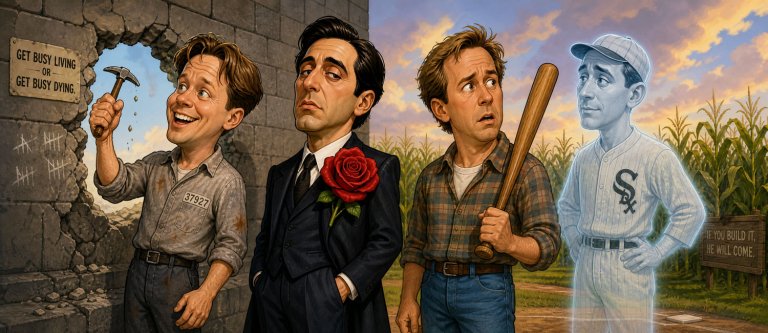
Consider The Shawshank Redemption. On paper, the plot is: man goes to prison, spends twenty years there, escapes. You could describe it in a sentence and it sounds almost mundane. What makes it one of the most beloved films ever made is not the escape — it’s Andy Dufresne, and Red, and the specific texture of their friendship, and what hope costs when the world has made very clear it has no interest in rewarding it. The escape is satisfying because we’ve spent two hours understanding exactly what it means to these two particular people. Strip out the character, and you’ve got a prison documentary with a mildly implausible ending.

Field of Dreams — one of my all-time favourite films, and yes, I will defend that choice vigorously and without apology — is a film about a man who builds a baseball diamond in his cornfield because a disembodied voice told him to. By every rational measure, this is absurd. And yet it works, devastatingly, because Ray Kinsella is drawn with such specificity and such emotional truth that you never once question why he does it. His relationship with his father, his sense of having missed something irretrievable, his willingness to follow an impossible instruction on the off-chance it leads somewhere meaningful — these are not plot mechanics. These are the film. The baseball is almost incidental.


The Engine Beneath Everything

Francis Ford Coppola understood this instinctively, and The Godfather is perhaps the most instructive example of character in filmmaking working at the highest possible level. The film is, technically, about organised crime and family succession and the moral compromises required to survive in a particular world. But what you actually watch — what you feel — is Michael Corleone becoming someone he didn’t intend to become. That transformation is the engine. The mob politics are just the road it drives on.

What’s remarkable about Michael is that Coppola and Mario Puzo never ask you to approve of him. They ask you to understand him. There’s a difference, and it’s a crucial one. The best characters in film are not necessarily good people. They are coherent people — people whose choices follow a legible internal logic, even when that logic leads somewhere dark. You may not agree with what Michael does. You will never be confused about why he does it.

The Coen Brothers take this even further with No Country for Old Men. Anton Chigurh is not a character who invites understanding in any conventional sense. He is, by most measures, a monster. And yet he has an internal consistency — a philosophy, even, however warped — that makes him more unsettling than any amount of cartoonish villainy could manage. He operates by rules. They are not your rules. But they are his, and he never breaks them. That coherence is what makes him frightening. You always know exactly what he’ll do next. You just can’t stop him.


The Audience Doesn’t Watch Films — They Follow People

This is the thing that took me the longest to properly internalise as a filmmaker: audiences do not engage with stories in the abstract. They engage with people. The moment they find someone on screen they can follow — someone whose interiority they can access, whose desires and fears feel recognisable even when the circumstances are completely foreign — they are in. And once they’re in, they will go almost anywhere with you.

This is why science fiction and fantasy can work despite their total departure from everyday reality. It’s why a film set in a medieval Italian village or a dystopian future or a 1940s jazz club can feel intimate and immediate. The world doesn’t need to be yours. The people do. Or at least — the emotional truth of the people does.

It’s also why no amount of production value will save a film with hollow characters. I’ve sat in screenings of technically beautiful films — gorgeous cinematography, immaculate design, a score that would make you weep on its own — and felt absolutely nothing, because there was no one on screen I could find my way into. The camera was watching people. I was not.


Giving Them Room to Breathe

The practical upshot of all this, for anyone actually making films rather than just writing enthusiastically about them, is that character in filmmaking requires space. Characters need room to exist before they need to do things. They need texture — the small details that tell you who someone is without announcing it. The way they respond when plans change. The things they notice. What they find funny. What they can’t quite bring themselves to say.

The mistake is treating character as information to be delivered rather than a person to be discovered — both by the audience and, frankly, by you. The character who took over my script did so because I’d written enough of them that they had their own momentum. I’d done enough of the work that they could, in some sense, continue without me. That’s the goal, I think. Not control, but comprehension. You need to know them well enough that they can surprise you — and well enough that when they do, it feels inevitable.

It’s genuinely difficult work. It requires you to inhabit a perspective that isn’t yours, to sustain that inhabitation across dozens of drafts, and to resist the temptation to make your characters convenient rather than true. When the plot needs someone to make a bad decision, the character has to make that character’s bad decision, arrived at through that character’s specific logic — not whatever bad decision happens to serve the next scene.


Worth Every Difficult Minute

The reason to do any of this, despite all of the above, is simple: when it works, there is nothing like it. When you watch Michael Corleone’s face at the end of The Godfather as the door closes, or when Ray Kinsella finally gets to have the catch he’s been building toward for the whole film, or when Andy Dufresne stands in the rain with his arms out — you are not watching plot resolution. You are watching a person, fully understood, arriving at a moment that only means what it means because of everything that came before it. That’s character in filmmaking at its best. That’s the whole thing, really.

The gear doesn’t do that. The locations don’t do that. The colour grade doesn’t do that.

The people do that. They always do.

Every filmmaker gets asked the same question eventually. Sometimes it comes from a curious friend, sometimes from a nervous newcomer at a workshop, and sometimes — if you’re honest — you ask it of yourself at two in the morning when the cursor is blinking and the page is empty.

Where do the ideas come from?

The truthful answer is: everywhere. And nowhere in particular. But that’s not especially helpful, so let’s dig a little deeper.

Start With What Moves You

The most reliable source of a good idea isn’t a clever concept or a marketable premise. It’s an emotional response to something that already exists. A film you saw. A song you can’t get out of your head. A TV show you watched twenty years ago that still sits with you.


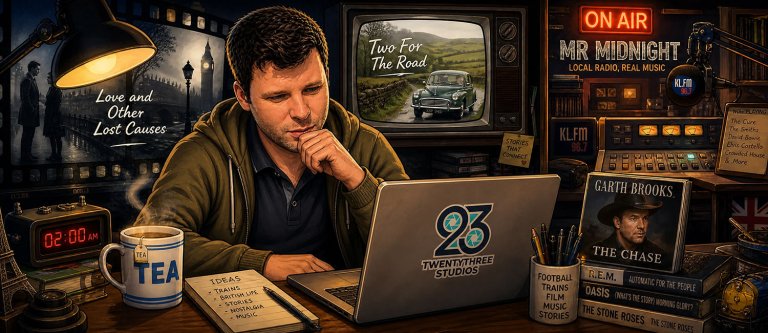
One of my own projects in development, Two For The Road, started exactly there. Growing up, I was captivated by Tim Grundy and his cameraman — known simply as The Eye — in their Discovery Home & Leisure series Two’s Country. There was something magical about their dynamic: warm, funny, genuinely informative without ever feeling like it was trying to teach you anything. Tim was one of the greatest TV and radio presenters this country ever produced, and I wanted to do something that honoured that legacy. The idea for Two For The Road was born not from a gap in the market, but from love — for a show, for a style, for a man whose work deserved a tip of the hat.

That’s as good a reason to make something as any.

Chase a Feeling, Not Just a Story

Here’s something film schools don’t always tell you: you don’t have to start with a story. Sometimes you start with a feeling — a mood, an aesthetic, an atmosphere — and build the story around it afterwards.

Love and Other Lost Causes came from exactly that. I used to run a film festival in Folkestone, and one short film I screened stopped me in my tracks. Not necessarily because of the story, but because of how it felt — the grade, the texture, the emotional temperature of it. I knew immediately that I wanted to capture something of that feeling in my own work, even if the story I told was entirely different.

The actual plot of Love and Other Lost Causes came later — a two in the morning brainstorming session, as it happens (there’s something about that particular hour that loosens the creative mind). But the seed of it was purely sensory. If a piece of work makes you feel something, ask yourself why. Then ask whether you can make something that makes someone else feel the same way.

Let Other Art Forms In

Film doesn’t exist in isolation. The best filmmakers are readers, music lovers, theatre-goers, gallery wanderers. Ideas cross borders all the time, and some of the most interesting projects begin somewhere other than a screenplay.

My project Mr Midnight began with a Garth Brooks song. If you know the track, you’ll understand immediately why it sparked something. If you don’t, I’d suggest looking it up. What I took from it wasn’t the literal narrative but the emotional world it suggested — and from there, with my own creative licence, I’ve been building a story largely set inside a small local radio station. The first draft is in progress. The song remains on the playlist.

Music, in particular, is a gift to filmmakers. A great song can hand you a tone, a character, a world, or a theme in three and a half minutes. Don’t ignore it.

Practical Tips for Finding Your Idea

If you’re stuck, here are a few starting points worth trying:

Write down five things that have genuinely moved you in the last year — films, songs, books, overheard conversations, places, memories. Don’t filter. Just list them. Then look for the thread that connects them. That thread is probably something you care about deeply, and something you care about deeply is worth making something about.

Ask yourself what you haven’t seen. Not in a commercial sense — not “what’s missing from the marketplace” — but personally. What story do you wish existed? What character do you never see represented? What place, what moment, what feeling has never quite been captured on screen in a way that felt true to you?

Don’t wait for the perfect idea. Start with the good-enough idea and let it become something better in the writing and the development. Love and Other Lost Causes was a 2am brainstorm. Mr Midnight started as a feeling about a song. Two For The Road started as gratitude. None of them arrived fully formed.

The Idea Is Just the Beginning

Finding the idea is only the first step, of course. There’s the writing, the rewriting, the pre-production, the endless logistics of actually getting something made. Two For The Road is ready to shoot — we’re just locking in the dates. Love and Other Lost Causes is written and moving into pre-production. Mr Midnight is still taking shape on the page.

Each one started somewhere different. Each one started with a feeling that refused to go away.

That’s the real test of an idea worth pursuing: not whether it sounds good in a pitch, but whether it’s still there in the morning.

EDIT: I’ve had a few messages and a phone call from family and friends asking how I am as a result of this blog post. Let me say that I’m talking about filmmaking, not my day job which I thoroughly enjoy.

There was a time when I couldn’t switch my brain off from filmmaking. A shot would catch my eye on a walk and I’d be reverse-engineering the lighting before I’d finished crossing the road. A line of dialogue would land wrong in something I was watching and I’d be rewriting it in my head, half paying attention to whatever I was actually meant to be doing. It wasn’t a job I was working towards. It was just how my brain worked, all the time, whether I wanted it to or not.

I’m not sure exactly when that stopped. That’s part of what makes this hard to write about. There’s no single morning I can point to and say “that’s the day it left.” It was more of a slow leak than a puncture. One day I looked up and the tank was just… lower than I remembered, and I genuinely couldn’t tell you which mile it happened on.

I want to be honest about this, because I think a lot of people carry some version of it quietly, and the quiet is the worst part.


It’s Not One Thing. That’s What Makes It Hard.

If I could point to a single cause, this would almost be an easier post to write. A bad experience, a project that fell apart, a person who knocked the wind out of me. Something with an edge to it, a villain, a clean narrative.

It’s not that. It’s everything, a little bit, all at once.

It’s the back injury and the bone spurs that mean a full day on set, on my feet, lugging kit, isn’t the straightforward thing it used to be. It’s the fatigue that comes with managing a chronic illness I’ll be carrying for the rest of my life, even in remission, even on a “good” day. It’s running front of house at the Tower Theatre, which I genuinely love, but which also takes a great deal of the same creative and organisational energy that filmmaking demands — there’s only so much of that particular fuel in the tank on any given week, and theatre has, fairly, been getting most of it. It’s the writing projects, the wiki work, the music, Sadie’s care, the general business of staying upright. Filmmaking didn’t get pushed out by one thing. It got quietly outcompeted by a dozen things, none of which were its fault, and none of which I particularly regret choosing in the moment.

And then there’s the industry itself, which I won’t pretend hasn’t played its part. The gap between the dream version of filmmaking — the one I had in my head as a younger man, scripts and sets and a clear path forward — and the actual mechanics of trying to make anything happen as an independent creator with limited time and limited budget, is a genuinely difficult gap to keep staring across. I’ve written things I’m proud of. Story bibles, scripts formatted properly, projects with real bones to them. And then they sit there, because the next step requires a kind of relentless self-promotion and networking energy that I simply don’t have spare most weeks. That’s not the industry’s fault either, particularly. It’s just true.

So: a mixture. Health, time, energy, the industry, life. All of it, a little bit, pulling in the same direction.

The Guilt Bit (You Knew There’d Be a Guilt Bit)

Here’s the part I find hardest to admit. There’s a specific kind of guilt that comes with losing interest in the thing you always said was your dream. Other people remember you talking about it. They ask how the latest script is going, with genuine warmth, and you have to decide in that moment whether to give the easy answer or the true one.

The easy answer is “yeah, ticking along.” The true answer is closer to “I haven’t opened that file in three months and I’m not entirely sure why, and when I think about opening it I feel something closer to tired than excited, and I don’t know what to do with that feeling.”

I don’t think losing passion for something makes it less real that you once loved it, or that you might love it again. But it took me a long time to separate “I’m not currently excited about this” from “I’ve failed at the thing that mattered most to me,” and I’m still not sure I’ve fully managed it. Those two sentences feel identical at 11pm. They are not, in fact, the same sentence.

What I’m Not Going to Do

I’m not going to wrap this up with a neat resolution, because I don’t have one. This isn’t the part of the post where I tell you I rediscovered my spark on a long walk and everything’s back to how it was. That would be a nicer ending. It would also not be true, and I promised myself a while ago that this blog is the place I tell the truth rather than the highlight reel.

What I will say is that I don’t think the passion is gone. I think it’s buried under quite a lot of other, currently louder things — pain, fatigue, caring responsibilities, a job I love that takes more than it gives back some weeks, and an industry that asks for energy I don’t reliably have. I don’t think that’s the same as it being dead. Dead feels permanent. This feels more like a fire that’s gone quiet under the ash, still warm somewhere underneath, waiting for slightly better conditions than the ones I’m currently in.

I don’t know when those conditions arrive. Maybe when the back settles into something more manageable. Maybe when there’s a stretch of life that isn’t quite so determined to throw things at me, on the evidence of my last blog post, which — if you’ve read it — you’ll know is a fairly long list. Maybe it just happens gradually, the way it left, and I won’t notice the exact day it comes back either.

For now, I’m trying to let that be okay. Trying not to force a passion that isn’t currently there, because forcing it has never once worked and has only ever made me feel worse about both the not-wanting-to and the guilt about the not-wanting-to. Trying to trust that the bit of me that used to rewrite dialogue on the walk home is still in there somewhere, just resting.

If You’re In This Too

If any of this sounds familiar — if there’s a version of you that used to light up about something and currently just feels tired when you think about it — I don’t have a fix for you. I’m not sure there is one, or at least not a fast one. But I don’t think you’ve failed, and I don’t think it’s gone for good. I think you’re just carrying a lot, and the thing that needs the most energy is, unfairly, often the first thing that gets quietly put down when the energy runs low.

I’d genuinely like to know if this resonates. Has your relationship with a dream changed shape over the years? Did it come back? What did that look like? Drop it in the comments — I think there’s more comfort in knowing this is common than there is in pretending it isn’t happening at all.


Gary is a designer, developer, theatre manager, songwriter, and — somewhere under the ash — a filmmaker, based in Kent.