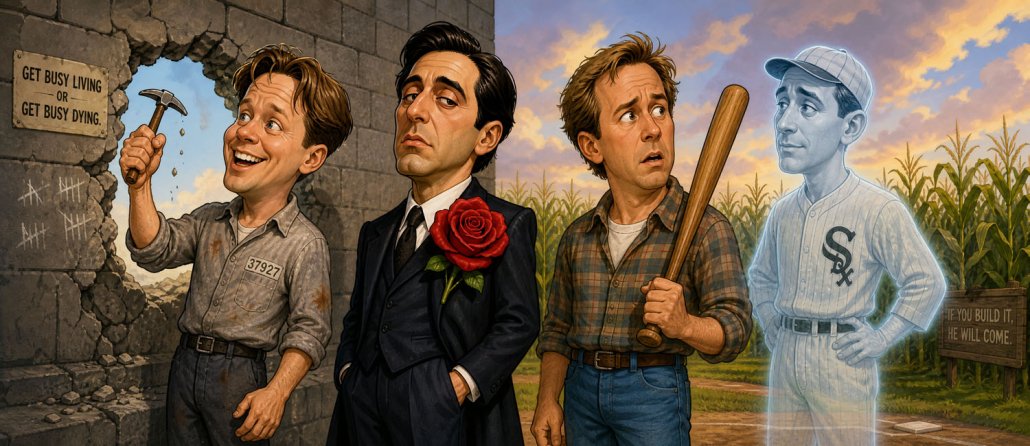
There is a moment, if you spend enough time writing screenplays, when a character stops being yours. You’ve named them, given them a backstory, decided what they want and why they can’t have it — and then, somewhere between draft two and draft four, they start making decisions you didn’t plan for. They say something you didn’t write. They go somewhere you didn’t intend. And the strange, slightly unnerving truth is that this is not a problem. This is the whole point.
I’ve experienced it myself. A character I was developing for an original project — someone I’d thought of as relatively minor, a supporting presence to carry a scene or two — quietly refused to stay minor. They had opinions about everything. They pushed back against the plot I’d constructed around them. At some point I stopped trying to control them and started following them instead. The script got better almost immediately. I wish I could claim I knew that would happen. I did not.
Character in filmmaking is not a component of storytelling. It is storytelling. Everything else — structure, pacing, cinematography, score — exists in service of the people on screen. Get the character wrong, and you can have the most technically accomplished film in the world and still lose your audience somewhere around the twenty-minute mark. Get the character right, and people will forgive you an enormous amount.
[ez-toc]
Plot Is Just What Happens to Them
There’s a temptation, particularly when you’re starting out, to think of story in terms of events. Something happens, then something else happens, then there’s a twist, then it resolves. This is not a story. This is a sequence of events. A story is what those events mean to someone — and that someone has to be a person we care about, or none of it lands.
Consider The Shawshank Redemption. On paper, the plot is: man goes to prison, spends twenty years there, escapes. You could describe it in a sentence and it sounds almost mundane. What makes it one of the most beloved films ever made is not the escape — it’s Andy Dufresne, and Red, and the specific texture of their friendship, and what hope costs when the world has made very clear it has no interest in rewarding it. The escape is satisfying because we’ve spent two hours understanding exactly what it means to these two particular people. Strip out the character, and you’ve got a prison documentary with a mildly implausible ending.
Field of Dreams — one of my all-time favourite films, and yes, I will defend that choice vigorously and without apology — is a film about a man who builds a baseball diamond in his cornfield because a disembodied voice told him to. By every rational measure, this is absurd. And yet it works, devastatingly, because Ray Kinsella is drawn with such specificity and such emotional truth that you never once question why he does it. His relationship with his father, his sense of having missed something irretrievable, his willingness to follow an impossible instruction on the off-chance it leads somewhere meaningful — these are not plot mechanics. These are the film. The baseball is almost incidental.
The Engine Beneath Everything
Francis Ford Coppola understood this instinctively, and The Godfather is perhaps the most instructive example of character in filmmaking working at the highest possible level. The film is, technically, about organised crime and family succession and the moral compromises required to survive in a particular world. But what you actually watch — what you feel — is Michael Corleone becoming someone he didn’t intend to become. That transformation is the engine. The mob politics are just the road it drives on.
What’s remarkable about Michael is that Coppola and Mario Puzo never ask you to approve of him. They ask you to understand him. There’s a difference, and it’s a crucial one. The best characters in film are not necessarily good people. They are coherent people — people whose choices follow a legible internal logic, even when that logic leads somewhere dark. You may not agree with what Michael does. You will never be confused about why he does it.
The Coen Brothers take this even further with No Country for Old Men. Anton Chigurh is not a character who invites understanding in any conventional sense. He is, by most measures, a monster. And yet he has an internal consistency — a philosophy, even, however warped — that makes him more unsettling than any amount of cartoonish villainy could manage. He operates by rules. They are not your rules. But they are his, and he never breaks them. That coherence is what makes him frightening. You always know exactly what he’ll do next. You just can’t stop him.
The Audience Doesn’t Watch Films — They Follow People
This is the thing that took me the longest to properly internalise as a filmmaker: audiences do not engage with stories in the abstract. They engage with people. The moment they find someone on screen they can follow — someone whose interiority they can access, whose desires and fears feel recognisable even when the circumstances are completely foreign — they are in. And once they’re in, they will go almost anywhere with you.
This is why science fiction and fantasy can work despite their total departure from everyday reality. It’s why a film set in a medieval Italian village or a dystopian future or a 1940s jazz club can feel intimate and immediate. The world doesn’t need to be yours. The people do. Or at least — the emotional truth of the people does.
It’s also why no amount of production value will save a film with hollow characters. I’ve sat in screenings of technically beautiful films — gorgeous cinematography, immaculate design, a score that would make you weep on its own — and felt absolutely nothing, because there was no one on screen I could find my way into. The camera was watching people. I was not.
Giving Them Room to Breathe
The practical upshot of all this, for anyone actually making films rather than just writing enthusiastically about them, is that character in filmmaking requires space. Characters need room to exist before they need to do things. They need texture — the small details that tell you who someone is without announcing it. The way they respond when plans change. The things they notice. What they find funny. What they can’t quite bring themselves to say.
The mistake is treating character as information to be delivered rather than a person to be discovered — both by the audience and, frankly, by you. The character who took over my script did so because I’d written enough of them that they had their own momentum. I’d done enough of the work that they could, in some sense, continue without me. That’s the goal, I think. Not control, but comprehension. You need to know them well enough that they can surprise you — and well enough that when they do, it feels inevitable.
It’s genuinely difficult work. It requires you to inhabit a perspective that isn’t yours, to sustain that inhabitation across dozens of drafts, and to resist the temptation to make your characters convenient rather than true. When the plot needs someone to make a bad decision, the character has to make that character’s bad decision, arrived at through that character’s specific logic — not whatever bad decision happens to serve the next scene.
Worth Every Difficult Minute
The reason to do any of this, despite all of the above, is simple: when it works, there is nothing like it. When you watch Michael Corleone’s face at the end of The Godfather as the door closes, or when Ray Kinsella finally gets to have the catch he’s been building toward for the whole film, or when Andy Dufresne stands in the rain with his arms out — you are not watching plot resolution. You are watching a person, fully understood, arriving at a moment that only means what it means because of everything that came before it. That’s character in filmmaking at its best. That’s the whole thing, really.
The gear doesn’t do that. The locations don’t do that. The colour grade doesn’t do that.
The people do that. They always do.