
Posts

If you’ve ever wanted to know how to start writing a novel, you’ve probably already done what most aspiring writers do: opened a blank document, stared at it for twenty minutes, typed the word “Chapter” and then gone to make a cup of tea. This is, for the record, a completely normal part of the process. What’s less normal is everything that should happen before you open the document, and that’s what this guide is about.

I’ll be upfront: I have two novels currently in progress, which technically makes me a person who knows how to start writing a novel and considerably less certain about how to finish one. But starting — really starting, with a solid foundation rather than a vague sense of enthusiasm and a half-remembered dream — is something I’ve now done enough times to have opinions about. Here’s what actually works.


Find an Idea Worth Committing To

The most common advice you’ll hear is “write what you know,” which is simultaneously true and completely unhelpful. A more useful framing is: write what you can’t stop thinking about. The idea that keeps coming back to you on the commute, in the shower, in the middle of other people’s conversations. That persistent, slightly annoying creative itch is usually the one worth scratching for 80,000 words.

Ideas don’t have to arrive fully formed. They almost never do. What you’re looking for at the start is a collision: two or three things that don’t obviously go together but produce something interesting when they do. A familiar setting with an unfamiliar problem. A well-worn genre with an unexpected character at its centre. My own comedy-horror novel started as nothing more than a location and a mood — the story came later, one piece at a time.

Once you think you have an idea, test it with a single sentence. Not a marketing blurb or a pitch — just the core of the thing. “A disgraced [X] must [do Y] before [Z happens]” is a good enough template to start with. If you can fill it in, you probably have an idea. If you can’t, you might just have a vibe, and vibes alone won’t carry you to chapter twelve.

Know Your Genre (Even If You Plan to Bend It)

Genre isn’t a cage, it’s a set of reader expectations — and knowing what those expectations are is what gives you the power to meet them, subvert them, or do something interesting somewhere in between. A reader picking up a thriller expects momentum and a ticking clock. A reader picking up literary fiction expects interiority and precise language. Neither is right or wrong, but if you’re writing a thriller and you don’t know that yet, you might spend three chapters on backstory that your readers are silently screaming past.

Spend some time reading in your genre before you start writing in it. Not to copy what’s there, but to understand the shape of it. Stephen King, in his indispensable book On Writing, argues that reading widely is as important as writing regularly — and he’s produced enough novels to have earned the right to say so.

Plotter, Pantser, or Something in Between

This is the great ideological divide of the writing world, and it generates a disproportionate amount of heated debate for what is, ultimately, a question about your personal working style.

A plotter plans extensively before writing. Chapter breakdowns, character sheets, scene-by-scene outlines, the lot. There’s a story structure before a single page of prose exists. The advantage is that you’re much less likely to write yourself into a corner at chapter fifteen with no idea how to get out. The disadvantage is that some writers find the detailed outline kills the creative excitement before they’ve started.

A pantser (from the phrase “writing by the seat of your pants”) starts with an idea, possibly a character, maybe an opening scene, and simply writes to find out what happens. The advantage is that the story feels genuinely discovered rather than executed. The disadvantage is that the middle of the novel can become a swamp of scenes that don’t quite connect, and the dreaded first draft can require substantial structural surgery.

Most working novelists end up somewhere in the middle: a rough outline or some anchor points (beginning, a few key turns, a sense of the ending), but enough flexibility to let the story surprise you along the way. That’s the approach I’d recommend for a first novel. Enough structure to keep you from losing the thread, enough freedom to not feel like you’re colouring inside someone else’s lines.

Build Characters You Actually Understand

Plot is what happens. Character is why it matters. Readers will forgive a lot of structural wobble in a novel if they’re sufficiently invested in the people inside it — and they’ll put down a technically accomplished book in a heartbeat if the characters feel like furniture.

Before you start writing, know your protagonist well enough to predict how they’d react to things that aren’t in the novel. What do they want, and what do they need, and are those two things the same? (They rarely are, and the gap between them is often where the most interesting story lives.) What’s the thing they most want to avoid, and how quickly can you arrange for exactly that to happen? What are they wrong about at the start of the story, and will they know they were wrong by the end?

Secondary characters deserve the same treatment, even if they won’t get as much page time. A character who exists only to deliver information, create obstacles, or be impressed by the protagonist is a character the reader won’t believe in. Give everyone a reason for being in the room that has nothing to do with the protagonist, and the whole thing starts to feel populated rather than staged.

You don’t need a forty-page character bible. A page of notes per major character, honestly answered, is usually enough to get started. The rest you’ll discover as you write them.

One quick test that saves a lot of time later: read a page of your protagonist’s dialogue aloud and cover the dialogue tags. If you can’t tell who’s speaking, your character doesn’t have a distinct voice yet. Every significant character should sound like themselves rather than like the author — and finding that voice is one of the most enjoyable parts of a first draft, because it usually surprises you.

Structure: The Architecture Before the Bricks

Whatever genre you’re writing in, your novel has a shape — and understanding that shape before you start is the difference between knowing where you’re going and hoping you’ll figure it out when you get there.

The three-act structure is the standard starting point for a reason: it’s a description of how most satisfying stories actually work rather than a rigid formula imposed from outside. Act one establishes your world, your character, and the problem. Act two is the long middle — complications, reversals, rising stakes, your character being tested. Act three is the resolution. Roughly speaking, that’s about 25% setup, 50% middle, 25% ending, though these are guidelines rather than measurements.

For a first novel, I’d suggest knowing three things before you write chapter one: where your story begins (not just logistically, but emotionally — what is the status quo that’s about to be disrupted?), at least one major turning point in the middle, and roughly where it ends. You don’t need every beat mapped. You need enough that if you get lost, you have somewhere to navigate back to.

Choose Your Point of View Before You Start

Point of view is one of the most consequential decisions you’ll make about your novel, and it’s one that first-time writers often don’t consciously make at all — they just start writing from wherever feels natural and then wonder why the thing feels slightly off in places.

First person (“I walked into the room”) puts the reader directly inside one character’s head. It’s immediate, intimate, and great for voice-driven stories, but it limits you strictly to what that character knows, sees, and experiences. If something important happens when your narrator isn’t present, you have a logistical problem.

Third person limited (“She walked into the room”) gives you a little more flexibility — you’re narrating from close to one character at a time, following their perspective, but with slightly more narrative distance. This is the most common choice for contemporary commercial fiction, and for good reason: it gives you intimacy and flexibility without the strict constraints of first person.

Third person omniscient (“They walked into the room, unaware of what was waiting”) gives the narrator god-like knowledge of events, characters, and consequences. It can feel old-fashioned in contemporary literary fiction but works very well in certain genres. The danger is “head-hopping” — jumping between different characters’ inner thoughts so rapidly that the reader loses their footing.

Second person (“You walk into the room”) is a choice you should probably not make for your first novel unless you have a very specific and deliberate reason. It’s the kind of thing that works brilliantly in the right hands and reads as a gimmick in everyone else’s.

Pick your point of view intentionally, test it against the first few scenes in your head, and then commit to it. Changing POV halfway through a draft is one of the most time-consuming structural rewrites there is.

Set Up a Writing Routine That Works for Your Actual Life

This is the part where most writing guides suggest waking up at five in the morning to write three thousand words before breakfast. I’ll be honest: I find that advice intensely irritating, because it assumes a lifestyle that the majority of working people with jobs and families and commitments simply don’t have. The trick isn’t to write more than is humanly sustainable. It’s to write consistently with whatever time you actually have.

Five hundred words a day is 182,500 words in a year. That’s two novels, or one very chunky one. Even two hundred and fifty words — less than this section — written daily adds up to a completed first draft in a year if you don’t stop. The goal is not the session count. It’s not stopping.

Set a target you’ll actually hit on a tired Tuesday evening after work. Not the target you’d hit on an ideal Saturday with nothing else to do. Protect that time as much as you can, but don’t punish yourself for missing it — just write the next day instead. Guilt is not a useful creative tool.

How to Start Writing a Novel: Actually Writing Chapter One

Start as late in the story as you can. This is the single most useful tactical piece of advice I can give about the opening chapter of a novel, and it’s the one that new writers most consistently ignore (understandably, because instinct pulls in the opposite direction).

Most first chapters begin too early: the protagonist waking up, the weather, the backstory, the scene-setting that feels necessary but isn’t. Readers don’t need to know everything before something happens. They need something to happen, and they’ll accept the context as it becomes relevant. Start in the middle of something: a conversation, a decision, a moment of change. Give your reader a reason to read sentence two before you’ve finished sentence one.

Your first chapter needs to do several things at once: establish voice, introduce character, set the tone, raise a question the reader wants answered, and hint at the world without turning into a guided tour of it. That’s a lot to ask of a few thousand words. The good news is that you don’t have to get it right the first time. First drafts exist to be fixed, and the opening chapter of most published novels looks almost nothing like its first draft. Write it, move on, and come back to it when you know what the book actually is.

Common Mistakes to Avoid from the Start

A few patterns trip up most first-time novelists, and knowing them in advance is worth more than stumbling into them at chapter six:

  • Waiting until the idea is perfect. It won’t be. Start with the best version of the idea you have now, and let the writing improve it. The perfect idea that never gets written is worth precisely nothing.
  • Editing as you go. A chapter rewritten seventeen times while chapters two through ten don’t exist yet is not progress. Get the draft done first. Fix it second. They’re different jobs, and doing them simultaneously is a good way to finish neither.
  • Telling people about it instead of writing it. This is one I’ve learned the hard way. Talking about a novel releases some of the same creative satisfaction as writing it, with none of the word count. Be very selective about who you discuss it with until you have something on the page worth discussing.
  • Comparing your first draft to other people’s finished books. You are reading their final, edited, professionally polished work. You are writing your first attempt at a chapter you might not keep. They are not comparable things.
  • Stopping when it gets hard. It will get hard. Usually around a third of the way in, when the initial excitement has worn off and the end is still nowhere in sight. This is called the murky middle, and every novelist goes through it. Some days you’ll write scenes you know are wrong just to get through them. That’s fine. Wrong scenes that exist can be fixed. Blank pages can’t. The only way out is through.

One Last Thing

The gap between wanting to write a novel and having written one is, in its entirety, the act of sitting down and doing it on enough consecutive days. There’s no technique that substitutes for that, and no preparation that’s a replacement for the first draft. Read widely, plan enough to get started, and then write — imperfectly, inconsistently some weeks, occasionally brilliantly, more often adequately. The draft you finish is infinitely more useful than the one you’re still perfecting in your head.

If you’re at the funding and legal side of a creative project, I’ve also covered the indie film funding side of things separately — different medium, same fundamental principle: get started, and sort the rest out as you go.

There is a moment, if you spend enough time writing screenplays, when a character stops being yours. You’ve named them, given them a backstory, decided what they want and why they can’t have it — and then, somewhere between draft two and draft four, they start making decisions you didn’t plan for. They say something you didn’t write. They go somewhere you didn’t intend. And the strange, slightly unnerving truth is that this is not a problem. This is the whole point.

I’ve experienced it myself. A character I was developing for an original project — someone I’d thought of as relatively minor, a supporting presence to carry a scene or two — quietly refused to stay minor. They had opinions about everything. They pushed back against the plot I’d constructed around them. At some point I stopped trying to control them and started following them instead. The script got better almost immediately. I wish I could claim I knew that would happen. I did not.

Character in filmmaking is not a component of storytelling. It is storytelling. Everything else — structure, pacing, cinematography, score — exists in service of the people on screen. Get the character wrong, and you can have the most technically accomplished film in the world and still lose your audience somewhere around the twenty-minute mark. Get the character right, and people will forgive you an enormous amount.


Plot Is Just What Happens to Them

There’s a temptation, particularly when you’re starting out, to think of story in terms of events. Something happens, then something else happens, then there’s a twist, then it resolves. This is not a story. This is a sequence of events. A story is what those events mean to someone — and that someone has to be a person we care about, or none of it lands.

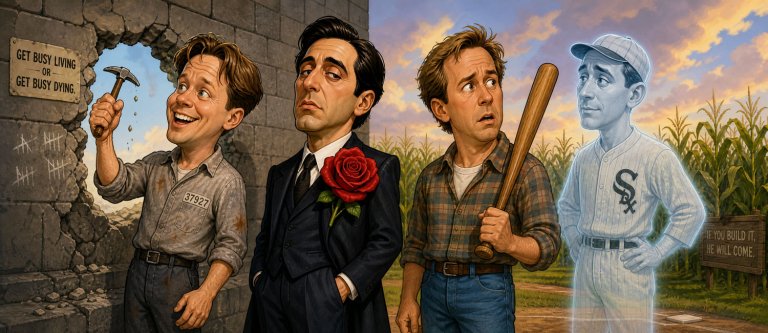
Consider The Shawshank Redemption. On paper, the plot is: man goes to prison, spends twenty years there, escapes. You could describe it in a sentence and it sounds almost mundane. What makes it one of the most beloved films ever made is not the escape — it’s Andy Dufresne, and Red, and the specific texture of their friendship, and what hope costs when the world has made very clear it has no interest in rewarding it. The escape is satisfying because we’ve spent two hours understanding exactly what it means to these two particular people. Strip out the character, and you’ve got a prison documentary with a mildly implausible ending.

Field of Dreams — one of my all-time favourite films, and yes, I will defend that choice vigorously and without apology — is a film about a man who builds a baseball diamond in his cornfield because a disembodied voice told him to. By every rational measure, this is absurd. And yet it works, devastatingly, because Ray Kinsella is drawn with such specificity and such emotional truth that you never once question why he does it. His relationship with his father, his sense of having missed something irretrievable, his willingness to follow an impossible instruction on the off-chance it leads somewhere meaningful — these are not plot mechanics. These are the film. The baseball is almost incidental.


The Engine Beneath Everything

Francis Ford Coppola understood this instinctively, and The Godfather is perhaps the most instructive example of character in filmmaking working at the highest possible level. The film is, technically, about organised crime and family succession and the moral compromises required to survive in a particular world. But what you actually watch — what you feel — is Michael Corleone becoming someone he didn’t intend to become. That transformation is the engine. The mob politics are just the road it drives on.

What’s remarkable about Michael is that Coppola and Mario Puzo never ask you to approve of him. They ask you to understand him. There’s a difference, and it’s a crucial one. The best characters in film are not necessarily good people. They are coherent people — people whose choices follow a legible internal logic, even when that logic leads somewhere dark. You may not agree with what Michael does. You will never be confused about why he does it.

The Coen Brothers take this even further with No Country for Old Men. Anton Chigurh is not a character who invites understanding in any conventional sense. He is, by most measures, a monster. And yet he has an internal consistency — a philosophy, even, however warped — that makes him more unsettling than any amount of cartoonish villainy could manage. He operates by rules. They are not your rules. But they are his, and he never breaks them. That coherence is what makes him frightening. You always know exactly what he’ll do next. You just can’t stop him.


The Audience Doesn’t Watch Films — They Follow People

This is the thing that took me the longest to properly internalise as a filmmaker: audiences do not engage with stories in the abstract. They engage with people. The moment they find someone on screen they can follow — someone whose interiority they can access, whose desires and fears feel recognisable even when the circumstances are completely foreign — they are in. And once they’re in, they will go almost anywhere with you.

This is why science fiction and fantasy can work despite their total departure from everyday reality. It’s why a film set in a medieval Italian village or a dystopian future or a 1940s jazz club can feel intimate and immediate. The world doesn’t need to be yours. The people do. Or at least — the emotional truth of the people does.

It’s also why no amount of production value will save a film with hollow characters. I’ve sat in screenings of technically beautiful films — gorgeous cinematography, immaculate design, a score that would make you weep on its own — and felt absolutely nothing, because there was no one on screen I could find my way into. The camera was watching people. I was not.


Giving Them Room to Breathe

The practical upshot of all this, for anyone actually making films rather than just writing enthusiastically about them, is that character in filmmaking requires space. Characters need room to exist before they need to do things. They need texture — the small details that tell you who someone is without announcing it. The way they respond when plans change. The things they notice. What they find funny. What they can’t quite bring themselves to say.

The mistake is treating character as information to be delivered rather than a person to be discovered — both by the audience and, frankly, by you. The character who took over my script did so because I’d written enough of them that they had their own momentum. I’d done enough of the work that they could, in some sense, continue without me. That’s the goal, I think. Not control, but comprehension. You need to know them well enough that they can surprise you — and well enough that when they do, it feels inevitable.

It’s genuinely difficult work. It requires you to inhabit a perspective that isn’t yours, to sustain that inhabitation across dozens of drafts, and to resist the temptation to make your characters convenient rather than true. When the plot needs someone to make a bad decision, the character has to make that character’s bad decision, arrived at through that character’s specific logic — not whatever bad decision happens to serve the next scene.


Worth Every Difficult Minute

The reason to do any of this, despite all of the above, is simple: when it works, there is nothing like it. When you watch Michael Corleone’s face at the end of The Godfather as the door closes, or when Ray Kinsella finally gets to have the catch he’s been building toward for the whole film, or when Andy Dufresne stands in the rain with his arms out — you are not watching plot resolution. You are watching a person, fully understood, arriving at a moment that only means what it means because of everything that came before it. That’s character in filmmaking at its best. That’s the whole thing, really.

The gear doesn’t do that. The locations don’t do that. The colour grade doesn’t do that.

The people do that. They always do.

Every filmmaker gets asked the same question eventually. Sometimes it comes from a curious friend, sometimes from a nervous newcomer at a workshop, and sometimes — if you’re honest — you ask it of yourself at two in the morning when the cursor is blinking and the page is empty.

Where do the ideas come from?

The truthful answer is: everywhere. And nowhere in particular. But that’s not especially helpful, so let’s dig a little deeper.

Start With What Moves You

The most reliable source of a good idea isn’t a clever concept or a marketable premise. It’s an emotional response to something that already exists. A film you saw. A song you can’t get out of your head. A TV show you watched twenty years ago that still sits with you.


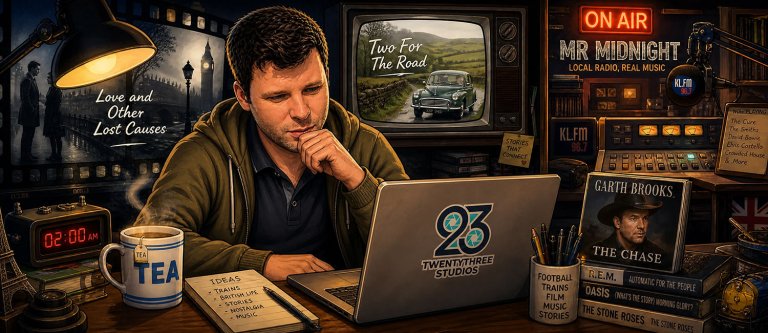
One of my own projects in development, Two For The Road, started exactly there. Growing up, I was captivated by Tim Grundy and his cameraman — known simply as The Eye — in their Discovery Home & Leisure series Two’s Country. There was something magical about their dynamic: warm, funny, genuinely informative without ever feeling like it was trying to teach you anything. Tim was one of the greatest TV and radio presenters this country ever produced, and I wanted to do something that honoured that legacy. The idea for Two For The Road was born not from a gap in the market, but from love — for a show, for a style, for a man whose work deserved a tip of the hat.

That’s as good a reason to make something as any.

Chase a Feeling, Not Just a Story

Here’s something film schools don’t always tell you: you don’t have to start with a story. Sometimes you start with a feeling — a mood, an aesthetic, an atmosphere — and build the story around it afterwards.

Love and Other Lost Causes came from exactly that. I used to run a film festival in Folkestone, and one short film I screened stopped me in my tracks. Not necessarily because of the story, but because of how it felt — the grade, the texture, the emotional temperature of it. I knew immediately that I wanted to capture something of that feeling in my own work, even if the story I told was entirely different.

The actual plot of Love and Other Lost Causes came later — a two in the morning brainstorming session, as it happens (there’s something about that particular hour that loosens the creative mind). But the seed of it was purely sensory. If a piece of work makes you feel something, ask yourself why. Then ask whether you can make something that makes someone else feel the same way.

Let Other Art Forms In

Film doesn’t exist in isolation. The best filmmakers are readers, music lovers, theatre-goers, gallery wanderers. Ideas cross borders all the time, and some of the most interesting projects begin somewhere other than a screenplay.

My project Mr Midnight began with a Garth Brooks song. If you know the track, you’ll understand immediately why it sparked something. If you don’t, I’d suggest looking it up. What I took from it wasn’t the literal narrative but the emotional world it suggested — and from there, with my own creative licence, I’ve been building a story largely set inside a small local radio station. The first draft is in progress. The song remains on the playlist.

Music, in particular, is a gift to filmmakers. A great song can hand you a tone, a character, a world, or a theme in three and a half minutes. Don’t ignore it.

Practical Tips for Finding Your Idea

If you’re stuck, here are a few starting points worth trying:

Write down five things that have genuinely moved you in the last year — films, songs, books, overheard conversations, places, memories. Don’t filter. Just list them. Then look for the thread that connects them. That thread is probably something you care about deeply, and something you care about deeply is worth making something about.

Ask yourself what you haven’t seen. Not in a commercial sense — not “what’s missing from the marketplace” — but personally. What story do you wish existed? What character do you never see represented? What place, what moment, what feeling has never quite been captured on screen in a way that felt true to you?

Don’t wait for the perfect idea. Start with the good-enough idea and let it become something better in the writing and the development. Love and Other Lost Causes was a 2am brainstorm. Mr Midnight started as a feeling about a song. Two For The Road started as gratitude. None of them arrived fully formed.

The Idea Is Just the Beginning

Finding the idea is only the first step, of course. There’s the writing, the rewriting, the pre-production, the endless logistics of actually getting something made. Two For The Road is ready to shoot — we’re just locking in the dates. Love and Other Lost Causes is written and moving into pre-production. Mr Midnight is still taking shape on the page.

Each one started somewhere different. Each one started with a feeling that refused to go away.

That’s the real test of an idea worth pursuing: not whether it sounds good in a pitch, but whether it’s still there in the morning.