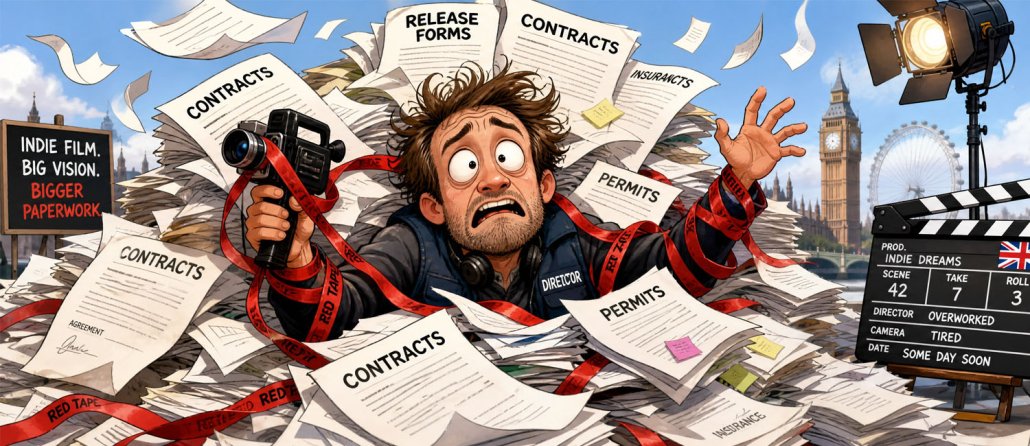
Getting your UK film legal basics sorted is not why anyone picks up a camera. You get into filmmaking for the itch to tell a story, the thrill of watching something you imagined turn into something you can actually point a lens at. Then, somewhere around your second short film, you discover that half the job is paperwork you didn’t know existed, signed by people who’d much rather be acting than reading small print.
I learned most of this the hard way, which is the traditional method for indie filmmakers everywhere. If you’ve already worked through funding your production, this is the natural next step: here’s the legal groundwork every UK indie production needs, minus the bits that only apply if you’re shooting a car chase through Piccadilly Circus.
[ez-toc]
Contracts: Get It In Writing, Even When You Trust Everyone
The awkward truth about working with friends, or friends-of-friends, on a low-budget shoot is that goodwill doesn’t hold up when someone’s unpaid invoice becomes a dispute six months later. A basic deal memo or contract for cast and crew doesn’t need to run to twenty pages, but it does need to cover who’s doing what, for how much (even if that’s “expenses only” or “deferred payment”), and what happens to the footage afterwards.
Clear job descriptions and agreed terms aren’t just good practice — they’re the difference between a smooth shoot and a group chat that goes very quiet after wrap.
Cast and crew contracts don’t need to be identical, because they’re covering different risks. A cast agreement should nail down the role, the shoot dates you actually need them for, any nudity or intimacy clauses if relevant (and whether an intimacy coordinator is involved), credit billing, and — critically — a clear grant of rights to use their likeness and performance in the finished film and any promotional material. Without that last part, you can end up with a finished film you’re not actually allowed to distribute.
A crew contract cares less about likeness and more about scope of work, equipment responsibility, and ownership of anything they create. If your DOP is bringing their own kit, say so and say who’s liable if it’s damaged. If your composer is writing an original score, the contract needs to specify who owns the copyright afterwards — by default, this can get murky, and “we’ll sort it out later” is how indie films end up unable to license their own soundtrack.
If you’re working with anyone under a union banner, it’s worth knowing the landscape. Equity covers performers, BECTU covers the wider crew and broadcasting side, and the Writers’ Guild of Great Britain covers scriptwriters. You don’t have to be a union production to benefit from knowing their guidance on pay rates and working practices, even as a benchmark for what’s reasonable.
Funding, Crowdfunding and the Legal Small Print
I’ve covered UK indie film funding properly in a separate guide, so I won’t repeat all of it here — but it’s worth flagging where funding and legal paperwork overlap, because they overlap more than people expect.
If you’re running a crowdfunding campaign, transparency isn’t just good manners, it’s a legal expectation: be accurate about what backers are actually funding and deliver on whatever rewards you promised, because unfulfilled crowdfunding rewards can and do end up as consumer disputes. If you’re paying cast or crew on deferred terms — “you’ll get paid once the film sells” — put the deferral in writing with clear conditions for when and how that payment triggers. A verbal “you’ll get paid eventually” is not a contract, and it’s not something anyone can enforce.
Insurance: The Bit That Actually Lets You Film
Insurance sits slightly apart from the rest of this because in practice, it’s often the gatekeeper: most UK locations and councils won’t grant filming permission without proof of public liability insurance in hand, so it needs sorting in early pre-production rather than as an afterthought.
Public liability insurance covers injury or property damage caused during your shoot — the classic scenario being a light stand going through someone’s window, or a member of the public tripping over a cable. Beyond that, most productions also want equipment insurance in case anything you’ve hired or borrowed is damaged or stolen, and if you’re paying cast or crew, employer’s liability insurance is a legal requirement in the UK the moment you have anyone working for you in an employment-like relationship, even briefly.
Short-term production insurance policies exist specifically for indie and student productions and are usually far cheaper than people assume for a single shoot or short run. It’s worth getting quotes before you lock your shoot dates, not after, since some insurers want notice.
Release Forms: Your Get-Out-Of-Lawsuit Card
Here’s a fact that surprises most first-time filmmakers: you don’t legally need permission to film identifiable members of the public in the UK, because there’s no general expectation of privacy in a public space. But that’s the floor, not the ceiling — and if you’re publishing footage commercially, especially with someone as the clear focus of a shot, a signed model release form is standard practice, not paranoia.
If you’re filming for a business purpose and collecting footage of identifiable people, you may well count as a “data controller” under GDPR and the Data Protection Act 2018, which brings its own obligations around consent, transparency, and what happens if someone later asks you to take their face out of your film. Getting a signature at the time saves an enormous amount of grief later.
Location releases are the other half of this. If you want to film on someone’s property — private or council-owned — you need explicit permission from whoever actually has the authority to give it. That sounds obvious until you’re standing in a leased shop unit and the person saying yes turns out to be a sub-tenant with no legal standing to authorise anything. A proper release should nail down the exact site (postal address, not “that café near the station”), the dates and times you need access including set-up and breakdown, what you’re allowed to do while you’re there, and whether you’re changing anything about the space that needs restoring afterwards.
Health and Safety: The Risk Assessment You Can’t Skip
This is the one that gets treated as pure box-ticking right up until something goes wrong, at which point it becomes the single most important document on the production. If you have anyone working for you — paid, deferred, or favour-based — you have a duty of care towards them, and a written risk assessment covering your locations, equipment, and any specialist activity (stunts, weapons, animals, working at height, night shoots) is the standard way of showing you’ve actually thought about it rather than just hoping for the best.
It doesn’t need to be complicated. For most low-budget shoots it’s a page or two: what could go wrong, how likely it is, what you’re doing to reduce the risk, and who’s responsible for checking it on the day. If anything involving explosives, armourers, or specialist stunt work is on your shoot, the relevant practitioners should hold recognised qualifications through the Joint Industry Grading Scheme, and the police need to be informed in advance if weapons of any kind — including replicas — are being used.
Film Permits in the UK: When “Just Turning Up” Isn’t an Option
Small-crew filming on public land like streets and parks generally doesn’t need a permit in the UK. It gets complicated fast, though, the moment your shoot blocks a pavement, uses large equipment or artificial lighting, involves drones, or lands somewhere with its own filming policy — which increasingly includes major cities and busy public spaces. The rule of thumb: if your shoot could plausibly annoy a council officer, ring the council first. Bring your public liability insurance documents when you ask — most councils will want to see them before granting permission.
Drones are their own small nightmare of bureaucracy, governed by the Civil Aviation Authority rather than your local council, and flying one over residential rooftops without the right permissions is a good way to turn a low-budget short into an unplanned legal case study.
Errors and Omissions Insurance: The One Nobody Thinks About Until Distribution
This is the insurance that catches indie filmmakers out precisely because it’s not needed until later — and by then, half your paperwork trail is scattered across old email threads and someone’s WhatsApp. Errors and omissions (E&O) insurance covers legal claims arising from your finished film: defamation, copyright infringement, unauthorised use of someone’s likeness, that sort of thing. Distributors and streaming platforms increasingly won’t touch a film without it, because they want that risk covered before they’ll agree to release it.
The practical takeaway is this: every release form, every music clearance, every location agreement you signed during production is exactly what an E&O insurer — and later, a distributor’s legal team — will want to see. Keep a single folder, physical or digital, with every signed document from day one. Future you, trying to close a distribution deal eighteen months after wrap, will be very grateful.
The Bits People Forget
A handful of smaller things trip up more indie productions than you’d expect:
- Child performers need to be licensed through the local education authority in the area where you’re filming, and the licence dictates working hours and safeguarding requirements. This one’s non-negotiable and worth sorting weeks in advance, not the night before your shoot day.
- Weapons on set — including replicas and non-functioning props — require you to inform the police beforehand, even on private land.
- Music and copyrighted material caught in shot or used on the soundtrack needs clearing. A song playing on a car radio in the background of your scene is still someone’s copyrighted work.
- Defamation applies even to fictional characters if they’re recognisably based on a real, living person. “Based on a true story” is doing a lot of legal heavy lifting in your opening titles for a reason.
None Of This Is a Substitute for an Actual Solicitor
I’ll say the obvious bit plainly: I’m a filmmaker, not a lawyer, and this post is the “know what to ask about” guide, not the “here’s your legally binding advice” guide. For anything with real money, real risk, or a location owner who seems litigious, get a solicitor who actually knows UK media law to look over your paperwork. Organisations like the British Film Commission also publish up-to-date regulatory guidance worth bookmarking. It costs less than you think, and considerably less than the alternative.
What I can tell you from experience is that the productions which sail through smoothly are almost always the ones where someone sat down before day one and got the boring bits sorted. Treat your contracts and releases as part of the craft, not an obstacle to it, and the actual filmmaking gets to be a lot more fun.