
Nobody Warned Me It Would Feel Like This
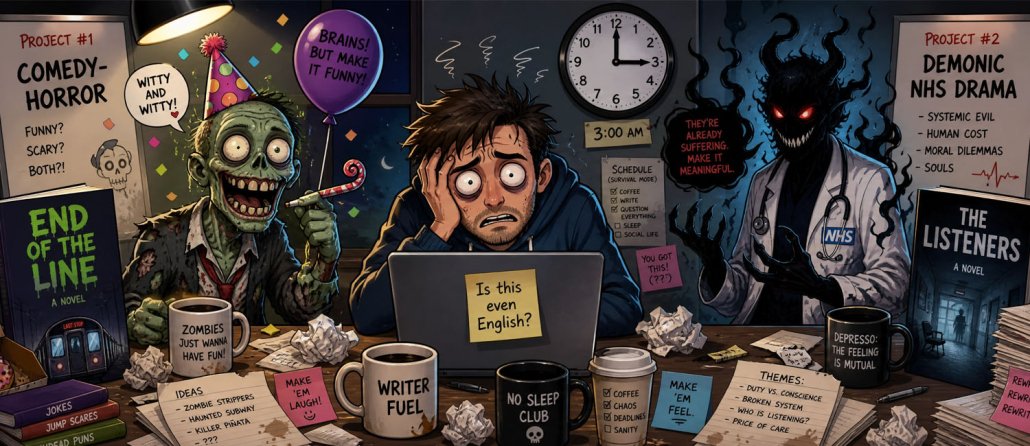
I have two novels on the go. This is either an admirable display of creative ambition or a spectacular failure of self-knowledge, and I’m honestly not sure which. One of them — End of the Line, a comedy-horror — currently sits at just over 25,000 words, which sounds impressive until you remember that a finished novel is typically around 80,000, and that the words I have are almost certainly not the words that will end up on the page. The other — The Listeners, a psychological, paranormal, demonic drama set in an NHS teaching hospital — is at a rather more modest 5,700, and is currently staring at me from my laptop screen with the quiet menace of something that knows it’s not done yet.
I say all of this not to brag — there is nothing to brag about here — but to establish that I have enough experience of the novel-writing process to tell you, with some confidence, that it is nothing like what people imagine it to be. Not even close.
What People Think It Is
There is a persistent and deeply romantic image of the novelist: sat in some atmospheric study, perhaps at a mahogany desk, perhaps near a window overlooking rolling hills, some excellent coffee steaming gently to one side, the words flowing out of them like water from a tap that someone has left running. The novelist in this image is channelling. They are visited by a muse. The story arrives, and they simply transcribe it.
I want to be very clear about this image: it is a lie. Not a gentle exaggeration or a slight simplification, but a thorough, comprehensive, structurally unsound lie, built on no evidence whatsoever and maintained entirely by the publishing industry’s reluctance to put “actually this nearly destroyed me” on the back cover. Stephen King — a man who has written more novels than most people have read — put it more bluntly than I can: “Amateurs sit and wait for inspiration, the rest of us just get up and go to work.” (On Writing, 2000). There is no muse. There is only the chair, and the screen, and the next sentence.
The reality — at least in my experience, and in the experience of most writers I’ve read about or listened to talk honestly about their work — is considerably less cinematic. The reality involves staring at a sentence you wrote last Tuesday and genuinely not knowing whether it’s the best thing you’ve ever produced or an embarrassment to the English language. Often, it is both. Sometimes it is neither. The real problem is that you can’t always tell the difference. Elmore Leonard’s advice — “I try to leave out the parts that people skip” (Elmore Leonard’s 10 Rules of Writing, 2007) — is, in principle, excellent. In practice, it requires you to know which parts those are, and that is precisely the judgment that deserts you at three in the morning when you’re re-reading chapter six for the fourth time and everything looks equally suspect.
Two Projects, Two Very Different Kinds of Torture
The thing about having two novels in progress simultaneously is that they illuminate each other in unexpected ways. Not in a useful, “this insight from one has improved the other” sense — though occasionally that happens — but in a “these two things are both making me question my own judgment and they are doing it in entirely different ways” sense.
End of the Line is, at its core, a comedy-horror. It is absurd, it is dark, it has a particular kind of energy that I find very easy to hear in my head and very difficult to sustain on the page for 80,000 words without it either becoming repetitive or losing the thread of what made it funny in the first place. The challenge with comedy-horror — and I say this with the authority of someone who has now written 25,000 words of it — is that the comedy and the horror are in constant negotiation. Too much comedy, and the threat evaporates. Too much horror, and the jokes stop landing. The whole thing is a tonal tightrope, and at 25,000 words in, I am acutely aware that I am both further than I’ve ever been and simultaneously not even halfway there.
The Listeners is a different problem entirely. Where End of the Line has voice — a very specific, recognisable voice that I can hear clearly — The Listeners has atmosphere. An NHS teaching hospital where something is very wrong, where the demonic and the bureaucratic rub uncomfortably against each other, where the paranormal intrudes on the mundanely institutional. I know what it feels like. I know what it sounds like, in the way you know what a piece of music sounds like even before you can play it. Getting that feeling into 5,700 words has been, so far, the work. Getting it into 80,000 words feels like a problem I’m not yet qualified to solve.
The Self-Doubt Is the Feature, Not the Bug
Here is something I wish someone had told me before I started writing long-form fiction: the self-doubt does not go away. You do not reach a point, somewhere around chapter three, where you think, “Yes — I’ve cracked this, I know what I’m doing,” and proceed with confidence from that point forward. Every writer I have ever heard speak honestly about the process describes some version of the same experience: the doubt remains. It shapeshifts. Early on, it asks whether the idea is good enough. In the middle, it asks whether you’ve made a catastrophic structural error that you’ll have to go back and unpick. Near the end, it asks whether the whole thing is actually the novel you set out to write, or some compromised version of it.
Hemingway is widely credited with the observation that “the first draft of anything is shit” — though the precise origin of that quote is genuinely disputed, appearing in various biographical accounts and letters without a definitive source. Dubious provenance aside, the sentiment is accurate enough to have stuck, and it’s stuck because writers recognise it immediately. Anne Lamott, whose Bird by Bird (1994) is probably the most honest book about writing that has ever been written, made essentially the same point with more generosity: “Almost all good writing begins with terrible first efforts. You need to start somewhere.” The words you have are not the words that will survive. That’s not failure. That’s the process.
What changes — or what I’m told changes, because I have not yet finished anything long enough to experience this personally — is your relationship to the doubt. You stop treating it as evidence that you should stop, and start treating it as evidence that you’re paying attention. The doubt, at its most useful, is your critical faculty staying engaged. It’s the part of you that cares whether the work is good. The problem is that this same part of you, at its least useful, will also spend forty-five minutes reading and re-reading a paragraph that is perfectly fine and interrogating it for flaws until it stops meaning anything at all. Both of these experiences feel identical from the inside. Joe Hill — who knows something about writing horror, having grown up watching his father do it — put it with characteristic economy: “Every first draft is perfect, because all a first draft has to do is exist.” (Various interviews, including Rolling Stone, 2013). It sounds like a reassurance. It might also be a survival strategy.
The Craft Question Nobody Likes to Answer
There is a conversation that writers — particularly writers who also work in other storytelling forms — eventually have to have with themselves, and it is this: what do you actually know about telling a story at novel length?
I come from a filmmaking background. I understand three-act structure. I understand scene-building, pacing, the mechanics of tension. These things are useful. They are not, it turns out, sufficient. The novel does things that film cannot, and the most important of those things is interiority — the capacity to live inside a character’s head for extended periods, to render thought and feeling and memory and perception in a way that no camera can quite capture. King again, this time from The Body (1982): “The most important things are the hardest things to say. They are the things you get ashamed of, because words diminish them.” This is, among other things, a description of why interiority is so difficult to write well — because the closer you get to what something actually feels like from inside a human consciousness, the more inadequate language starts to seem. This is also, not coincidentally, the thing that takes the longest to learn how to do without it becoming either self-indulgent or impenetrable.
End of the Line benefits from its genre in this respect: comedy-horror has a momentum to it, a plot-level drive that keeps things moving and gives the interiority somewhere to go. The Listeners demands it. A hospital drama with demonic undertones, built on psychological dread and institutional unease, lives or dies on whether the reader is inside the right heads at the right moments. Getting that wrong by thirty pages is, structurally speaking, catastrophic.
I am still working out how to get it right.
Why Do It, Then
This is the question that deserves an honest answer, and the honest answer is: because the alternative is not writing it, and not writing it is worse.
Jack London — who produced enough work in his lifetime to make the rest of us feel professionally inadequate — reportedly said: “You can’t wait for inspiration. You have to go after it with a club.” (Widely attributed; various collected letters and biographical accounts.) It’s the kind of advice that sounds aggressive until you’re actually in the middle of a novel, at which point it sounds like the most reasonable thing anyone has ever said.
There is a version of End of the Line that is funny and horrifying and exactly what I want it to be. There is a version of The Listeners that captures precisely the atmosphere I can feel but not yet fully articulate. I don’t know if I’ll write either of those versions. I might write something close to them, or something adjacent to them, or something that is a reasonable first attempt that I’ll look back on in five years and see exactly where it went wrong. That’s fine. That’s how it works.
Nobody who has ever written a novel — nobody who has got to the end, typed the last word, and closed the laptop — has done so without having the experience, somewhere in the middle of the thing, of not knowing whether they were capable of finishing it. Truman Capote, who was not known for sentimentality about the writing process, once said that finishing a book is “just like you took a child out in the back yard and shot it” (The Paris Review, 1957). I find this both deeply alarming and oddly comforting — alarming because it suggests the end is no easier than the middle, and comforting because at least it confirms there is an end. The uncertainty is not a sign that you’re doing it wrong. The uncertainty is just what it is.
Twenty-five thousand words in on one. Five thousand seven hundred on the other. Both of them waiting, with varying degrees of patience, for the next session.
I’ll get there.
Probably.
A little support goes a long way! If you’d like to help me keep creating, you can do so at https://ko-fi.com/garyjjspate
Bluesky Discussion
View on BlueskyNo replies yet. Be the first to comment on Bluesky!








Leave a Reply
Want to join the discussion?Feel free to contribute!